
Miami-Dade Jewish population grew 7% to 130,100. Jewish children up 13%. Day schools nearly doubled to 74. The institutional infrastructure that makes the Florida–Israel corridor irreversible.
The Florida–Israel technology corridor runs on venture capital, accelerator pipelines, and direct flights from Tel Aviv. But it stays because of something harder to measure: the institutional infrastructure of Jewish communal life that thickened across South Florida at exactly the moment Israeli founders were deciding where to plant themselves in America. The synagogues, the day schools, the JCCs, the mikvahs, the kosher restaurants, the whole architecture of a full Jewish life, expanded in scale and confidence just as the capital moved south. That is not a coincidence. It is the community layer that makes the business corridor stick.
The Numbers: Jewish Miami Is Growing, and Getting Younger
The Greater Miami Jewish Federation's Jewish Miami: A 2024 Community Study, the decennial population survey, found that the Jewish population of Miami-Dade County grew 7% over the past decade, reaching 130,100 people. The growth is concentrated in the cohort that matters most for long-term institutional vitality: the number of Jewish children grew 13%, even as the adult population grew only 5%.
South Florida's Jewish population now skews more Orthodox than the national U.S. Jewish average. The post-COVID period brought a large influx of Orthodox families, part of a broader population spike in Florida, and that demographic shift is reshaping the communal infrastructure. More Orthodox families means more demand for day schools, more synagogues opening or expanding, and a deeper everyday market for kosher food, ritual services, and community programming.
Day Schools: 58% Growth, 40 to 74 Schools
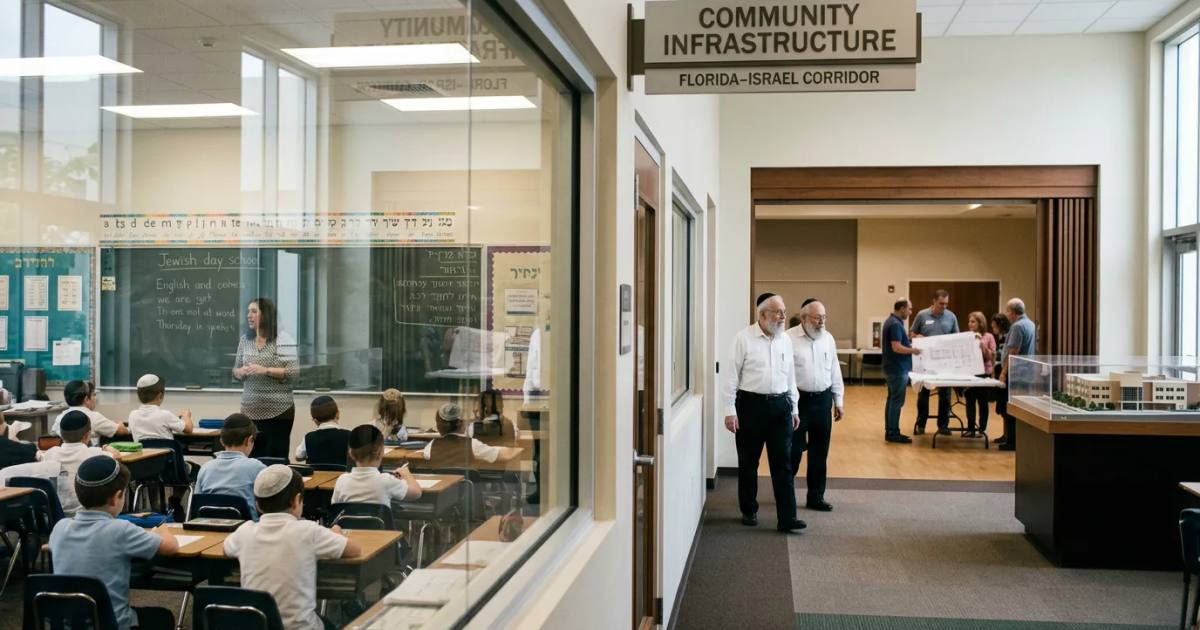
The data is extraordinary. A joint study by Teach Coalition's Office of Jewish Education Policy and Research and Step Up for Students found that Florida's Jewish schools grew 58% from 2007 to 2023, with the number of yeshivas and Jewish day schools nearly doubling from 40 to 74. In the 2024-25 school year alone, Jewish schools in Florida added another 1,088 students, a 7.4% single-year increase.
The growth has a policy driver: Florida's state-sponsored education scholarship programs. In 2011-12, only 10% of Jewish school students received state scholarships, averaging $3,820 each. By 2022-23, 60% of Jewish school students received scholarships, with an average value of $8,090. Universal eligibility, signed into law in 2023, accelerated enrollment further.
The national trend is the mirror image. Jewish day school enrollment across the U.S. had been declining for years, particularly in non-Orthodox schools. Florida bucked the trend. Non-Orthodox schools in Florida saw a 21% enrollment increase since 2017-18, reversing decades of national decline. The Prizmah network's 2025-26 data confirms the pattern: in Florida, Jewish day school enrollment increased by 1,370 students, a 15% jump, from 2021 to 2024.
The flagship institution: Scheck Hillel Community School in North Miami Beach, a PreK-12 school with approximately 1,350 students, the largest Jewish day school in South Florida and a two-time Blue Ribbon School. Adjacent to the Michael-Ann Russell JCC, Hillel draws students from 17 countries, with a large Latin American contingent that reflects Miami's international Jewish demography.
Synagogues, JCCs, and the Full-Life Infrastructure
Day schools are the most measurable indicator, but they sit inside a broader institutional expansion. Synagogues across South Florida are expanding, building new sanctuaries, adding programming space, hiring additional clergy. The kosher restaurant ecosystem in Miami Beach, Aventura, Boca Raton, and Hollywood has grown substantially. New mikvahs have been built or renovated. JCCs are expanding their physical campuses and programming; the Bryan Glazer Family JCC in Tampa, where FIBA is headquartered, is itself a node in the Florida–Israel corridor's communal infrastructure.
The Latin American layer adds a dimension unique to South Florida. Since 2000, a significant wave of Jewish families from Venezuela, Argentina, Colombia, Brazil, and Mexico have settled in the Miami-Dade corridor, driven by economic instability and political insecurity in their home countries. These families are deeply engaged in Jewish institutional life. They enroll their children in day schools, join synagogues, and participate in communal organizations, adding cultural diversity and demographic depth to a community that was historically Ashkenazi-dominated.
October 7 and the Post-2023 Pull
The anchor article in Olam's Florida–Israel section notes that "since 2023, that pull has only strengthened." The 2024 community study quantifies part of it, the youth-driven growth, the Orthodox tilt. But there is a harder-to-measure dimension: the perception, among Jewish families nationally, that South Florida is a place where Jewish life feels confident, growing, and safe. The post-October 7 environment accelerated a migration pattern already in motion, families seeking communities where Jewish institutions are expanding, not contracting.
Why the Institutional Build Matters for the Corridor
An Israeli founder deciding where to open a U.S. office evaluates tax rates, investor proximity, flight routes, and regulatory climate. Those are table stakes. What tips the decision, what turns a two-year experiment into a permanent headquarters, is whether the founder's family can live a full Jewish life in the city the business chose. Can the kids go to a Jewish school. Can the family walk to shul. Can they buy challah on Friday. Can they find a community that speaks Hebrew, or at least understands the rhythms of Israeli life.
South Florida answers every one of those questions with a yes that is getting louder each year. 130,100 Jews in Miami-Dade. 74 Jewish schools statewide. A 13% increase in Jewish children. The institutional build is not a sidebar to the technology corridor. It is the infrastructure that makes the corridor irreversible.
This article is part of Olam's Florida–Israel section, ongoing reporting and research on the capital, companies, and community building the Florida–Israel corridor.
Related on Olam
- Florida Is Israel's New American Address
- Florida–Israel Real Estate: The Israeli Developers Building South Florida's Luxury Skyline
- The Florida-Israel Business Accelerator
Olam and 5W AI Communications share common ownership. Olam reports independently on the Israeli economy, including on research produced by 5W. Editorial decisions are made by Olam's editorial team.