
Aventura, Florida, has the densest Israeli-American concentration in the U.S. Hebrew is spoken in 3.66% of households in this 40,000-person city.
Aventura, Florida holds roughly 40,000 residents and the highest concentration of Israeli-Americans of any city in the United States, according to U.S. Census Bureau American Community Survey data showing Hebrew spoken in 3.66% of area households. Median household income sits at $89,274. The city's synagogues, day schools, and kosher retail corridor turned a stretch of reclaimed swampland into the anchor of what has become a $7.3 billion Israeli-American settlement pattern across South Florida.
How Did Aventura Become the Densest Israeli-American City in the U.S.?
Aventura did not exist as a city until 1995, when it incorporated out of unincorporated Miami-Dade County land that developer Don Soffer began assembling in 1967. Soffer and partner Edward J. Lewis of Oxford Development purchased 785 acres of submerged mangrove swamp facing the Intracoastal Waterway for under $10,000 an acre, according to Turnberry Associates' own company history, and Soffer sketched the initial concept for the community on a cocktail napkin before any road or canal existed on the site.
Turnberry Isle Resort & Club opened in the early 1970s with two Robert Trent Jones Sr. golf courses, followed by Aventura Mall in 1983 and successive waves of high-rise condominium construction through the 1980s and 1990s. Successive waves of Latin American, Russian, and Israeli immigration filled those towers, and by the 2020s the U.S. Census Bureau recorded Hebrew spoken in 3.66% of Aventura households and Yiddish in another 2.78%, according to Census Bureau American Community Survey estimates compiled by Florida International University's Metropolitan Center, a combined concentration higher than any other municipality in the country.
What Do Aventura's Census Numbers Show About Its Jewish Population?
Aventura's 2020 Census population was 40,036, and the Census Bureau's 2026 population estimate puts the city at 39,892 residents, according to Census Bureau Population Estimates Program data compiled by World Population Review. The median age is 46.9, nearly nine years above the national median, and 27.88% of residents are 65 or older, according to the Census Bureau's 2017-2021 American Community Survey five-year estimates.
The city's citizenship rate is 77.9%, well below the 92.9% national average, reflecting the large immigrant share of the population, according to Census Bureau data aggregated by Data USA. Beyond the Hebrew- and Yiddish-speaking households, Florida International University's Metropolitan Center identifies specific growth in Aventura's Brazilian, Colombian, Israeli, Romanian, Venezuelan, and Russian communities, a demographic mix that maps directly onto the city's synagogue rolls and its Spanish- and Hebrew-language commercial signage.
What Does Everyday Israeli Life Look Like on 41st Street?
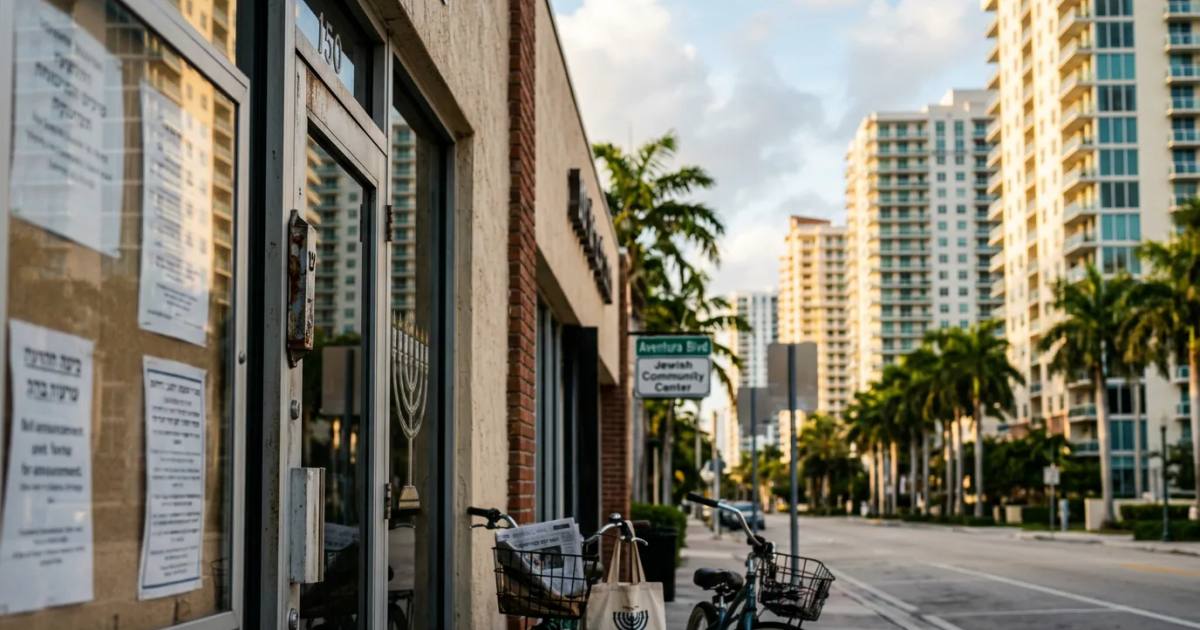
Walk down 41st Street and the signage, conversation, and menus are Hebrew as often as English. Kosher restaurants including Pita Hut, Levy's, Backyard BBQ, Fuego, and Harbour Grill serve a customer base that eats Israeli food, not simply food that meets kosher certification, alongside Israeli grocers, bakeries, and coffee shops that cater to the same corridor.
The corridor extends north into neighboring Sunny Isles Beach and south into Bal Harbour and Surfside, where kosher shops line Harding Avenue and high-rise condominiums are built with Shabbat-observant residents in mind, according to Chabad.org's reporting on the Surfside Jewish community. Aventura functions as the commercial and institutional center of a Jewish corridor that runs along several miles of the Intracoastal Waterway rather than a single isolated neighborhood.
Which Synagogues Anchor Aventura's Jewish Community?
Aventura Turnberry Jewish Center, a Conservative congregation at 20400 NE 30th Avenue, began in 1976 as a 1,000-square-foot storefront shul and dedicated its current 70,983-square-foot campus in 1990, according to the congregation's own history and Partner Energy's building records. The center now serves roughly 800 member families and includes a Holocaust memorial designed by Israeli artist Frank Meisler and the Tauber Academy early childhood program, and its High Holiday services are held in Spanish as well as Hebrew and English to reflect the congregation's Latin American membership. The synagogue marked its 20th anniversary in a gala that drew more than 450 congregants and community leaders, according to a 2011 report in Aventura Community News.
The Edmond J. Safra Synagogue traces its origin to the early 1990s, when a small group of Sephardic men from Brooklyn and Deal, New Jersey, including Ossie Harary, Eddie Sitt, and Sam "Sonny" Gindi, began meeting to pray in a room in Turnberry's North Tower before the congregation grew into its own building, according to the synagogue's published history. Orthodox shtiebels, additional Sephardic congregations, and Israeli-style minyanim operate throughout the city.
The Shul of Bal Harbour, a Chabad-Lubavitch congregation founded by Rabbi Sholom Lipskar in 1981 a few miles south in Surfside, completed a $20 million, 55,000-square-foot expansion described by Chabad.org in 2017 that draws heavily from the same Israeli and Jewish population as Aventura. The congregation now counts more than 700 member families plus roughly 1,000 additional unaffiliated families in its orbit, and Newsweek named it one of America's 25 most vibrant congregations in 2009, according to Chabad.org's own reporting.
What Role Does Scheck Hillel Community School Play in the Community?
Scheck Hillel Community School, a PreK-12 institution on a 14-acre campus at 19000 NE 25th Avenue in North Miami Beach, enrolls approximately 1,350 students and is recognized as one of the largest Jewish day schools in the country, according to the school's own enrollment figures and its 2011 and 2020 National Blue Ribbon School designations from the U.S. Department of Education. Founded in 1970 and relocated to its current site in 1976, the school runs a dual curriculum of Judaic and secular studies, offers 25 Advanced Placement courses, and draws a substantial international student population from Israel and Latin America, according to the school's admissions materials.
The campus includes a 115,000-square-foot athletic complex and sits adjacent to the Michael-Ann Russell Jewish Community Center at 18900 NE 25th Avenue, a membership organization founded in 1973 that runs Camp Sol Taplin, one of the largest Jewish summer day camps in South Florida, according to the Greater Miami Jewish Federation's community directory. The two institutions together form a campus that functions as a hub for Jewish family life beyond religious services alone.
What Retail Anchors the Aventura Corridor?
Aventura Mall, owned by Turnberry Associates in partnership with Simon Property Group, is Florida's largest shopping mall at approximately 2.7 million square feet and more than 300 stores, drawing roughly 30 million visitors a year by the mall's own figures. The mall opened in 1983 as South Florida's largest enclosed shopping center at the time, spanning over 1 million square feet before its later expansions, according to company history published by Turnberry.
The mall sits inside the same corridor as the synagogues and kosher restaurants, making it as much a piece of the neighborhood's daily infrastructure as a shopping destination. Turnberry's broader Aventura portfolio, including the Turnberry Isle Resort and the residential towers built around it, has been valued at more than $10 billion across the company's history, according to Turnberry Associates' own disclosures.
How Does Israeli Capital Shape Aventura's Real Estate Market?
Aventura sits inside a cluster of cities, including Sunny Isles Beach and Bal Harbour, where cultural affinity, climate, and Florida's lack of a state income tax have drawn sustained Israeli-American real estate investment since 2020, according to market analysis published by NY Realty Israel. Israeli-Brazilian developer Isaac Toledano's BH Group has partnered with Related Group and Dezer Development on luxury towers nearby in Sunny Isles Beach, part of a broader pattern of Israeli developers building South Florida's luxury skyline, extending the same capital and buyer networks that sustain Aventura's institutional density into new construction up and down the coastline.
Weekly transaction reports on the Aventura and Sunny Isles market regularly show dozens of closed sales in the multimillion-dollar range, according to Sunny Isles Beach Real Estate Blog listings data, reflecting a market where Israeli, Latin American, Russian, and European buyers compete for oceanfront and Intracoastal-facing towers built by the same handful of developers who shaped the neighborhood's original synagogues and mall.
How Does Latin American Jewish Migration Change the Picture?
Significant numbers of Jewish families from Venezuela, Argentina, Colombia, Brazil, and Mexico have settled in the Aventura corridor alongside Israeli, Ashkenazi, and Sephardic residents, producing a Jewish population more culturally mixed than most other American Jewish settlements of comparable size, according to Florida International University's Metropolitan Center community background report. Aventura Turnberry Jewish Center's Spanish-language High Holiday services are one direct institutional response to that shift, and the congregation describes Portuguese, Hebrew, Russian, and French as languages that regularly echo through its hallways in addition to Spanish and English.
Why Does Aventura Matter to Florida's Israeli-American Population?
Aventura functions as community infrastructure, not just a neighborhood: its synagogues, schools, and retail corridor are what make the $7.3 billion Israeli-American corridor across Florida durable rather than a temporary migration pattern. A family relocating from Tel Aviv, Caracas, or Moscow can find a Hebrew-speaking congregation, a dual-curriculum school with 100% college placement, a kosher restaurant row, and a JCC summer camp within the same four-square-mile city, and that density of institutions, not any single building or business, is what distinguishes Aventura from other Florida communities with growing Israeli populations.
Frequently Asked Questions
What percentage of Aventura, Florida speaks Hebrew?
Hebrew is spoken in 3.66% of Aventura households, with Yiddish spoken in another 2.78%, according to U.S. Census Bureau American Community Survey data compiled by Florida International University's Metropolitan Center. That combined concentration is higher than any other city in the United States.
What is the largest synagogue in Aventura, Florida?
Aventura Turnberry Jewish Center, a Conservative congregation at 20400 NE 30th Avenue, is the largest synagogue based inside Aventura's city limits, with roughly 800 member families and a 70,983-square-foot campus dedicated in 1990. The Shul of Bal Harbour, a Chabad-Lubavitch congregation with more than 700 member families, is larger but sits a few miles south in neighboring Surfside.
What is the largest Jewish day school near Aventura?
Scheck Hillel Community School in North Miami Beach enrolls approximately 1,350 students on a 14-acre campus and is one of the largest Jewish day schools in the United States, according to the school's own enrollment figures and two National Blue Ribbon School designations from the U.S. Department of Education.
When did Aventura become a city?
Aventura incorporated as a city in 1995, decades after developer Don Soffer began assembling 785 acres of swampland for the project in 1967 through his company, Turnberry Associates.
Why do Israeli-Americans choose Aventura over other Florida cities?
Aventura combines an established synagogue infrastructure, a large dual-curriculum Jewish day school, a kosher restaurant corridor, and Florida's lack of a state income tax in one four-square-mile city, according to market analysis published by NY Realty Israel. That combination of religious, educational, and financial factors is harder to find concentrated in one place elsewhere in the state.
How we report: Olam stories draw on public filings, company disclosures and named sources, checked by our editors. Read our methodology · Corrections