
A rare 1948 letter by Menachem Begin, written to Irgun fighters after the Altalena affair, is now offered by Farkash Gallery in Jaffa Port. A page-by-page look at what it says and where to see it.
A rare typewritten letter Menachem Begin wrote to Irgun fighters in the summer of 1948 is now offered by Farkash Gallery, the Tel Aviv dealer in vintage Israeli Judaica, posters, and historical documents. Published that year in Herut, the Irgun's bulletin, the two-page letter is Begin's clearest public account of why he refused to let a deadly clash within the young state's forces spiral into wider conflict.
What is the Begin letter itself?

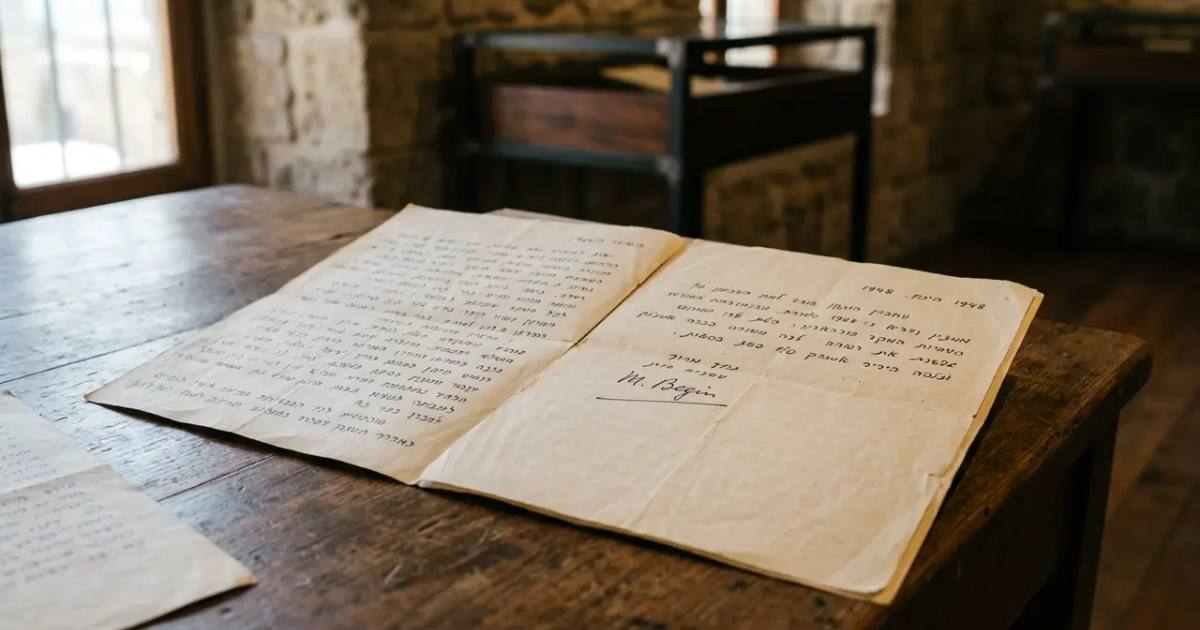
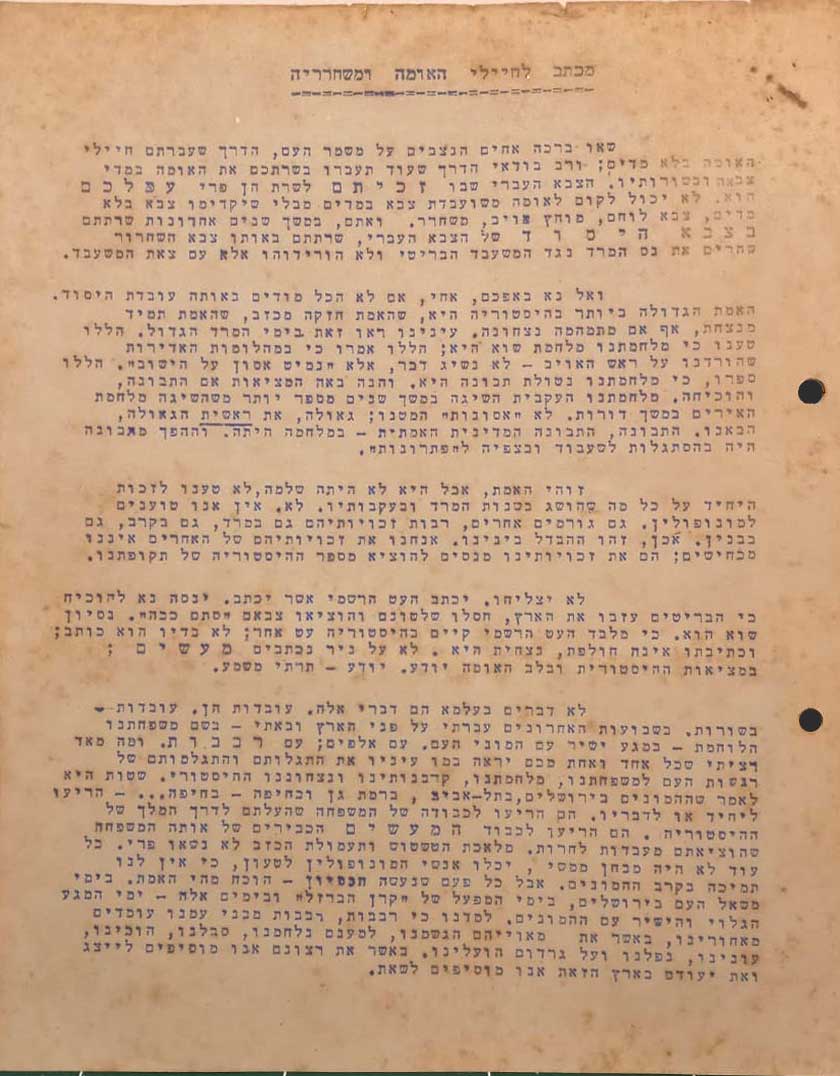
The two-page 1948 Begin letter, offered by Farkash Gallery. Photo courtesy of Farkash Gallery.
The piece Farkash Gallery is offering is a period typewritten document, two pages long, headed "A Letter to the Soldiers of the Nation and Its Liberators." It carries no formal letterhead. It is signed by hand at the close, "Yours always, Menachem Begin," the informal sign-off Begin used with his own fighters rather than a prime ministerial or organizational title.
The letter was written and broadcast on Herut Radio by Begin, then set in type for the Herut newspaper on September 2, 1948. That places it as a primary publishing document from the underground press of Israel's founding year, not a personal keepsake, which is part of what gives it archival weight beyond its content.
What prompted Begin to write it?
Five weeks after Israel declared independence, the Irgun arms ship Altalena arrived off Tel Aviv carrying weapons and new immigrants. A dispute over control of that cargo between Begin and Prime Minister David Ben-Gurion ended in gunfire. Sixteen Irgun fighters and three IDF soldiers died, and the ship burned and sank off the coast in June 1948.
Israeli researchers with the Survey of Israel's Marine Mapping Division located the wreck intact on August 24, 2026, at a depth of 503 meters about 20 kilometers offshore, using the research vessel Bat Galim, following months of planning, according to The Times of Israel. The ship was found, not recovered, and it remains on the seabed. That discovery, 78 years after the ship burned, is what returned attention to Begin's letter.
How has the discovery been covered in recent weeks?
The find has drawn heavy coverage across Israeli and Jewish media since late August. Israel Hayom and Ynet both reported the ship was located intact using specialized sensors and advanced survey systems after months of preparation, ending a search that had been narrowed down and lost again multiple times since a previous, less precise location was reported back in 2012. The Jerusalem Post and Religion News Service both marked the find as the 78th anniversary of the ship's sinking, calling it one of the most searched-for wrecks in Israeli history.
Israel's Heritage Ministry has said it is weighing options for marking the site, including a floating memorial marker, and that documentation work on the submerged wreck is ongoing. Maritime archaeology experts cited by Haaretz and Ynet caution that actually lifting the intact hull from 503 meters is close to technically unfeasible with equipment currently available in Israel, meaning the ship itself will likely stay where it was found even as the discovery is marked on land.
Outlets including Aish and the JTA wire service have also used the anniversary to revisit the broader Altalena affair for readers unfamiliar with it, an event historians describe as the closest Israel came to civil war in its founding weeks. That renewed general-interest coverage is part of what has driven attention back to primary documents from the episode, including the Begin letter Farkash Gallery is now offering.
What does the first page argue?
The opening addresses former Irgun fighters directly as brothers, then moves into the letter's central claim: that the Hebrew army they now served in could not have existed without the underground army that preceded it. Begin credits the Irgun's years-long revolt against British rule with forcing the British withdrawal, and treats that revolt as the true origin of Israeli statehood, years before the Provisional Government existed to claim it.
He anticipates being contradicted, arguing that an official version of events would try to write the Irgun's role out of the historical record, and insists that deeds themselves remain knowable independent of who controls the narrative. He is careful to add that the Irgun does not claim exclusive credit for the state's founding, acknowledging that other movements and institutions earned real standing in the same fight.
He then turns to public sentiment, describing recent travels across the country and the crowds that greeted him in Jerusalem, Tel Aviv, Ramat Gan, and Haifa. Begin frames this reception as proof that ordinary Israelis, not just the underground's own veterans, recognized the Irgun's contribution, pointing to the Jerusalem referendum and the Irgun's Iron Fund campaign as earlier tests of that same public support.
What does the second page argue?
The second page shifts from the past to the future. Begin outlines the work still ahead for his movement as it becomes a political party: building policy on foreign affairs, domestic governance, and what he calls the social question, which he flags as a coming priority. He is explicit that this program will take time and cannot skip stages, comparing it to how the revolt itself grew from small, doubted beginnings into a movement that reshaped the country.
He closes with a construction metaphor rather than a grievance, describing the shared national project ahead as something to be built "brick by brick, layer upon layer, all of us together." The letter's final paragraphs turn to the fighters themselves, praising their discipline and courage, and noting that their record held even through what he describes only obliquely as the aftermath of the Altalena shelling. He points specifically to their service in the Negev against invading Egyptian forces as proof the humiliation had not broken their loyalty to the state.
Begin never names Ben-Gurion in the letter. Its argument is aimed inward, at persuading his own fighters that absorbing the loss, rather than avenging it, was the harder and more consequential choice.
Where can the Begin letter be seen today?
Begin's handwritten sign-off, "Yours always, Menachem Begin." Photo courtesy of Farkash Gallery.
Farkash Gallery, located at Retzif Aliyah Shniya 24 in Jaffa Port, Tel Aviv, lists the letter among its Zionism-era holdings for $3,900. The gallery welcomes visitors to view its collection of vintage Israeli posters, photographs, and rare documents in person, and the full listing with additional images is available on the Farkash Gallery product page for the Begin letter, alongside the gallery's own writeup of the document.
It follows a similar 1940 letter by Ze'ev Jabotinsky the gallery previously offered, which Olam covered in a report on Jabotinsky's last letter from Room 74. Both documents give a firsthand view of how Israel's founding generation argued, in real time, over unity, legitimacy, and who would get to tell the story afterward.
How we report: Olam stories draw on public filings, company disclosures and named sources, checked by our editors. Read our methodology · Corrections