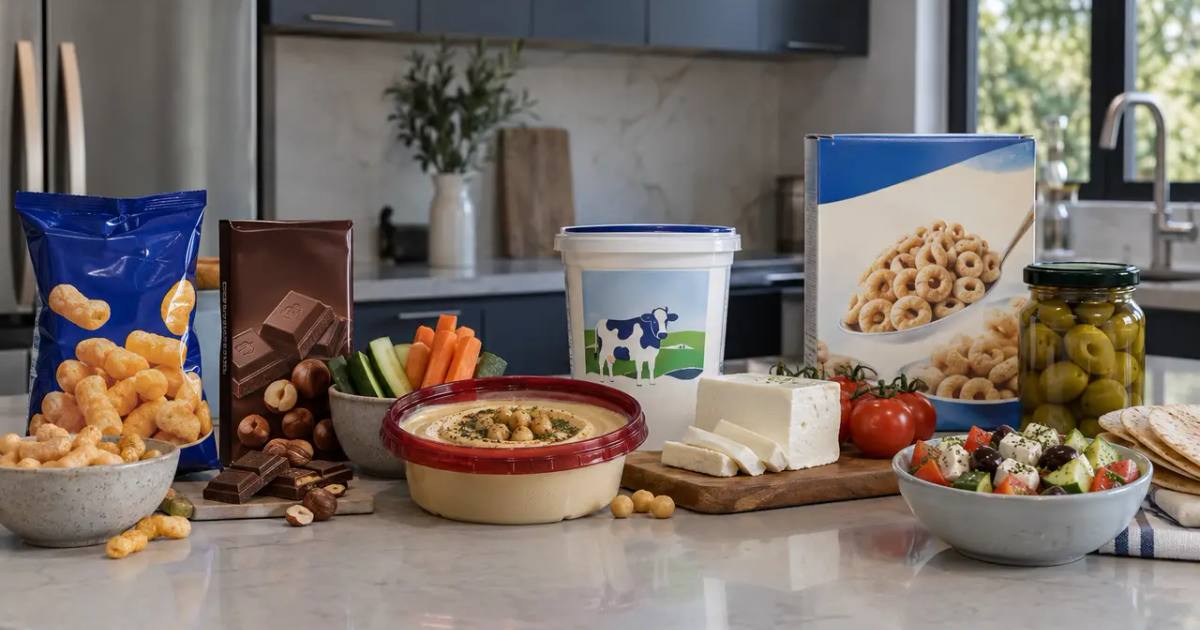

From Bamba and Elite chocolate to Tnuva cheese, Sabra hummus and Israeli breakfast cereals, familiar foods have traveled from Israeli kitchens to American grocery shelves.
Israeli food brands sold in American supermarkets include Bamba, Bissli, Elite, Tnuva, Wissotzky, Sabra and Prigat. Some, like Bamba and Osem, belong to Nestlé, while Sabra became wholly owned by PepsiCo in December 2024. Others reach shoppers through kosher and specialty grocers. Here are 15 brands and the ownership stories behind them.
Last updated: November 7, 2026
Walk through an American supermarket, and you might be surprised by how many products have connections to Israel. That bag of peanut-butter puffs is an Israeli childhood favorite. The hummus in the refrigerated section is a major American food brand with an important chapter in Israeli corporate history. The chocolate bars, fruit drinks, olives, cheeses and breakfast cereals in the international aisle often come from businesses that have been part of Israeli family life for generations.
Israel is internationally recognized for cybersecurity, artificial intelligence, defense technology and billion-dollar startup acquisitions. Its food industry receives considerably less attention. Yet Israeli food companies have spent decades developing products, building international distribution networks, entering foreign markets and attracting multinational investors. Some have become subsidiaries of enormous international corporations. Others remain closely associated with their original Israeli businesses.
Their American presence varies considerably. Certain products are distributed through major supermarket chains. Others are found primarily in kosher grocery stores, specialty food retailers and international markets, and some are available through American online grocery businesses. What connects them is a surprisingly rich collection of business stories. For wider context, see Olam's guide to the kosher economy and its coverage of retail and consumer brands.
What Israeli Food Brands Are Covered in This Guide?
This guide covers 15 Israeli food brands and Israeli-connected food businesses with documented American retail presence, along with the companies, acquisitions and entrepreneurial histories behind them.
- Bamba
- Bissli
- Osem
- Elite
- Klik
- Tnuva
- Wissotzky
- Achva
- Kvuzat Yavne
- Telma
- Hashachar Ha'ole
- Pereg
- Beigel & Beigel
- Prigat
- Sabra
Which Israeli Food Brands Are Sold in American Supermarkets?
Fifteen Israeli food brands have documented American retail presence, and the table below shows who owns each one and where Americans can find it.
| Brand | Maker or owner | Where Americans can find it |
|---|---|---|
| Bamba | Osem, part of Nestlé | Osem-Nestlé USA distribution, supermarkets, specialty grocers |
| Bissli | Osem, part of Nestlé | Osem-Nestlé USA distributors, kosher supermarkets |
| Osem | Nestlé (wholly owned since 2016) | International aisles, kosher food retailers |
| Elite | Strauss Group | H-E-B listings, kosher and specialty stores |
| Klik | Unilever Israel | Safeway listing, specialty candy retailers |
| Tnuva | Bright Food is the controlling shareholder | Tnuva USA distributors, kosher supermarkets |
| Wissotzky | Wissotzky Tea, a company founded in 1849 | H-E-B listings, kosher groceries |
| Achva | Achva, with a heritage dating to 1929 | H-E-B and Target listings, online grocers |
| Kvuzat Yavne | Kibbutz-linked olive and pickle brand | H-E-B listing, specialty retailers |
| Telma | Unilever Israel | Israeli grocery importers, kosher retailers |
| Hashachar Ha'ole | Israeli cocoa spread brand | Kroger listing, kosher supermarkets |
| Pereg | Family business dating to 1906 | Pereg's American online store, specialty grocers |
| Beigel & Beigel | Israeli snack maker with Unilever reported as a major shareholder | H-E-B listing, kosher supermarkets |
| Prigat | Central Bottling Company group | H-E-B and Kroger listings, specialty retailers |
| Sabra | PepsiCo (wholly owned since December 2024) | American grocery retailers |
1. Bamba: The Peanut Snack Now in US Supermarkets
Bamba is the Israeli peanut-flavored corn snack that has been a fixture of Israeli grocery stores, school lunches and family snack cupboards for generations. Few foods are more closely associated with Israeli childhood. Its texture is unusual for Americans encountering it for the first time: airy, crunchy at first and quick to soften in the mouth, with a flavor that comes from peanuts rather than the cheese seasoning common in American puffed-corn snacks.
Osem introduced Bamba in 1964, and it developed into one of Israel's best-known snack products. According to Osem's American corporate history, Bamba entered the United States in 1993. In 2019, the company launched the product nationally through major American supermarkets. That expansion turned a distinctly Israeli snack into a product with a broader international commercial opportunity.
Today, the American Bamba range includes original peanut puffs, hazelnut-filled varieties and other flavors and package sizes. The product is marketed in the United States by Osem-Nestlé USA, part of the multinational Nestlé group. The remarkable aspect of Bamba's success is its simplicity. It is not a luxury food or a complicated culinary invention. It is an inexpensive packaged snack built around a recognizable flavor and an unusual texture, which shows how a product developed for one domestic market can find consumers thousands of miles away.
The business connection: Bamba demonstrates how an Israeli household brand can expand internationally through established grocery distribution networks.
Where Americans can find it: Osem's American distribution network, supermarkets carrying international foods and specialty grocery retailers.
Sources: Osem Nestlé USA history; Osem's Bamba product information.
2. Bissli: The Crunchy Snack With Unexpected Flavors
Bissli is a wheat-based Israeli snack that Osem introduced in 1975. If Bamba represents Israel's love of peanut snacks, Bissli represents its enthusiasm for intensely flavored crunchy foods. Unlike conventional potato chips, Bissli is produced in distinctive shapes, and its flavor varieties include barbecue, onion, pizza and falafel. The result feels familiar enough to American consumers while offering something different from the standard potato-chip aisle.
Bissli also illustrates the value of developing several recognizable products under one corporate umbrella. Osem did not need to reinvent its international business to bring Bissli into American stores. The company already had manufacturing experience, brand recognition among Israeli consumers and an expanding export operation, so Bissli became another product in a growing portfolio. Osem-Nestlé USA presents Bissli as a major part of its American snack range, with several flavors and package formats.
For American consumers, the falafel flavor may be the most interesting. Falafel is already familiar through Mediterranean restaurants and street-food businesses, so a packaged snack inspired by it introduces Israeli snack culture through something recognizable. Bissli also has an advantage that many imported foods lack: it is easy to store, transport and display, needs no refrigeration and suits conventional packaged-food distribution.
The business connection: Bissli shows how a food manufacturer can expand internationally by exporting multiple products through the same established distribution system.
Where Americans can find it: Osem-Nestlé USA distributors, kosher supermarkets and specialty grocery retailers.
Sources: Osem Bissli product range; Osem USA milestones.
3. Osem: The Israeli Food Company Now Part of Nestlé
Osem is the Israeli food manufacturer behind Bamba and Bissli, and its business is much broader than snacks. Osem is associated with products that appear in everyday Israeli kitchens, including pasta, couscous, soups, sauces, crackers, pretzels and cooking ingredients. Its history also tells an important story about the development of Israel's packaged-food industry, because the company began operating during the years surrounding Israel's establishment and expanded as the domestic food market developed.
One of its early innovations was packaged soup almonds, known in Hebrew as shkedei marak. Despite the name, soup almonds are not nuts. They are small, crunchy additions commonly served with soup, and Osem's American corporate history dates their development to 1952. By 1959, the company was exporting products to the United States and other international markets, decades before Israel became internationally associated with technology startups. Osem was already participating in the older business of international trade: manufacturing food products, developing recognizable brands and building export relationships.
The company's international ambitions eventually brought it into a partnership with Nestlé in 1995. In 2016, Nestlé completed its acquisition of the remaining publicly held interests, making Osem a wholly owned business within the Nestlé group. A company that grew alongside Israel's domestic food economy had become part of one of the world's largest food corporations. American consumers can encounter Osem products across several categories, including couscous, soups, crackers and pasta.
The business connection: Osem illustrates how a domestic food manufacturer can become an international acquisition target through decades of brand development and distribution growth.
Where Americans can find it: Osem-Nestlé USA distribution, international grocery aisles and kosher food retailers.
Sources: Osem's American corporate history; Osem American product catalog.
4. Elite: The Chocolate Brand Behind Israeli Childhood
Elite is one of Israel's most recognizable confectionery names, and for generations Israeli consumers have associated it with chocolate bars, wafers, candy and sweet snacks. Its products include well-known Israeli favorites such as Pesek Zman, Kif Kef, Tortit and Mekupelet. Some of these names and packages may be unfamiliar to American shoppers, but their basic appeal is universal: chocolate-covered wafers, crunchy candy bars and chocolate tablets require little explanation.
Elite's history is closely connected to the development of Israel's domestic confectionery industry. The brand eventually became part of Strauss Group, one of Israel's major food businesses, which has operated across dairy, coffee, confectionery and international food ventures. Elite represents the confectionery side of that history, and it contrasts with the international ambitions of companies such as Osem. Many Israeli food products were designed primarily for domestic consumers, and their popularity in Israel did not automatically translate into mass-market American distribution.
Instead, many reached the United States through specialty retailers serving customers familiar with Israeli food. That model remains important. American supermarket chain H-E-B has listed Elite chocolate coins and Elite Chocolit powdered chocolate drink, with product information identifying Israeli manufacturing, and specialty grocery retailers also carry assorted Elite chocolate products. For business readers, Elite shows how an established domestic brand can keep its identity even as its parent company develops a broader international portfolio.
The business connection: Elite is part of Strauss Group's confectionery business and a longstanding example of Israeli consumer-brand development.
Where Americans can find it: Selected supermarket catalogs, kosher grocery stores and specialty food retailers.
Sources: Strauss Group investor information; H-E-B Elite chocolate listing.
5. Klik: Israel's Chocolate-Covered Crunch Obsession
Klik is an Israeli confectionery brand known for chocolate-covered crunchy snacks, including cereal pieces, biscuits, wafers and other small treats. Some snack brands succeed by introducing an entirely new category. Others, like Klik, succeed by combining familiar ingredients in a format consumers enjoy. Its products often pair chocolate with a crisp interior, and the variety of textures and flavors gives the brand a distinctive identity.
Klik is also a reminder that ownership of Israeli snack brands is easy to confuse. Not every Israeli chocolate product belongs to Strauss or Elite. Klik has been associated with Unilever Israel, which shows the role multinational consumer-goods companies play in Israel's food industry. American distribution listings identify Klik products manufactured in Israel, including chocolate bars containing cereal pieces and crunchy fillings. Safeway has listed a Klik Crunch chocolate bar, while American specialty distributors carry additional varieties.
The brand offers a useful lesson in international consumer marketing. A product does not necessarily need an expensive reinvention to appeal to a foreign market, because chocolate and crunchy cereal are already familiar ingredients. The challenge is introducing a less familiar brand name and persuading shoppers to try something new. For Americans who enjoy chocolate-covered pretzels, cereal clusters or wafer bars, Klik offers a recognizable flavor experience with a different origin story.
The business connection: Klik demonstrates the importance of product formats, texture and international distribution in building a recognizable snack brand.
Where Americans can find it: Selected supermarket listings, specialty candy retailers and kosher grocery distributors.
Sources: Safeway Klik product listing; Paskesz Klik distribution catalog.
6. Tnuva: The Dairy Giant With an American Cheese Business
Tnuva is one of the most important names in Israeli food history. Established in 1926, the company developed into a major dairy and food business closely associated with Israeli agriculture, and its milk, cheese, yogurt and other dairy products made it a household name for generations of Israeli consumers.
The company's American business is interesting because cheese presents a different expansion challenge from packaged snacks. Cheese must be manufactured, stored, transported and distributed under appropriate temperature and food-safety conditions, which makes international dairy distribution more complicated than shipping boxes of shelf-stable crackers. Tnuva USA markets a broad range of dairy products, including feta, Edam, Muenster, Swiss-style cheeses, labaneh and other Mediterranean specialties, along with desserts and specialty cheeses.
One particularly interesting offering is labaneh, a strained cultured dairy product widely enjoyed across the Middle East. As Mediterranean foods become more familiar to American consumers, products such as labaneh give established dairy companies new opportunities. Tnuva's ownership history is also notable. The company is no longer simply an Israeli cooperative business, because China's Bright Food became its controlling shareholder, which illustrates the international investment interest that major Israeli consumer businesses have attracted.
The business connection: Tnuva combines nearly a century of Israeli food history with international ownership and a dedicated American dairy operation, and it shows that Israeli food exports include refrigerated foods requiring more complex logistics.
Where Americans can find it: Tnuva USA distributors, kosher supermarkets and specialty dairy retailers.
Sources: Tnuva USA corporate history; Tnuva American dairy catalog.
7. Wissotzky: The Tea Company Older Than Israel
Wissotzky Tea is an Israeli tea brand whose business history is older than the modern State of Israel. Not every major Israeli food brand was originally founded in Israel, and Wissotzky is an important example. The business traces its history to 1849 and developed from the tea trade of the Russian Empire. Over time its operations expanded internationally, and the company eventually established a major presence in what became Israel, where it developed into a familiar tea brand.
That history makes Wissotzky different from food companies created during Israel's early decades. It represents a business tradition that crossed national borders, survived major historical changes and developed new markets over generations. In a food industry filled with newly launched brands, a company with roots stretching back more than 175 years offers something different.
American consumers can find Wissotzky products through grocery and specialty retail channels. H-E-B has listed Wissotzky English Breakfast, Earl Grey, mint and herbal tea varieties, and the Israel Export Institute has identified the United States among Wissotzky's international markets. The range combines traditional tea blends with regional flavor preferences: mint tea is closely associated with Middle Eastern hospitality, while English Breakfast and Earl Grey are familiar to international tea drinkers.
The business connection: Wissotzky illustrates how a historical family business can become part of Israel's modern consumer economy while maintaining international markets.
Where Americans can find it: Selected supermarket catalogs, kosher groceries and specialty tea retailers.
Sources: Israel Export Institute Wissotzky profile; H-E-B Wissotzky tea listing.
8. Achva: The Tahini and Halva Brand in America
Achva is an Israeli business known for tahini and halva, a traditional sesame-based confection. Tahini has become an increasingly familiar ingredient in American kitchens. Made from ground sesame seeds, it is used in hummus, sauces, salad dressings and desserts. For Israeli consumers it is a longstanding everyday food, and for many American shoppers it has become a versatile ingredient associated with Mediterranean cooking. Achva connects those two markets, and American retail listings identify Achva tahini products with a heritage dating to 1929.
Its American presence spans both cooking ingredients and sweets. H-E-B has listed Achva sesame tahini products, and Target has listed Achva vanilla, pistachio and marble halva products. That creates two potential audiences: consumers who already know tahini and want an established brand, and shoppers discovering halva as a sweet treat.
Halva is unusual for people who have never tried it. Its texture can be crumbly, dense and slightly fibrous, with a rich sesame flavor. For a food company, introducing a traditional regional confection to a broader market presents both challenges and opportunities. The product needs explanation, but its ingredients and flavor profile can also appeal to consumers looking for something different.
The business connection: Achva demonstrates how traditional Israeli and Middle Eastern foods can enter American retail through both ingredient and confectionery categories.
Where Americans can find it: Selected supermarket catalogs, specialty retailers and online grocery sellers.
Sources: H-E-B Achva tahini listing; Target Achva halva listing.
9. Kvuzat Yavne: Kibbutz Olives on American Shelves
Kvuzat Yavne is an Israeli brand associated with olives, pickles and preserved vegetables, and its name connects the business to Kibbutz Yavne. Some of the most interesting Israeli food businesses began in kibbutzim rather than major cities, reflecting the agricultural and cooperative traditions that helped shape Israel's early food economy. Unlike many technology startups, agricultural food businesses often develop around physical resources: farmland, processing facilities, production expertise and established distribution relationships.
Preserved foods offer several commercial advantages. They can be packaged in jars, transported internationally and sold without the refrigeration requirements of fresh dairy products. Olives also have broad culinary appeal, appearing in salads, sandwiches, appetizers and Mediterranean dishes. American supermarket chain H-E-B has listed Kvuzat Yavne green olives, with the product description identifying Israel as the country of origin. The retailer's listing does not guarantee availability in every location, but it documents the brand's presence in an American grocery catalog.
For consumers, Kvuzat Yavne is simply another option in the olive aisle. For business readers, it shows how an agricultural community can develop products that travel internationally and compete within a familiar supermarket category.
The business connection: Kvuzat Yavne represents the agricultural and kibbutz-based side of Israeli food manufacturing.
Where Americans can find it: Selected supermarket catalogs and specialty food retailers.
Source: H-E-B Kvuzat Yavne olive listing.
10. Telma: The Israeli Cereal Brand With a Sweet Tooth
Telma is a familiar Israeli breakfast brand whose products include cornflakes, sweetened cereals, chocolate varieties and filled cereal pieces. Breakfast cereal is one of the most competitive categories in American grocery stores, where consumers already choose from an enormous selection of cornflakes, chocolate cereals, granola and sweetened breakfast products, which makes Telma's American presence particularly interesting.
Israeli consumers may recognize names such as Shugi, Ugi and Kariot. Some products are conventional breakfast cereals, while others resemble sweet snacks as much as traditional breakfast foods. Telma's business history is associated with Unilever's Israeli operations, which illustrates an important feature of the Israeli food market: some of its best-known brands operate within multinational corporate structures rather than as independently owned local businesses.
American specialty grocery retailers list Telma cereals, including cornflakes, Shugi, Ugi and Kariot varieties. For Israeli expatriates and families familiar with these products, buying Telma in America can recreate part of an Israeli breakfast, while American consumers discovering the brand may be drawn to unusual flavors and textures. Telma's presence in the United States is more specialized than that of major American cereal companies, but it shows how recognizable domestic brands can develop export demand among consumers who grew up with them.
The business connection: Telma illustrates how multinational ownership and specialty import channels help maintain demand for familiar national food brands abroad.
Where Americans can find it: Israeli grocery importers, kosher food retailers and specialty online supermarkets.
Sources: Telma products at Groceries By Israel; Telma products at Israeli Supermarket Online.
11. Hashachar Ha'ole: The Chocolate Spread Israelis Love
Hashachar Ha'ole is an Israeli chocolate spread served on bread, toast and sandwiches. Americans know chocolate spreads largely through international brands such as Nutella, but Israel has its own tradition, and this is one of its most recognizable names. For many Israeli consumers it represents a familiar childhood food: a sweet cocoa-flavored spread that turns an ordinary slice of bread into a treat. The brand has been associated with Israeli food culture since the 1950s.
American grocery listings show that the brand has also reached the United States. Kroger has listed Hashachar Ha'ole Special Cocoa Spread, although its online catalog has not consistently shown availability for delivery or pickup. That distinction matters, because a product can appear in a supermarket company's national database without being stocked at every branch. For imported brands, distribution is often concentrated in particular regions or communities.
Hashachar Ha'ole also illustrates the commercial value of nostalgia. Consumers who grew up with a particular food may keep buying it long after moving to another country, and that demand can sustain a specialty import market even when the product is unfamiliar to most shoppers. For Israelis living abroad, the spread may offer something less tangible than flavor: the taste of a familiar childhood breakfast.
The business connection: Hashachar Ha'ole demonstrates how emotional attachment and long-established brand recognition can support international specialty-food demand.
Where Americans can find it: Selected grocery catalogs, kosher supermarkets and specialty retailers.
Source: Kroger Hashachar Ha'ole product listing.
12. Pereg: The Family Spice Business in America
Pereg is a family food business that specializes in spices, grains, seasoning blends and pantry products, and it traces its history to 1906. Not every Israeli-connected food business is built around a famous snack or sweet. Some operate in categories that consumers use every day without thinking much about the company behind them. According to its corporate website, Pereg began as a small spice-selling operation and developed into a multigenerational food business.
Its American business offers products such as paprika, sumac, za'atar, quinoa mixes, breadcrumbs and other cooking ingredients, emphasizing traditional ingredients alongside contemporary pantry staples. Spices are a small purchase for most consumers, but they can have a major influence on how people cook. A shopper who discovers sumac or za'atar may begin using those ingredients regularly, which creates repeat-purchase opportunities.
Pereg also benefits from the growing familiarity of Mediterranean and Middle Eastern cooking in the United States. Ingredients that once required a trip to a specialty market are increasingly recognizable to home cooks. The company operates an American online store, which provides direct evidence of its U.S. commercial presence. Its story is different from that of a multinational snack corporation: it is about family business history, product specialization and the ability to serve changing consumer tastes.
The business connection: Pereg demonstrates how a longstanding specialty-food business can develop an American market around ingredients rather than finished snacks.
Where Americans can find it: The company's American online store and specialty grocery channels.
Sources: Pereg company history; Pereg American product catalog.
13. Beigel & Beigel: Israeli Pretzels in America
Beigel & Beigel is an Israeli maker of pretzels, crackers and other baked snacks, and its products include conventional pretzel shapes and seasoned varieties. Pretzels are hardly unfamiliar to Americans, who treat them as one of the country's most recognizable packaged snacks. That makes Beigel & Beigel an interesting example of an Israeli brand competing in a category Americans already understand.
The company has operated within Israel's packaged-snack industry, and Unilever has been reported as a major shareholder. American grocery chain H-E-B has listed Beigel & Beigel Super Pretzel Sticks, and the product description identifies Israel as the country of origin. To an American consumer the product may look like an ordinary bag of pretzels, and the Israeli connection becomes apparent only through the packaging and brand history. That is what makes the brand suitable for a list of unexpected Israeli grocery products.
Beigel & Beigel also shows that international food exports do not always require unfamiliar flavors. A company can enter a foreign market with a product consumers already understand, and the challenge becomes distribution, price, packaging, quality and brand recognition. Imported pretzels face established American manufacturers with extensive supermarket relationships. Its presence in American retail catalogs nevertheless shows that Israeli manufacturers participate in familiar snack categories as well as distinctive regional foods.
The business connection: Beigel & Beigel shows how Israeli manufacturers can export products in established international snack categories.
Where Americans can find it: Selected grocery catalogs, kosher supermarkets and specialty snack retailers.
Source: H-E-B Beigel & Beigel product listing.
14. Prigat: Israeli Fruit Drinks in American Stores
Prigat is an Israeli beverage brand associated with fruit-flavored drinks, including orange, grape, mango and other fruit varieties. For American consumers the category is immediately recognizable. Fruit drinks occupy a large section of the beverage market, competing with juices, flavored waters, soft drinks and other packaged beverages.
Prigat's American presence is documented through several grocery retailers. H-E-B has listed Prigat grape, mango and strawberry-banana drinks, and Kroger and related grocery banners have carried product listings for Prigat beverages. The product descriptions identify Israeli manufacturing for certain varieties. One important detail is that fruit drinks are not necessarily equivalent to pure fruit juice. Some Prigat products contain a mixture of water, juice concentrates, sweeteners and flavorings, so consumers should evaluate individual products by their ingredient labels rather than assuming every bottle contains 100% juice.
From a business perspective, beverages create different distribution challenges from dry packaged foods. Bottles are heavy, transportation costs can be significant, and products compete for limited supermarket shelf space, so an imported beverage must offer enough appeal to justify those costs. Prigat is associated with Israel's Central Bottling Company business group, and its international presence reflects the broader development of Israel's packaged-beverage industry.
The business connection: Prigat illustrates how Israeli beverage brands participate in international grocery markets despite substantial competition and distribution costs.
Where Americans can find it: Selected Kroger-affiliated grocery catalogs, H-E-B listings and specialty food retailers.
Sources: H-E-B Prigat grape drink; Kroger Prigat product listing.
15. Sabra: The Hummus Brand Now Owned by PepsiCo
Sabra is a hummus brand that is now wholly owned by PepsiCo, and it may be the most commercially significant American supermarket story on this list. Unlike many Israeli food products that reached the United States through specialty importers, Sabra developed into a major participant in America's refrigerated dips market. The brand is associated with hummus, a traditional chickpea-based food widely enjoyed across the Middle East.
Its corporate history includes an important partnership between Israel's Strauss Group and American food giant PepsiCo. In 2008, the companies established a joint venture to manufacture, market and distribute refrigerated dips and spreads, combining Strauss's food-industry experience with PepsiCo's commercial resources. Sabra became a leading American hummus brand. In November 2024, PepsiCo announced an agreement to purchase Strauss Group's remaining 50% interest in Sabra and the related Obela business, and said Sabra had nearly $400 million in annual U.S. retail sales at the time. PepsiCo subsequently confirmed that Sabra became a wholly owned subsidiary in December 2024.
The transaction illustrates an important distinction between a brand's history and its current ownership. Sabra has a significant Israeli corporate connection through Strauss Group, but it is now wholly owned by PepsiCo and should not be described as an Israeli-owned company today. Sabra also differs from most other brands on this list because its business was built around the American refrigerated-food market rather than simply exporting an established Israeli product. Its history shows how international partnerships can help introduce regional food categories to mainstream consumers.
The business connection: Sabra represents one of the clearest examples of Israeli food-industry expertise participating in the growth of a major American consumer category.
Where Americans can find it: American grocery retailers carrying Sabra refrigerated dips and spreads.
Sources: PepsiCo's Sabra acquisition announcement; PepsiCo SEC annual filing.
Why Are Israeli Food Brands Appearing in American Grocery Stores?
Israeli food brands appear in American grocery stores because companies used five different strategies: exporting familiar products, using specialty retailers, partnering with multinationals, serving nostalgic customers and riding Mediterranean food trends. Some companies developed products for Israeli consumers and later exported them. Others entered the United States through partnerships, acquisitions or specialized distribution agreements, and a few built American businesses large enough to attract major international investors.
1. Familiar Products Create Export Opportunities
Familiar product categories make export easier because shoppers do not need an explanation. Pretzels, chocolate, cheese, tea and fruit drinks are already familiar to American shoppers, so Israeli companies entering these categories compete on flavor, quality, packaging, price and availability rather than on education. That is one reason Elite chocolate, Tnuva cheese and Wissotzky tea can appeal beyond their original Israeli audience.
2. Specialty Grocery Stores Help Brands Enter New Markets
Specialty grocery stores give Israeli brands a lower-cost route into the American market than national supermarket chains. Entering a large chain can require substantial investment and commercial relationships, while specialty retailers serve customers already interested in imported products, regional cuisines or specific dietary requirements. Kosher supermarkets have historically provided an important American distribution channel for Israeli food brands, and Olam has mapped America's kosher supermarket chains and their owners. A brand may develop an American presence long before mainstream shoppers recognize it, even as the kosher price premium shapes what those shoppers pay.
3. Multinational Ownership Can Change a Brand's Future
Multinational ownership gives Israeli brands capital and distribution reach, and it can also change their strategic priorities. Osem became part of Nestlé, Tnuva attracted controlling investment from China's Bright Food, and Sabra developed through a Strauss-PepsiCo partnership before becoming wholly owned by PepsiCo. Telma and Klik have operated within Unilever's Israeli business. Large food corporations can provide capital, distribution expertise, manufacturing resources and access to additional markets, but the product name may stay familiar even when the company behind it changes.
4. Nostalgia Can Sustain International Demand
Nostalgia sustains international demand because some products succeed by serving communities that already know and value them. A familiar breakfast cereal, chocolate spread or snack can carry strong emotional associations, and for someone who grew up in Israel, finding a familiar product in an American supermarket can be more meaningful than discovering a new brand. That loyalty supports demand and can provide a foundation for reaching new consumers through recommendations, family connections and cultural familiarity.
5. Mediterranean Foods Have a Broader American Audience
Mediterranean foods give Israeli companies a broader American audience because tahini, hummus, olives, labaneh and specialty cheeses are now mainstream ingredients. These foods are not exclusively Israeli, since they have histories across multiple Middle Eastern and Mediterranean cultures, but Israeli companies have participated in their production, branding and international distribution. As Americans encounter these ingredients through restaurants, cookbooks and home cooking, established food companies can reach additional consumers, though they compete with manufacturers from many other countries.
Which Israeli Food Brands Are Actually Israeli-Owned Today?
National origin and corporate ownership are different things, and that is one of the most important lessons from these brands. A product can have Israeli origins while belonging to a foreign multinational. Osem's best-known snacks, including Bamba and Bissli, are part of the Nestlé corporate group. Tnuva has a controlling shareholder based in China. Sabra, after years of partnership between Strauss Group and PepsiCo, became wholly owned by PepsiCo in December 2024. Other brands remain associated with Israeli business groups or operate within multinational companies' Israeli subsidiaries.
For consumers, the distinction may not matter when choosing a snack. For investors, entrepreneurs and business journalists, it matters considerably, because ownership determines who controls the business, receives its profits, makes major investment decisions and directs its long-term strategy.
Manufacturing location is a separate question. An Israeli-founded brand may manufacture products outside Israel, while an internationally owned company may continue producing goods in Israeli factories. The most accurate way to describe a food brand is therefore to distinguish its origin, current ownership and manufacturing location, because those details can tell very different stories.
Where Can Americans Buy Israeli Food Brands?
Where Americans can buy Israeli food brands depends on the product and the location. Some Israeli products have documented distribution through large American grocery companies, while others are available primarily through specialty food retailers. Bamba and Osem products benefit from an established American distribution operation, and Tnuva operates a dedicated American dairy business. Brands such as Elite, Klik, Telma and Hashachar Ha'ole can be found through specialty retailers and selected supermarket catalogs. American grocery websites also list products from Wissotzky, Achva, Kvuzat Yavne, Beigel & Beigel and Prigat.
However, a retailer's online product page does not guarantee that the product is currently stocked at every location. Imported products may be available only in certain regions, during particular seasons or through specific distribution partners, so consumers should check local inventory before visiting a store specifically to buy an imported product.
Frequently Asked Questions About Israeli Food Brands
What are the most famous Israeli food brands?
Well-known Israeli food brands include Osem, Bamba, Bissli, Elite, Tnuva, Wissotzky and Achva. Their international distribution and brand recognition vary significantly. Some are familiar primarily to Israeli consumers, while others have established American businesses.
Can you buy Israeli snacks in American supermarkets?
Yes, Israeli snacks can be bought in American supermarkets. Bamba and Bissli are marketed in the United States through Osem-Nestlé USA, and other Israeli snack brands are available through selected supermarket catalogs and specialty food retailers. Availability depends on the store and location.
Is Bamba an Israeli brand?
Yes, Bamba is an Israeli brand. Bamba was introduced by Israeli food company Osem in 1964. The brand is now part of Osem-Nestlé, which belongs to Nestlé.
Is Sabra hummus Israeli-owned?
No, Sabra hummus is not Israeli-owned. Sabra has an important Israeli corporate history through Strauss Group, which previously owned half the business alongside PepsiCo. PepsiCo acquired Strauss's remaining interest in December 2024, making Sabra wholly owned by the American company.
Is Tnuva still an Israeli company?
Tnuva remains closely associated with Israel's food industry and maintains substantial Israeli operations. However, China's Bright Food became its controlling shareholder, so its Israeli heritage should be distinguished from its current ownership structure.
Which Israeli chocolate brands are sold in America?
Elite, Klik and Hashachar Ha'ole are examples of Israeli chocolate or cocoa-based brands with documented American retail listings. Distribution varies by brand and retailer.
Are Israeli food products available at major grocery chains?
Some Israeli food products are available at major grocery chains. American retailers including H-E-B, Kroger-affiliated chains, Safeway and Target have listed selected Israeli food products, while others are primarily distributed through kosher and specialty supermarkets. Online listings should not be treated as proof of inventory at every location.
What Is the Bigger Story Behind Israel's Food Exports?
Israel's food exports tell a business story that technology headlines rarely cover. Cybersecurity companies, artificial intelligence startups, semiconductor businesses and major software acquisitions dominate the country's international reputation, but the consumer-food industry is a story of brands developed over decades rather than months. It involves family businesses, agricultural communities, manufacturing companies and international food partnerships, and products that began as ordinary household purchases and eventually crossed borders.
Some became part of multinational corporations. Others remained specialized brands serving loyal customers. And some, like Sabra, developed into major American food businesses through international partnerships. For a related look at how Israeli consumer brands surface in AI answers, see Olam's Israeli brand AI visibility benchmark.
The next time an American shopper picks up a bag of peanut puffs, a jar of tahini, a chocolate bar or a container of hummus, there may be a much larger business story behind the product. Sometimes the most interesting international business connections are not found in stock-market filings or technology conferences. They are sitting on the supermarket shelf.
How we report: Olam stories draw on public filings, company disclosures and named sources, checked by our editors. Read our methodology · Corrections