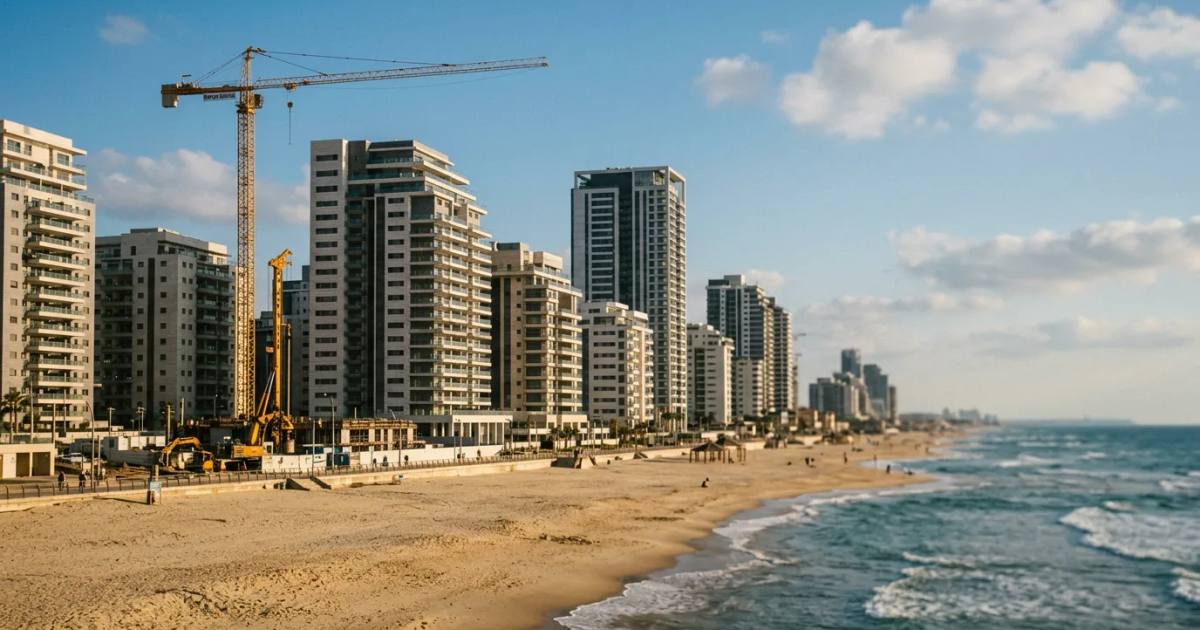
Africa Israel Residences anchored Ir Yamim through the Leviev era (1996-2010) and beyond. Danya Cebus as vertical construction arm. French buyer machinery. The district-scale commitment that separates anchor developers from project developers.
Africa Israel Residences — the residential development arm of Africa Israel Investments Ltd., historically controlled by Lev Leviev and one of the largest publicly traded Israeli real-estate holdings — is the anchor developer behind Ir Yamim, the master-planned district that reshaped Netanya into an internationally recognized coastal market. Africa Israel committed to the district in the early 2000s, delivered the initial tower phases in the mid-2000s, and set the price structure and product standard that every subsequent Ir Yamim developer worked underneath. The Netanya buildout was the single most consequential Africa Israel Residences project of the Leviev era and remains the reference for what a large-balance-sheet Israeli developer can accomplish when it commits to a district over a decade rather than a single project.
The Leviev era: 1996 to 2010
Africa Israel Investments was one of the largest Israeli holding groups of the 1990s and 2000s, with operations spanning real-estate development (Africa Israel Residences), construction (Danya Cebus, founded 1961), diamond and mining businesses, and international property investments across Russia, the United States, and Eastern Europe. Lev Leviev — the Bukharian Jewish businessman born in Tashkent who built his initial fortune in the diamond trade and rewrote the De Beers-controlled diamond market of the 1990s — took control of Africa Israel in 1996 and made it one of the most visible Israeli listed companies of the era.
The Leviev era at Africa Israel ran from 1996 through the aftermath of the 2008-2009 global financial crisis, when the group's international property exposure and leverage created a debt restructuring (hesder chov) that reshaped the corporate structure. Africa Israel Investments emerged from the restructuring with reduced international exposure and a continued focus on Israeli residential development through Africa Israel Residences. Later, control passed through a series of transitions — including a period under Israeli industrialist Moti Ben-Moshe's Extra Holdings — while the Israeli residential business, the Netanya anchor included, continued through cycles.
Why Ir Yamim mattered to Leviev
Africa Israel Residences committed to Ir Yamim because the district represented exactly the kind of long-cycle, high-capital-intensity, master-planned residential opportunity that only a large-balance-sheet developer could pursue at scale. The Netanya Municipality's coordination with the Israel Land Authority allocated development rights to a small number of qualified developers with the capital and construction capacity to build coherent urban form across multi-year timelines. Africa Israel had the balance sheet, the international investor base, and — critically through Danya Cebus — the in-house construction capacity to commit.
The strategic logic was equally clear on the demand side. Africa Israel's international brand and investor base gave it native access to the French Jewish property flow that was accelerating into Israel in the early 2000s. Marketing Netanya to French buyers required an Israeli developer with credibility outside Israel, and Africa Israel had exactly that. The district-and-developer match was structural.
The tower stack, phase by phase
Africa Israel Residences delivered its Ir Yamim buildout across successive tower phases from the mid-2000s through the mid-2010s. Each phase followed a similar architectural formula: high-rise residential towers with premium coastal orientation, structured parking, resident amenities (pools, fitness, resident-club spaces), and ground-floor retail integration where the district plan supported it. The towers were priced as premium Israeli coastal residential — above the Netanya interior market, competitive with south Tel Aviv and Herzliya coastal comparables.
Danya Cebus, Africa Israel's construction subsidiary since 1961, built the towers. Vertical integration between the developer and the construction arm — one of the distinguishing features of the Leviev-era Africa Israel structure — gave the group cost control and delivery predictability that developers without in-house construction could not match on projects of the same scale. Danya Cebus remains one of the largest Israeli general contractors and continues to build for Africa Israel Residences and for third-party developers across the coastal corridor.
The French machinery
Africa Israel's Ir Yamim marketing to French Jewish buyers was one of the most sophisticated diaspora-buyer commercialization campaigns any Israeli developer has run. Presale offices in Paris. French-language marketing materials matched to Israeli-Hebrew equivalents. Purchase contract structures designed for offshore buyers with Israeli banking-KYC compliance. Presale weekend events aligned with French Jewish community calendars. Sales representatives who could work simultaneously in French, Hebrew, and English.
The machinery worked. Ir Yamim absorbed a substantial share of the total French Jewish property flow into Israel during the 2000s and 2010s. Africa Israel's specific developer position within that district — the anchor developer with the largest single project count and the deepest French-buyer relationships — meant that Africa Israel Residences captured disproportionate share of the flow. The developer's brand and Netanya's district became mutually reinforcing.
After the restructuring
The 2008-2009 financial crisis triggered a multi-year debt restructuring across the Africa Israel group. International property exposure — particularly the Russian and Eastern European positions Leviev had built through the 2000s — was reduced. Governance was restructured. Leverage was cut. The Israeli residential business, including the Netanya anchor, continued through the restructuring and remained the group's most operationally stable segment.
Africa Israel Investments today operates on a substantially different corporate footing than the Leviev-era group, but the Netanya position and the Ir Yamim developer brand remain part of the group's core Israeli residential portfolio. New Ir Yamim phases have continued under the Africa Israel Residences banner, and the developer remains one of the largest single players in the district's ongoing buildout.
Where Africa Israel sits in the developer stack
Africa Israel Residences sits inside the top tier of Israeli residential developers by delivered-units-per-year and by total capital committed. Peers at that tier include Azrieli Group (primarily commercial), Melisron (commercial and mixed-use), Amot Investments (commercial), Big Shopping Centers (commercial retail), and — in pure residential — Aura Investments, Ashtrom's residential arm Ashdar, Y.H. Dimri, Electra Real Estate, Amos Luzon Development and Energy, Rotshtein, Zemach Hammerman, and Gindi Holdings.
Africa Israel's distinguishing characteristic within that tier is the multi-decade master-planned district commitment. Most Israeli residential developers work project-by-project. Africa Israel worked the Ir Yamim district over a decade-plus timeline, delivering successive phases inside a coherent municipal plan. That capacity to commit at district scale is what separates the anchor developers from the project developers.
The Danya Cebus edge
Vertical integration with Danya Cebus is worth naming separately because it is the single most durable competitive advantage Africa Israel Residences carries into any new project. Israeli residential construction has been buffeted through the 2020s by materials-cost volatility, labor shortages, and the reshaping of the Israeli construction workforce after October 2023. Developers without in-house construction have had to renegotiate contractor terms mid-project or absorb margin compression. Developers with in-house construction — Africa Israel Residences with Danya Cebus at the head of the list — have carried the cycle without the same disruption.
Why it matters
Africa Israel Residences built the reference Israeli greenfield coastal district of the twenty-first century. Ir Yamim is the district that every subsequent Israeli master-planned coastal buildout is measured against, and Africa Israel is the developer whose commitment to that district defined the pattern. The Leviev-era international footprint has receded. The Netanya anchor has not.
Netanya became internationally recognizable because one Israeli developer built the district that made it so.
Primary Sources
- Africa Israel Investments Ltd. — TASE filings and annual reports
- Africa Israel Residences — project portfolio and delivered-unit disclosure
- Danya Cebus Ltd. — construction subsidiary reports
- Netanya Municipality — Ir Yamim developer allocation records
- Israel Land Authority — coastal-district land allocation registry
Olam coverage
Part of Olam's Netanya real-estate series. Developer pages: Ir Yamim, Ashdar Netanya, Amos Luzon in Netanya. Thesis pages: Netanya Between Two Waves, Two Coasts, Two Doctrines, Netanya Industrial Zone, Netanya Beachfront Hospitality. Demand-side context: Netanya: The French Jewish Coastal Capital, Paris and the French Jewish Diaspora.