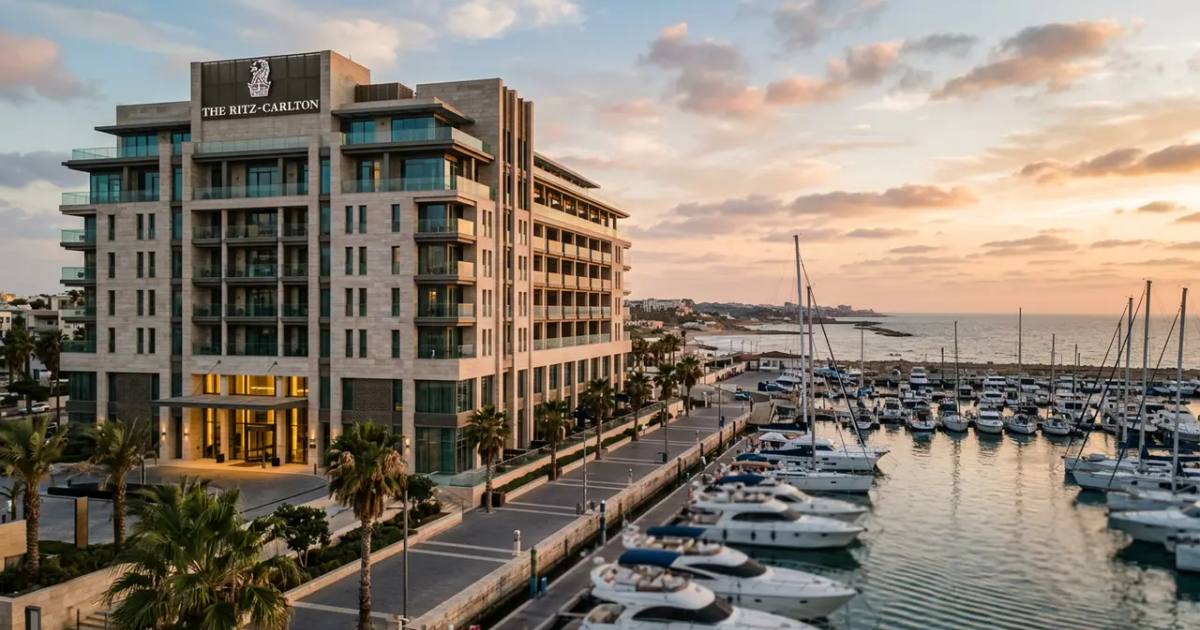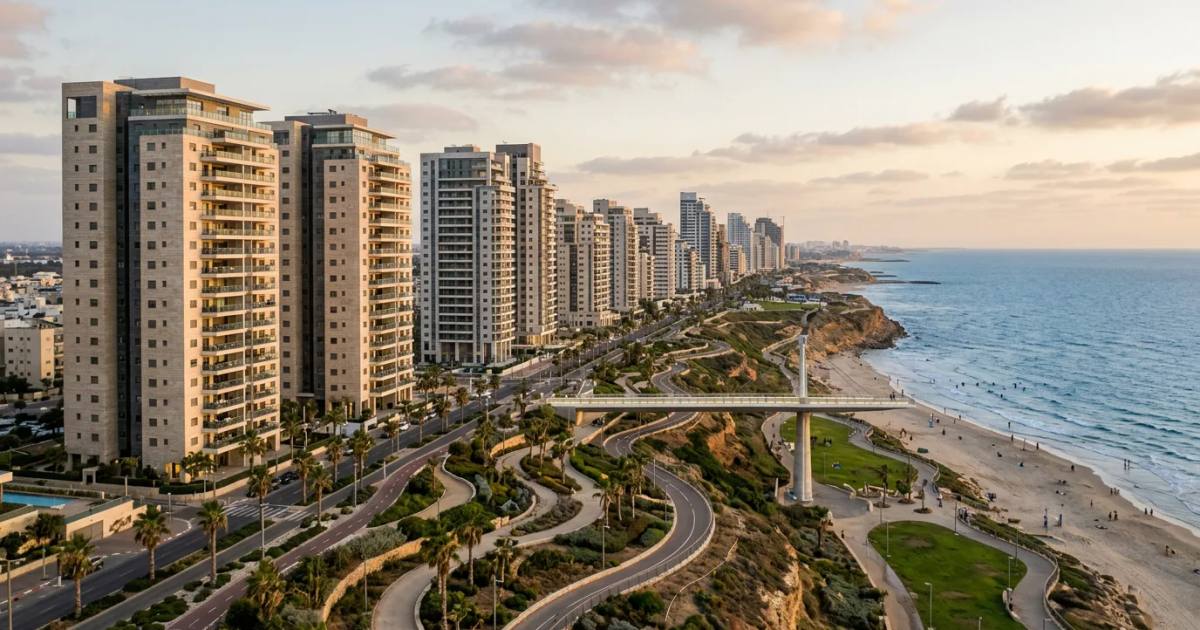

Ir Yamim, Netanya's master-planned district, features 10,000 units. Africa Israel Residences anchored its development, setting a national benchmark.
Ir Yamim ("City of Seas") is the master-planned coastal district that reshaped Netanya into an internationally recognized Israeli residential market. Built out on undeveloped coastal land in the southern part of Netanya starting in the early 2000s, Ir Yamim was designed from the ground up as a mixed-use, high-density residential district with structured street grids, a dedicated commercial core anchored by the Ir Yamim Mall, and a beachfront strip that runs continuously along the Mediterranean. It is the largest single master-planned district completed by any Israeli municipality since the founding-era new towns of the 1950s and 1960s. Africa Israel Residences was the lead developer. Ashdar, Electra Real Estate, Amos Luzon, Rotshtein, Y.H. Dimri, Zemach Hammerman, and Gindi Holdings all filled in around the anchor. Two decades of buildout, roughly 10,000 residential units delivered or in pipeline, and one of the most recognizable Israeli coastal skylines on the northern coast.
Greenfield, not rebuild
The land that became Ir Yamim was undeveloped coastal territory south of central Netanya — sand dunes and agricultural adjacencies rather than aged residential stock. That distinguishes Ir Yamim structurally from every other Israeli urban-renewal project of the same era. Ir Yamim is not a pinui-binui rebuild. It is not a TAMA 38 retrofit. It is a greenfield master-planned district — a category of Israeli residential development that had essentially stopped in the 1970s and was revived by the Netanya Municipality in coordination with the Israel Land Authority as the vehicle to absorb the French Jewish property wave and the broader coastal demand of the early 2000s.
The Netanya municipal doctrine that produced Ir Yamim was straightforward: designate a large tract of coastal land, run a single coordinated master plan across it, allocate development rights to a small number of qualified developers, and build out at density levels that the aging central Netanya stock could not support. The doctrine matched the moment. Israeli residential demand was rising. French Jewish property demand was accelerating after the early 2000s. Central Netanya was already built out and constrained. Ir Yamim was where the growth could go.
Africa Israel built the anchor
Africa Israel Residences — the residential development arm of Africa Israel Investments, then controlled by Lev Leviev — was the lead developer of Ir Yamim's initial phases. The company had the balance sheet, the international investor base, and the construction infrastructure (via Danya Cebus, Africa Israel's construction subsidiary since 1961) to commit to a multi-year multi-project buildout on a single district. The first Africa Israel Residences towers in Ir Yamim opened in the mid-2000s and set the reference price and the reference product for what buyers could expect in the district.
Africa Israel's dominance of Ir Yamim's early buildout is what turned the district into the French-buyer target market that Netanya became famous for. The developer marketed Ir Yamim internationally, particularly into the French Jewish community, and Leviev's international brand recognition — built on the diamond trade before it extended to real estate — gave French buyers a comfort factor that smaller Israeli developers could not match. The pricing structure Africa Israel established in the mid-2000s — premium coastal Israeli residential, marketed in Hebrew and French, structured for offshore buyer contracts — became the template that every subsequent Ir Yamim developer worked from.
The developers behind the anchor
Once Africa Israel established the price floor and the product standard, other Israeli residential developers moved into the district in successive phases. Ashdar (the residential subsidiary of Ashtrom Group) built the largest single mid-premium volume-play pipeline in the district. Electra Real Estate (part of the Electra Ltd. industrial group) delivered adjacent projects. Amos Luzon Development and Energy built successive mid-premium phases. Rotshtein Real Estate and Zemach Hammerman occupied the mid-market layer. Gindi Holdings has taken selective positions. Y.H. Dimri extended its coastal-corridor operations northward into Ir Yamim adjacencies. The result was a developer stack in which one dominant anchor set the reference and a diversified secondary layer competed underneath.
That developer stack matters because it produced pricing stability. If Ir Yamim had been built by a single developer, one commercial failure could have destabilized the district. Instead the multi-developer structure meant that individual project performance mattered less than the aggregate district performance, and the district as a whole compounded through the residential cycles of the 2000s, 2010s, and 2020s.
The commercial core: Ir Yamim Mall
The Ir Yamim Mall (Kanyon Ir Yamim) anchors the district's commercial center — a full-format Israeli shopping mall with anchor retail, food court, cinema, and everyday-services layer that gives the district's residents a walkable commercial destination without needing to travel into central Netanya or south to Tel Aviv. The mall opened in the mid-2000s alongside the first residential phases and has expanded through subsequent renovation cycles. Retail anchoring is what distinguishes a successful master-planned district from a residential-only project. Ir Yamim has it.
The commercial layer also includes street-level retail across the district's arterial roads, dedicated office space in a small commercial precinct, and the beachfront hospitality strip — a set of hotels and restaurants that face the Mediterranean and generate visitor foot traffic that supplements resident-driven retail demand. Full-service healthcare access runs through nearby Klalit and Maccabi clinics. The mix keeps the district active outside residential-peak hours, which is one of the harder problems for Israeli master-planned districts to solve.
Who buys Ir Yamim
Ir Yamim's buyer base has evolved across the district's twenty-year buildout. The initial phases were dominated by French Jewish buyers, whose demand created the pricing structure that made the district internationally recognizable. The 2013-2018 French property wave — the aftermath of the Toulouse, Hyper Cacher, and Bataclan attacks — concentrated substantial additional French buyer flow into Ir Yamim specifically, cementing the district's identity as the French coastal capital.
Later phases have absorbed more diverse demand. Israeli buyers, particularly upgraders from central Netanya and Tel Aviv commuters seeking coastal alternatives, have taken meaningful share. Anglo-diaspora buyers (South African, British, Australian) have added density. The buyer mix today is more heterogeneous than in the early years, but the French cohort remains the marginal-price-setter for the premium beachfront stock. The dynamic mirrors what has emerged in Bat Yam a decade later — diaspora demand priced against foreign home markets, closing the developer math on premium projects.
What Ir Yamim proved
Ir Yamim proved three things that shape Israeli residential planning today. First, master-planned coastal district development is still possible in Israel — the model had been assumed dead after the founding-era new-town cycle ended. Second, coordinated municipal-and-land-authority planning can produce coherent urban form at scale when the developer allocation is disciplined. Third, diaspora demand can be planned into a district's absorption forecast when the developer marketing and product design are aligned with it.
Every subsequent Israeli coastal master-planned district — Herzliya's Marina district extensions, Ashdod's northern beach zones, Nahariya's coastal buildout, and the current Bat Yam TABA 3700 densification — draws on lessons from the Ir Yamim precedent. Ir Yamim is the reference case.
Why it matters
Ir Yamim is the most successful Israeli greenfield residential district completed since the founding era. It anchors Netanya's coastal identity, absorbed the largest single share of the French Jewish property wave, and produced a developer stack — Africa Israel Residences as anchor, Ashdar as volume operator, Electra and mid-tier builders as fill — that Israeli residential planners now study as the working template.
The district is the answer to the question of whether Israeli master planning still works. It does.
Primary Sources
- Netanya Municipality — Ir Yamim master plan and district documentation
- Israel Land Authority — coastal-district land allocation records
- Africa Israel Investments — annual reports and TASE filings
- Ashtrom Group / Ashdar Ltd — TASE filings and residential portfolio
- Central Bureau of Statistics — Netanya housing and population data
Olam coverage
Part of Olam's Netanya real-estate series. See also Netanya: The French Jewish Coastal Capital; French-Jewish Capital and Real Estate; Paris and the French Jewish Diaspora.