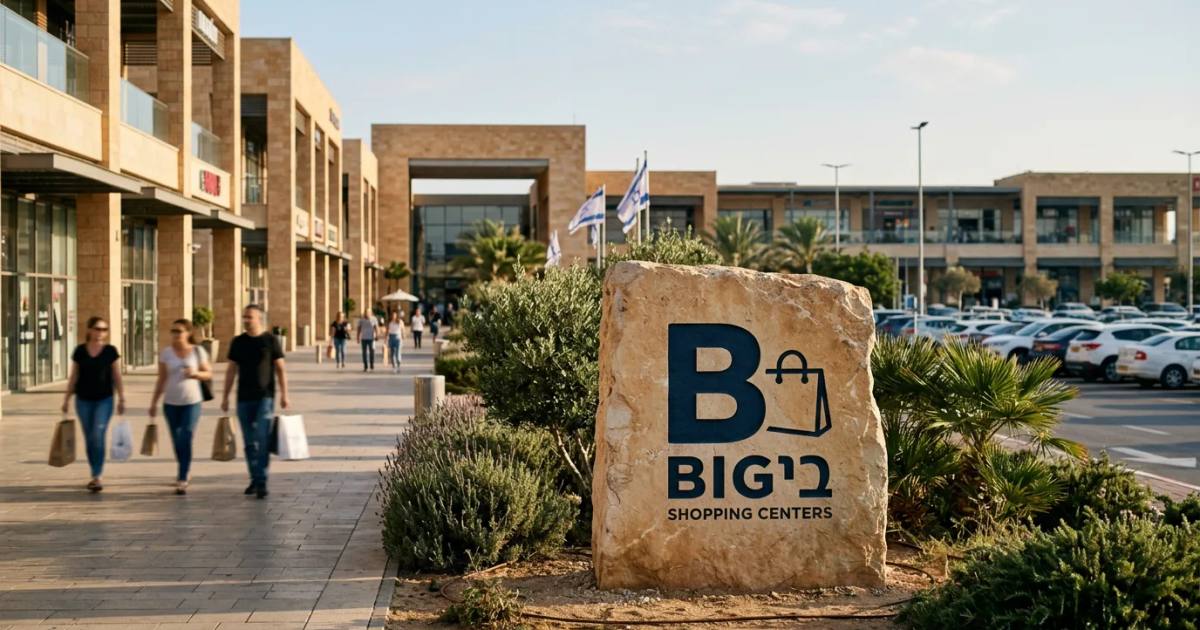

Yehuda Naftali founded BIG Shopping Centers in Herzliya in 1994 on a thesis Israeli retail rejected: that open-air power centers could beat the enclosed mall. Thirty years later BIG holds 62 projects across six countries, a market cap near NIS 18.7 billion, and a TA-125 seat.
Yehuda Naftali founded BIG Shopping Centers in Herzliya in 1994 on a thesis Israeli retail did not believe: that American-style open-air power centers could beat the enclosed mall. Thirty years later BIG holds 62 projects across six countries, a market capitalization near NIS 18.7 billion, and a TA-125 seat. He remains the largest shareholder and the strategic principal.
Yehuda Naftali (Hebrew: יהודה נפתלי) is the Israeli real estate developer who founded BIG Shopping Centers Ltd. (TASE: BIG) in 1994 and built it into the operator that created Israel's open-air retail format. He is the company's largest shareholder and its strategic principal. BIG today carries a market capitalization of approximately NIS 18.7 billion, sits in the TA-125 index, and holds ownership positions in 62 projects across Israel, the United States, Serbia, Montenegro, France, and Eastern Europe — 46 operational centers and 15 under development.
Naftali belongs to the category of Israeli principals who built at scale without building a public persona. He does not sit for regular interviews, does not front the company's marketing, and has not collected the trophy assets that make Israeli developers legible to the financial press. The record is in the portfolio.
At a glance
- Name — Yehuda Naftali · Hebrew: יהודה נפתלי
- Role — Founder and strategic principal, BIG Shopping Centers Ltd. (TASE: BIG); largest shareholder
- Company founded — 1994, Herzliya
- Headquarters — 7 Yad Haruzim Street, Herzliya
- Portfolio — 62 projects · 46 operational · 15 under development
- Countries — Israel · United States · Serbia · Montenegro · France · Eastern Europe
- Market capitalization — ~NIS 18.7 billion · TA-125 constituent
- Flagship asset — BIG Fashion Glilot, opened February 2025 — Israel's largest premium open-air lifestyle center
- Group CEO — Eitan Bar Zeev
- Format — Open-air power centers and lifestyle centers, layered with mixed-use: offices, residential-for-rent, senior housing, medical, hotels, renewables
The 1994 thesis
Naftali founded BIG at a moment when Israeli retail belonged to somebody else. Through the 1980s, Ofer, Britannia, and Africa Israel had assembled the covered-mall format that defined Israeli shopping — enclosed, air-conditioned, anchored, and by the early 1990s treated as settled architecture for a hot-climate country.
Naftali's proposition was that the American power center — open-air, surface-parked, big-box anchored, cheaper to build and cheaper to run — would work in Israel. At the time this was contested on climate grounds alone. It was also contested on consumer grounds: the Israeli shopper had been trained on the enclosed mall for a decade.
The format won on economics before it won on preference. Open-air centers carry lower construction cost per square meter, lower common-area maintenance, faster build cycles, and far more flexible expansion. That let BIG put centers into regional and community catchments the enclosed-mall operators could not justify, and build a national grid while the premium tier fought over the metro.
BIG Fashion Glilot: the thesis, proven at the top of the market
The definitive validation arrived in February 2025. BIG opened BIG Fashion Glilot at the Glilot Junction in Ramat HaSharon — 43,000 sqm of gross leasable area, roughly 160 stores, on a 44-dunam mixed-use site alongside a 43-floor office tower of 75,000 sqm and 4,000 parking spaces. Total investment approximately NIS 2 billion (~$540 million).
The design abandoned the mall entirely: two parallel urban high streets joined by three central plazas — the language Simon Property Group and Federal Realty used to reset American open-air lifestyle economics over the previous fifteen years. Anchors included the largest Zara in Israel at 4,800 sqm, the country's first OYSHO, and a 6,000 sqm Fox Group footprint covering Nike, Mango, and Foot Locker.
Glilot did not open into an empty market. It opened directly against Melisron's Ofer Ramat Aviv Mall and Israel Land Development Co.'s Seven Star Mall on the same coastal corridor — and pulled tenants across. Factory 54 relocated from Herzliya Arena to Glilot as the first visible move.
Thirty-one years after Naftali argued open-air could work in Israel at all, the open-air center became the premium address.
The American round trip
The most instructive line in Naftali's record is the one that runs the wrong way.
Through the 2010s, BIG USA — headquartered in Phoenix — acquired lifestyle and community centers across high-growth Sun Belt markets. Since June 2021 the strategy has run in reverse. BIG USA has sold 18 US shopping centers for more than $1.1 billion cumulatively. The remaining American portfolio stands at 7 centers, 2.5 million square feet, aggregate value over $550 million. Michael Bar relocated in 2017 to run the divestiture program and serves as president of the US business.
The capital came home. It funded Glilot and the domestic development pipeline. That is a rare direction of travel: most Israeli sponsors of comparable scale have spent the same decade moving capital into American assets, the pattern mapped in Olam's TASE dollar-bond sponsor map. Naftali ran the cycle backward and bought the Israeli premium tier with the proceeds.
The operating architecture
BIG runs on a founder-plus-operator structure. Naftali holds the strategy and the equity. Eitan Bar Zeev — a Hebrew University-trained economist and the former president of McDonald's Israel — leads the group as CEO. Michael Bar runs BIG USA from Phoenix. Eran Levy, now BIG USA COO, ran the Serbian center — BIG's first international position outside North America — before relocating.
The consumer-operator background in the CEO seat is not incidental. McDonald's Israel is a footfall-and-format business; so is an open-air center. The hire signals where BIG believes the value sits — in tenancy mix, dwell time, and catchment economics rather than in pure asset trading.
Where Naftali sits
Israeli commercial real estate concentrates around a small number of principals. The Ofer family holds the premium enclosed tier through Melisron. Alony Hetz holds mid-market office and commercial through Amot Investments. Azrieli Group holds the flagship Azrieli-branded malls. Naftali holds open-air — a format he created domestically and still leads.
The founder-plus-listed-vehicle structure he runs mirrors the model the Wertheimer, Ofer, and Federmann families have all operated: family or founder control of strategy, professional management of operations, public market for capital. The wider allocator picture sits in Olam's directory of the biggest family offices in Israel.
FAQ
Who is Yehuda Naftali?
Yehuda Naftali is the Israeli real estate developer who founded BIG Shopping Centers Ltd. (TASE: BIG) in Herzliya in 1994. He remains the company's largest shareholder and strategic principal. BIG holds ownership positions in 62 projects across six countries and carries a market capitalization of approximately NIS 18.7 billion as a TA-125 constituent.
What did Yehuda Naftali found?
BIG Shopping Centers Ltd., founded 1994 and headquartered at 7 Yad Haruzim Street, Herzliya. BIG built and still leads the open-air power-center and lifestyle-center format in Israel, and operates in the United States, Serbia, Montenegro, France, and Eastern Europe.
Is Yehuda Naftali still involved in BIG?
Yes. He remains the largest shareholder and the strategic principal. Day-to-day leadership sits with group CEO Eitan Bar Zeev, a Hebrew University-trained economist and former president of McDonald's Israel. Michael Bar leads BIG USA from Phoenix.
What was Naftali's original business thesis?
That American-style open-air power centers could work in Israel — a market that through the 1980s had been built around the enclosed, air-conditioned mall format assembled by Ofer, Britannia, and Africa Israel. The proposition was contested on both climate and consumer-preference grounds. Open-air won first on economics — lower build cost, lower common-area maintenance, faster cycles, easier expansion — which let BIG reach regional catchments the enclosed operators could not justify.
What is BIG Fashion Glilot?
BIG's flagship asset and the clearest proof of Naftali's original thesis. Opened February 2025 at the Glilot Junction in Ramat HaSharon: 43,000 sqm GLA, roughly 160 stores, a 44-dunam mixed-use site with a 43-floor office tower and 4,000 parking spaces, approximately NIS 2 billion invested. It is Israel's largest premium open-air lifestyle center and drew tenants directly from Melisron's Ofer Ramat Aviv Mall.
Why did BIG sell its American shopping centers?
BIG USA reversed its acquisition strategy in June 2021 and has since sold 18 US centers for over $1.1 billion, retaining 7 centers totaling 2.5 million square feet worth over $550 million. The proceeds funded BIG Fashion Glilot and the Israeli development pipeline — the reverse of the typical Israeli-sponsor capital direction, which generally flows from Israel into US assets.
How does Naftali compare to other Israeli real estate principals?
He holds the open-air format. The Ofer family holds premium enclosed malls through Melisron. Alony Hetz holds mid-market office and commercial through Amot Investments. Azrieli Group holds the Azrieli-branded flagship malls. Naftali created the open-air category domestically and still leads it.
Related Olam coverage
- BIG Shopping Centers (TASE: BIG) — the full company profile, portfolio, and US wind-down
- Melisron (TASE: MLSR) — the Ofer family's mall and office engine
- Amot Investments — Alony Hetz's Israeli office engine
- Israeli Real Estate in 2026 — the Olam guide
- Olam Index 2026: Real Estate — AI citation share across Israeli real estate
- The Biggest Family Offices in Israel — the allocator directory
- Real Estate — Olam's pillar coverage
- Founders & Companies — the full Olam reference layer
The Olam Editorial Team