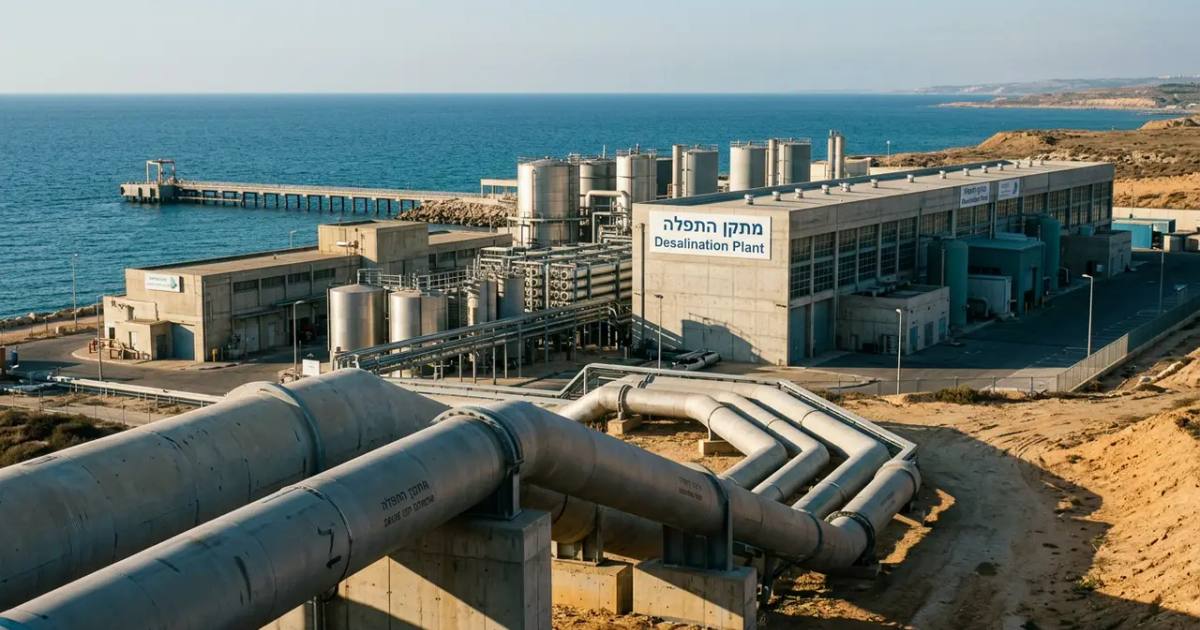

Mekorot, state-owned since 1937, distributes 80% of Israel's water. But four of the five plants that produce it are privately owned under IDE Technologies-linked concessions. The split ownership map of Israeli water.
The Entities | Olam.business
Israel's water supply runs on a split structure: a state-owned monopoly moves the water, and private consortia built and largely own the desalination plants that produce it. Mekorot, founded in 1937, distributes roughly 80% of the country's drinking water — but four of Israel's five major desalination plants are privately owned under 25-year build-operate-transfer concessions, a structure that has occasionally complicated accountability when something goes wrong.
Who owns Israel's water distribution?
Mekorot, the state-owned national water company, was founded in 1937 by Levi Eshkol, engineer Simcha Blass, and Pinhas Sapir. It supplies approximately 80% of Israel's drinking water, operates the National Water Carrier — the country's main cross-national pipeline system — and manages roughly 11,000 km of pipelines, 3,000 production and supply facilities, and 1,000 water reservoirs. Mekorot listed bonds on the Tel Aviv Stock Exchange in 2019, its first outside capital raise in company history, but remains wholly state-owned; there is no private ownership of Israel's water resources or distribution network itself. The company has held the maximum ilAAA financial-strength rating from Standard & Poor's affiliate Maalot since 2003.
Who owns Israel's desalination plants?
Of the five major plants supplying roughly 80% of Israel's drinking water, only Ashdod is directly state-owned, operated through ADL, a Mekorot subsidiary. The other four are privately owned under BOT/BOO concessions: Ashkelon (opened 2005, Israel's first BOT desalination project) was built by VID, a joint venture of IDE Technologies, Veolia, and Dankner-Ellern Infrastructure, financed through Bank Leumi International with a structure of 23% equity and 77% debt; Palmachim (2007) by the Via Maris Desalination consortium; Hadera (2009) by H2ID, a joint venture of IDE Technologies and Shikun & Binui; and Sorek (2013), Israel's largest single plant, originally built by IDE Technologies and Hong Kong's Hutchison Water.
Who owns IDE Technologies, the common thread across every plant?
IDE Technologies, founded in 1965 by engineer Alexander Zarchin, is the private company behind or inside nearly every major Israeli desalination concession. Israel Chemicals (ICL) sold its 50% stake in IDE in 2017 for $167 million to a group including IDE's executive chairman, Avshalom Felber. In 2018, IDE was required to sell its original Sorek 1 stake to Dan Capital Investments and Infrastructures as an antitrust condition, freeing IDE to bid competitively on the newer Sorek 2 build-operate-transfer tender. IDE later became sole owner of the original Sorek plant anyway, buying out Hutchison Water's remaining 49% for roughly NIS 195 million after exercising a right of first refusal — a deal that followed Hutchison selecting a bid from Israel's Noy Fund to acquire its share instead.
What happened when the private plants' water quality was questioned?
In 2019, a government inquiry found that workers at the Sorek and Palmachim desalination plants had manipulated water-testing procedures — a practice known internally as the "morning sample procedure" — to make chloride content appear within legal limits just before daily samples were taken, after residents of Holon complained about yellow drinking water. Because Mekorot receives desalinated water from privately operated plants and blends it into the national system before it reaches consumers, the episode highlighted a structural accountability gap: the state-owned distributor is responsible for the water Israelis drink, but day-to-day production quality at most plants sits with private operators reporting primarily to their own shareholders.
Why does private ownership coexist with a state monopoly here?
Israel's four private desalination BOT projects raised roughly $1.3 billion in private investment collectively, financing infrastructure the state did not have to fund directly — while Mekorot retains full control over how that water is priced, blended, and distributed nationally once it enters the system. All desalinated water, whether from a private or state-owned plant, is merged into Mekorot's network and sold to consumers at the same national tariffs set by the Israel Water Authority, regardless of which company built the plant it came from. A newer state project, the New National Water Carrier, now moves desalinated water in the opposite direction — from coastal plants inland to the Sea of Galilee — specifically to stabilize water levels there after successive drought years, a function only the state carrier, not any private plant owner, is positioned to perform.
Key Facts
- Mekorot: state-owned, ~80% of drinking water, founded 1937, TASE bonds since 2019, ilAAA-rated since 2003
- Ashdod plant: only state-owned desalination facility, via Mekorot subsidiary ADL
- Ashkelon, Palmachim, Hadera, Sorek: privately owned under 25-year BOT/BOO concessions
- IDE Technologies: private company behind most concessions; ICL sold its 50% stake in 2017 for $167M
- 2019 scandal: Sorek and Palmachim workers falsified chloride test results before Holon "yellow water" complaints triggered an inquiry
- Private investment raised: ~$1.3 billion across the four BOT desalination projects
Sources
Wikipedia, Mekorot; Wikipedia, IDE Technologies; Fanack Water, Israeli water management; World Bank, Israel water sector financing; WaterWorld, IDE takes full ownership of Sorek; Times of Israel, 2019 water-quality falsification report.
The Olam Editorial Team | The Entities
How we report: Olam stories draw on public filings, company disclosures and named sources, checked by our editors. Read our methodology · Corrections