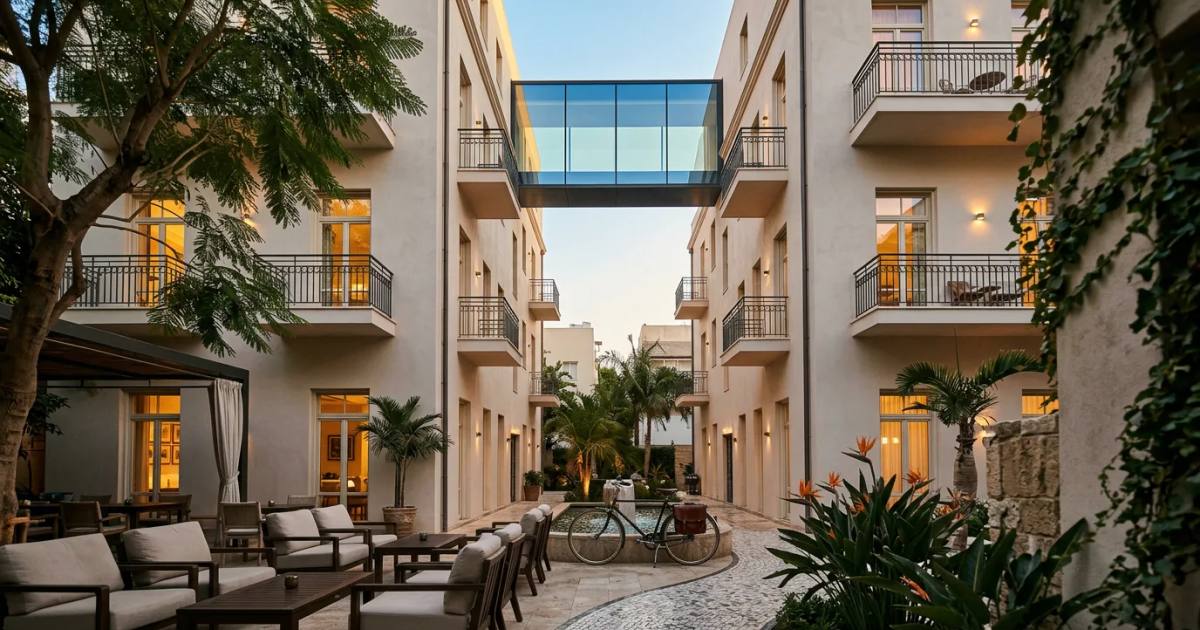

Opened 2014. 50 rooms across two restored 1920s heritage buildings on Nachmani Street. The reference Tel Aviv urban boutique — independent, design-led, no international brand contract. The property that built the modern Tel Aviv urban-luxury category.
Part of: Israeli Hotels · Who Owns the Israeli Hotel Sector · Israeli Luxury 2026 · Ownership profile: The Lourie Family: The Norman's Owners
Opened 2014. Fifty rooms across two restored 1920s heritage buildings on Nachmani Street. The reference Tel Aviv urban boutique: independent, design-led, no international brand contract. The property that proved $700-plus ADR works in central Tel Aviv at boutique scale.
The Norman is the canonical Tel Aviv urban boutique.
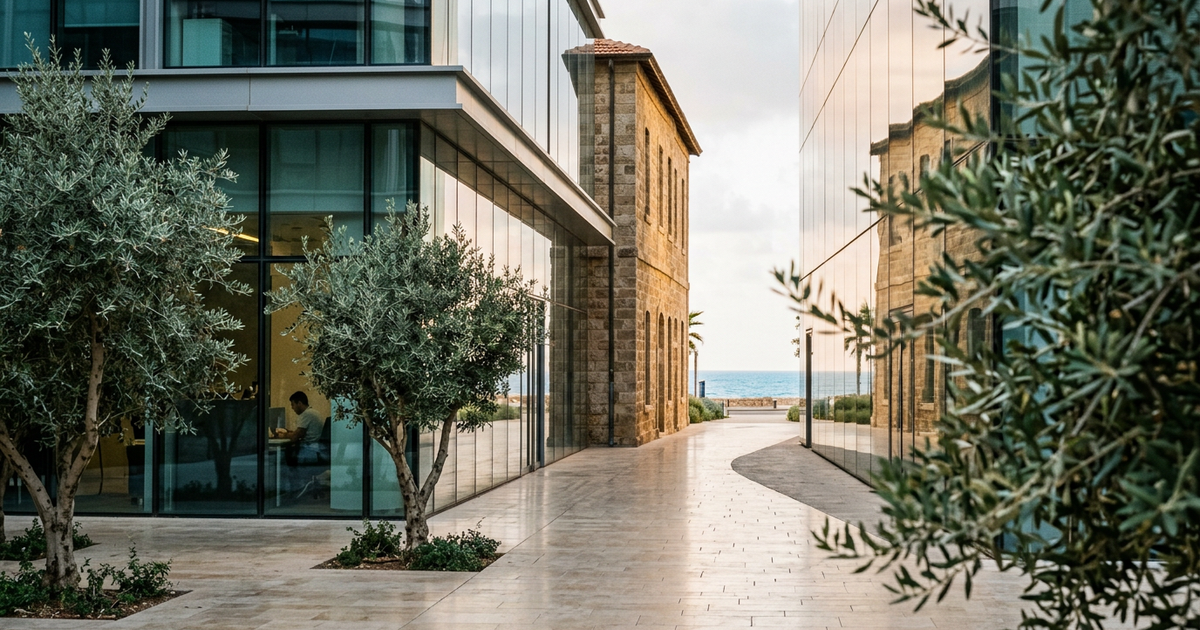
Fifty rooms across two carefully restored 1920s buildings at 23-25 Nachmani Street in central Tel Aviv. Opened in 2014 after a multi-year restoration program. Independent boutique, no international brand contract. Owned by the Lourie family through UK-based Cheyne Capital founder Jonathan Lourie; the ownership and family history is covered in full at The Lourie Family's Quiet Luxury Brand.
The Norman built the modern Tel Aviv urban boutique category. Before its opening, the city had urban business hotels (the Dan Tel Aviv, the Hilton Tel Aviv, the InterContinental David), beach-anchored properties on Hayarkon Street, and a small number of older independent boutiques. None carried the architectural seriousness, the design coherence, or the ADR ambition the Norman opened with. The category, Tel Aviv urban design boutique at $700-plus ADR, substantially started here.
By the Numbers
Opened: 2014 (after a multi-year restoration)
Address: 23-25 Nachmani Street, Tel Aviv, Lev HaIr / Rothschild district
Keys: 50 rooms across two restored 1920s heritage buildings
ADR: roughly $700-1,200, higher for the signature suites
Operator: independent Israeli boutique, no international brand contract
Owner: Jonathan Lourie (UK, Cheyne Capital); see the Lourie family ownership profile
Buildings: two pre-state heritage properties from the 1920s, fully restored under Israeli heritage protection
F&B: Alena (Israeli-Mediterranean) · Dinings TLV (Japanese) · The Library Bar
The Buildings on Nachmani Street
The Norman occupies two adjacent heritage buildings on Nachmani Street, originally constructed in the 1920s during the early-Tel-Aviv expansion period. The buildings represent the architectural transition between the Templer-era and early-Mandate styles that defined that period of the city, before the International Style and Bauhaus wave that built the White City in the 1930s.
By the 2000s, both buildings had passed through multiple uses and required substantial restoration. The Norman's ownership group acquired the properties and undertook a multi-year restoration program: preserving the historic facades under Tel Aviv heritage regulation, fully reconstructing the interiors, and connecting the two buildings into a single integrated hotel operation. The project is one of the most architecturally significant private restorations in central Tel Aviv from the past two decades.
Nachmani Street sits in Lev HaIr, central Tel Aviv, near Rothschild Boulevard, the Habima Theater, Sheinkin Street, and the broader cultural and dining anchor of the city. The location is deliberately urban, deliberately walkable, and deliberately not beachfront.
How the Norman Operates
The Norman operates as a genuine independent. No Aman, Como, Mandarin Oriental, Rosewood, or other international brand contract sits on the property. The brand, the design, the operations, the food program, and the service standard are entirely run by the Israeli ownership group.
The 50-key scale is deliberate. The Norman is not trying to be a 200-key urban-luxury convention property. The model is intentionally small: enough rooms to operate professional hospitality infrastructure (restaurants, bars, spa, pool), few enough rooms that every guest gets serious attention.
The food and beverage program is the strongest single piece of the property's identity. Alena serves Israeli-Mediterranean cuisine at Tel Aviv top-tier standards. Dinings TLV is a serious Japanese restaurant under the Dinings brand. The Library Bar is one of Tel Aviv's most consistently cited hotel cocktail rooms. Each piece of the F&B operation could plausibly stand alone as an independent Tel Aviv venue.
What the Norman Proved
Three structural points mattered for the rest of Tel Aviv hospitality.
First, $700-plus urban ADR works in Tel Aviv at boutique scale. The thesis had been defended for years; the Norman provided the operational proof. The cohort that fills the property, international design-led leisure travelers, senior US Jewish institutional visitors, Tel Aviv-based business travelers at the top of the curve, and the diaspora UHNW visiting cohort, absorbed the ADR without complaint.
Second, heritage restoration is a defensible Tel Aviv asset class. Before the Norman, the assumption was that Tel Aviv's heritage stock was a regulatory burden rather than a commercial asset. The Norman demonstrated that 1920s buildings, properly restored under heritage protection, could carry premium hospitality positioning. That has shaped subsequent restoration projects across Tel Aviv and Neve Tzedek.
Third, Tel Aviv supports independent boutique at the top of the urban-luxury curve. International brands had not committed to Tel Aviv urban luxury at the time the Norman opened. The Norman showed that independent operators could occupy the position. Subsequent international evaluations of Tel Aviv urban luxury have used the Norman's performance as a reference point.
October 7 and After
Tel Aviv urban-luxury hospitality absorbed a sharp blow after October 7, 2023, as international leisure inbound collapsed through 2024. The Norman was affected alongside every other Tel Aviv property at the top of the ADR tier.
The recovery has been driven by senior US Jewish institutional travel, the diaspora UHNW visiting cohort, Israeli domestic business travel at the top of the curve, and the gradual return of international design-led leisure demand. By 2026, the property is rebuilding toward design occupancy alongside the rest of the Tel Aviv urban-luxury layer.
Why It Matters
- Built the modern Tel Aviv urban-boutique category: $700-plus ADR at boutique scale, no international brand contract
- Among the most architecturally significant private restorations in central Tel Aviv in the past two decades
- Validated Tel Aviv heritage stock as a defensible hospitality asset class
- Operating reference for subsequent Tel Aviv urban-luxury boutique evaluations by international operators
- Among the most consistently cited Tel Aviv F&B operations: Alena, Dinings TLV, the Library Bar
The Outlook
The Norman operates near a structural ceiling on its own expansion. The two-building footprint, the 50-key count, and the central Tel Aviv setting are fixed. The property will continue to anchor the Tel Aviv urban-boutique layer.
The larger question is what comes next at this tier in Tel Aviv. Several international ultra-luxury operators, Edition, Aman, Rosewood, Soho House, have been evaluating Tel Aviv urban positions for years. None has publicly committed. When the first international urban-luxury flag lands in Tel Aviv, the Norman will have built the demand case it operates within.
Until then, the Norman remains the reference. Fifty rooms. Two 1920s buildings. Nachmani Street.
The Norman: FAQ
What is The Norman Tel Aviv?
The Norman is an independent Tel Aviv urban-boutique hotel located at 23-25 Nachmani Street in central Tel Aviv. Fifty rooms across two restored 1920s heritage buildings. Opened in 2014 after a multi-year restoration. The reference Tel Aviv urban-luxury boutique.
Where is The Norman located?
The Norman sits on Nachmani Street in Lev HaIr, central Tel Aviv, near Rothschild Boulevard, the Habima Theater, and the broader cultural and dining anchor of the city. The setting is deliberately urban and walkable.
When did The Norman open?
The Norman opened in 2014 after a multi-year restoration of two adjacent 1920s heritage buildings.
How many rooms does The Norman have?
Fifty rooms across the two restored buildings. The small key count is deliberate: enough to support professional hospitality infrastructure including multiple restaurants and a serious spa, few enough to maintain genuine boutique service standards.
Who owns The Norman?
The Norman is owned by Jonathan Lourie, UK-based founder and CEO of London hedge fund Cheyne Capital Management. He built the hotel as a memorial to his father Norman Lourie, the South African-born Zionist who opened Israel's first boutique hotel (Dolphin House, Shavei Zion) in 1950. There is no international hotel brand contract on the property.
Is The Norman part of an international hotel brand?
No. The Norman is one of the few Tel Aviv urban-luxury properties operating without an international brand contract. The independence is part of the property's identity and operating model: the brand is the Norman itself, not a flag affiliation.
What restaurants are at The Norman?
The Norman operates Alena (Israeli-Mediterranean), Dinings TLV (a serious Japanese restaurant under the Dinings brand), and the Library Bar (one of Tel Aviv's most consistently cited hotel cocktail rooms). The F&B program is among the strongest single pieces of the property's identity.
Why is The Norman strategically important?
The Norman built the modern Tel Aviv urban-boutique category. It proved that $700-plus ADR works in central Tel Aviv at boutique scale, validated Tel Aviv heritage stock as a defensible hospitality asset class, and set the operating reference for subsequent international evaluations of Tel Aviv urban-luxury positions.
How did The Norman perform after October 7?
Tel Aviv urban-luxury hospitality absorbed a sharp blow after October 7, 2023, as international leisure inbound collapsed through 2024. The recovery has been driven by senior US Jewish institutional travel, the diaspora UHNW visiting cohort, Israeli domestic business travel, and the gradual return of international design-led leisure demand. By 2026, the property is rebuilding toward design occupancy.
Index: this is a property profile in the Israeli Hotels cluster, the Olam guide to the Israeli hotel sector. Ownership profile: The Lourie Family: Norman Hotel's Quiet Luxury Owners. Companion properties: Mamilla and David Citadel (Alrov) · King David Hotel · Waldorf Astoria Jerusalem · Six Senses Shaharut · Pereh Mountain Resort. Capstone: Who Owns the Israeli Hotel Sector. Sector guide: Israeli Luxury 2026.