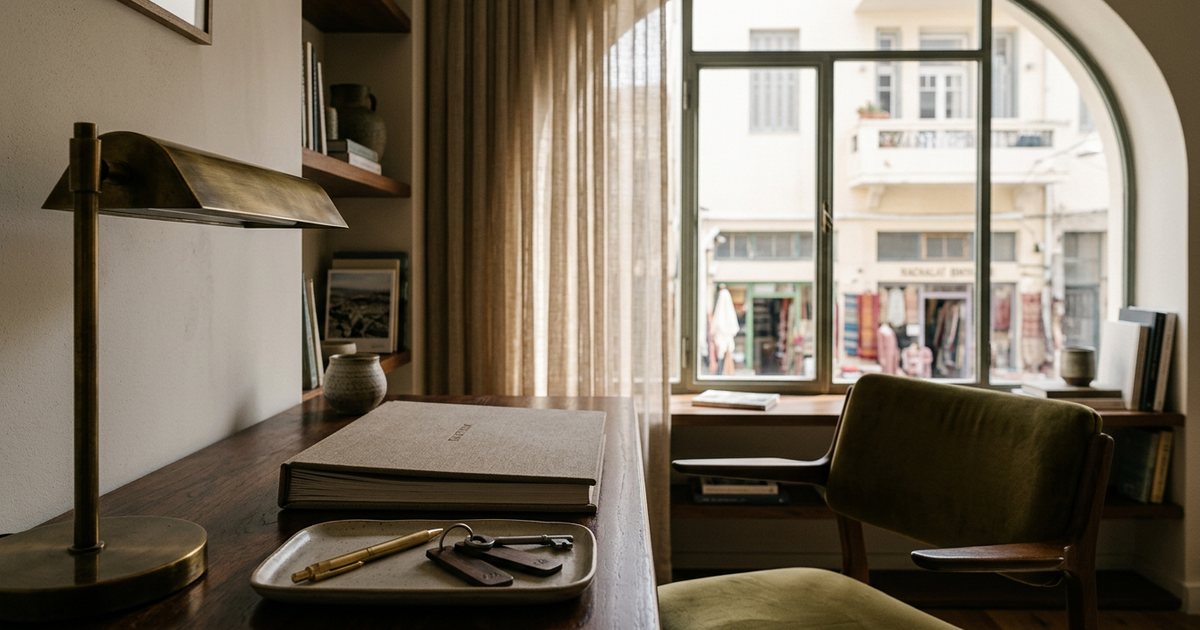

The Lourie family owns The Norman Hotel, a fifty-key property on Nachmani Street. It stands as a reference for Israeli boutique luxury, privately owned and without a press cycle.
Fifty keys on Nachmani Street. A London hedge-fund founder who built the hotel as a memorial to his father, the man who opened Israel's first boutique hotel in 1950. The family story behind Israeli boutique luxury's reference property.
The Norman Hotel is the smallest major Israeli boutique-luxury property and the one most deliberately built to stay small.
Owned by Jonathan Lourie, UK-based founder and CEO of London hedge fund Cheyne Capital Management. Named after his late father, Norman Lourie. For the property itself, the address, the restoration, the room count and the restaurants, see The Norman Tel Aviv: Urban Boutique Hotel Reference. This piece is the family story: who Norman Lourie was, why his son built a hotel in his name, and how that private capital found its way from a London hedge fund into an Israeli heritage restoration.
Who Was Norman Lourie?
Norman Lourie was a South African-born Zionist who moved into the early film industry of pre-state Palestine. He founded Palestine Films, which produced the country's first feature films and acted as a distributor for Hollywood studios in the region. Variety magazine described him in 1948 as a "one-man film industry." He served as a military reporter attached to the British Army's Jewish Brigade and the South African Engineering Corps during World War II.
In 1950 he opened Dolphin House in Shavei Zion, a twelve-room property on the Mediterranean north of Nahariya. Dolphin House is generally credited as Israel's first luxury or boutique resort hotel. Its guest list in the 1950s and 60s included Israel's first three presidents (Chaim Weizmann, Yitzhak Ben-Zvi, Zalman Shazar), Cornelius Vanderbilt, Danny Kaye, Kirk Douglas, Sophia Loren, and the cast of Exodus including Paul Newman and Joanne Woodward. Author Leon Uris wrote the Exodus screenplay while in residence. Norman Lourie operated Dolphin House for fifteen years before its popularity waned and he closed it.
Norman Lourie's long poem "Castle in the Sand," opening line "In the beginning there was nothing but the murmur of the sea, sand dunes in Galilee," is inscribed in raised letters down the atrium elevator wall of The Norman Hotel Tel Aviv.
Who Is Jonathan Lourie?
Jonathan Lourie is the founder and CEO of Cheyne Capital Management, the London-based alternative-credit and structured-credit investment firm he co-founded in 2000. Cheyne is one of Europe's established credit specialists, with multi-billion-dollar assets under management across real estate debt, corporate credit, social impact, and structured credit strategies. Jonathan is based in the United Kingdom.
The Norman Hotel is, in effect, a personal project funded out of Cheyne-era wealth, built as homage to his father and to Norman Lourie's vision for Israeli hospitality. The hotel's flagship restaurant, Alena, is named after Jonathan's mother. The capital structure reflects the operating philosophy: private family capital underwriting a single trophy asset rather than scaling through external capital. No private-equity participation. No public listing. No external equity.
Jonathan Lourie does not run a press cycle around the hotel. He grants almost no interviews about the business and maintains no public-facing profile around the property. The family's competitive position is partly built on operating discreetly. Luxury hospitality at this end of the market rewards quiet. The brand value sits in the operating standard, not in founder visibility.
By the Numbers
Owner: Jonathan Lourie (UK-based, founder and CEO, Cheyne Capital Management)
Named after: Norman Lourie (1916-2006), South African Zionist, filmmaker, founder of Palestine Films and the Dolphin House (Shavei Zion, 1950)
Listed: private, no public disclosure
Flagship: The Norman Hotel Tel Aviv (opened 2014); see the full property profile
General Manager: Yaron Liberman (since opening; previously Sheraton Tel Aviv and Waldorf Astoria New York)
Positioning: family-owned, no franchise, no press cycle
Who Runs the Norman Hotel Day to Day?
The hotel's General Manager since opening is Yaron Liberman, who joined from the Sheraton Tel Aviv (previously Waldorf Astoria New York) after winning the tender in summer 2012, while the buildings were still under restoration. Liberman has run the property continuously since opening day in 2014. Twelve-plus years under the same general manager is an unusual feature of Israeli luxury hospitality and part of why the property maintains its reference status.
The Norman Residences extended the brand into branded residential, serviced apartments operated under the Norman brand in central Tel Aviv, without expanding hotel room count materially. Compare to Brown Hotels, which has expanded to roughly fifty properties across six countries in fifteen years. The Norman has added perhaps one or two material projects in the same period. The pace is intentional.
Why Does the Family Story Matter?
- A diaspora-capital story: built out of London hedge-fund wealth as a memorial to a Zionist father, a clean expression of the UK-Jewish capital corridor into Israeli trophy real estate
- Family-controlled, private, deliberately small: the inverse of the Brown or Fattal acquisition-and-scale model
- No franchise exposure, no public listing, no founder press cycle: an operating model built on operating standard, not narrative
- Twelve-plus years of continuous general-manager leadership under Yaron Liberman, rare operating continuity at the Israeli luxury tier
What Comes Next for the Lourie Family?
The Norman is unlikely to grow the way Brown does. It is unlikely to acquire the way Fattal does. The likely path is more of the same: another carefully restored Tel Aviv or Jerusalem building, eventually a Norman property in a major international city (London, Paris, or Rome would all fit the brand), and the residential extension scaling slowly under the brand.
Whatever the family builds next will arrive without a press cycle. The operating standard is set. The memorial intent behind the name is established. Fifty keys on Nachmani Street. A London hedge-fund founder who doesn't do interviews about it. The family behind the hotel that set the bar.
Frequently Asked Questions
Who owns The Norman Hotel Tel Aviv?
The Norman Hotel is privately owned by Jonathan Lourie, the UK-based founder and CEO of London hedge fund Cheyne Capital Management. There is no franchise, no private-equity participation, and no public listing.
Why is it called The Norman?
The hotel is named after Jonathan Lourie's late father, Norman Lourie, a South African-born Zionist filmmaker who opened Dolphin House in Shavei Zion in 1950, generally credited as Israel's first luxury boutique hotel.
When did The Norman Hotel open?
The Norman Hotel Tel Aviv opened in 2014, restored across two 1920s buildings on Nachmani Street.
Who manages The Norman Hotel?
Yaron Liberman has served as General Manager since opening in 2014, having joined from the Sheraton Tel Aviv and previously the Waldorf Astoria New York.
Is The Norman Hotel part of an international brand?
No. The Norman is independently owned and operated, with no international hotel brand affiliation.
Index: this is the Lourie family ownership profile in the Israeli Hotels cluster, the Olam guide to the Israeli hotel sector. Property profile: The Norman Tel Aviv: Urban Boutique Hotel Reference. Capstone: Who Owns the Israeli Hotel Sector. Sister operator profiles: Fattal · Isrotel · Dan · Alrov · Brown.