
Sixty villas on a cliff above the Arava. An IHG-owned wellness-luxury brand that decided Israel was a market it needed to be in. The property that opened the door.
Part of: Israeli Hotels · Who Owns the Israeli Hotel Sector
Updated June 29, 2026.
Sixty villas on a cliff above the Arava. An IHG-owned wellness-luxury brand that decided Israel was a market it needed to be in. The property that opened the door.
Six Senses Shaharut is the single most strategically important hotel opening in Israeli history.
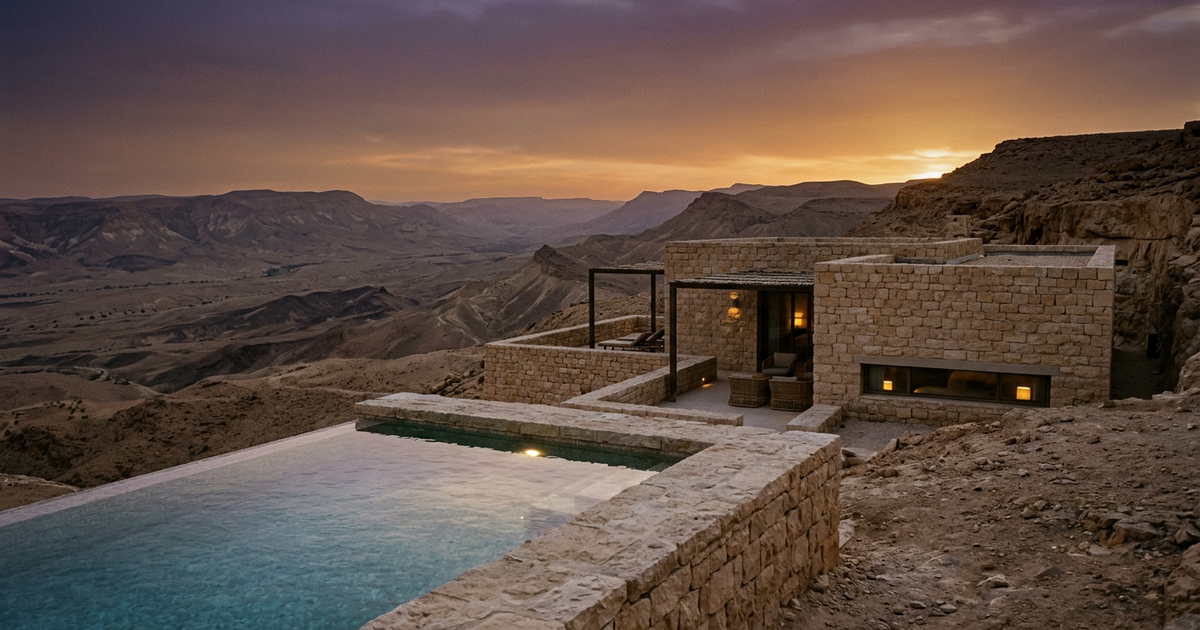
Sixty villas spread across the cliffs above the Arava desert, near Kibbutz Shaharut in the southern Negev. Opened in 2021. Operated under the Six Senses brand, the wellness-luxury house founded by Sonu and Eva Shivdasani in 1995 and acquired by InterContinental Hotels Group (IHG) in 2019. Room rates routinely exceed $1,500 a night.
It is the first true international ultra-luxury flag to plant itself in Israel. Everything in the Israeli hospitality market that has happened since is partially a consequence of Six Senses making the call.
By the Numbers
Opened: 2021
Location: cliffs above the Arava, near Kibbutz Shaharut
Keys: 60 villas (most with private pools)
ADR: $1,500+ per night, higher in peak season
Brand: Six Senses, founded 1995 by Sonu and Eva Shivdasani, acquired by IHG in 2019
Ownership: Israeli investors, operated under brand contract with IHG
How IHG Made the Six Senses Shaharut Call
In the late 2010s, IHG-owned Six Senses was looking to expand its ultra-luxury wellness-resort portfolio into geographies where the brand had not previously been present. Israel was an unusual candidate. The country had no other international ultra-luxury flag operating at the time. The market size for $1,500-a-night domestic demand was untested.
The decision to proceed was made on a structural read: Israel had high-income domestic demand at the top of the wealth curve, an emerging boutique-luxury layer (Beresheet had been operating successfully since 2011 and proving the $700 ADR thesis in the same desert geography), and a security and operating environment that, while complicated, was navigable for a brand with experience in remote, security-sensitive locations.
The Arava site was chosen for the same reason Aman or Singita might have chosen it: genuinely remote, structurally beautiful, and offering the horizon-line architecture that defines ultra-luxury wellness resort design at this price point.
Sixty Villas on the Shaharut Cliff
Sixty villas. Most with private plunge pools. Architecturally designed to disappear into the cliff face: earth tones, low profiles, integrated landscaping.
The amenity stack is comprehensive: spa, multiple restaurants, observatory, camel stable, horse riding, hiking, desert excursions. The wellness program is the brand's signature: integrated medical wellness, sleep program, fitness, meditation, traditional bodywork.
The Israeli operating partners are local. The brand operations and standards are Six Senses. The combination has produced a property that operates to Six Senses' international brand expectations while being recognizably Israeli in its food, sourcing, and cultural register.
Six Senses Shaharut at $1,500 a Night
An ultra-luxury resort of this size, in this remote a setting, with this level of architectural ambition typically runs $80-$150 million in total development cost. The break-even occupancy is high. The unit economics depend on sustained $1,500+ ADR through the year.
Through 2022 and into 2023, the property tracked toward those economics. The October 7 disruption interrupted that trajectory. Through 2024, the property held up better than most international-flagged trophy properties in Israel: domestic demand at the top of the wealth curve carried more of the load than expected. By 2026, international ultra-luxury demand is returning, and the property is back near design occupancy.
Why It Matters
- First true international ultra-luxury flag in Israel: broke the seal for Aman, Rosewood, Como, Belmond, Soho House evaluations
- Validated the $1,500-a-night Israel thesis at international brand scale
- Built on the foundation Beresheet (Isrotel, 2011) had laid: the two desert properties are structurally inseparable
- Israeli ownership plus a global brand operator: the template for international flags entering Israeli hospitality
- A sister property in Israel is the natural next step for the brand
Six Senses Shaharut Broke the Israeli Ultra-Luxury Seal
Three reasons that have nothing to do with the property itself.
One: it broke the seal. Before 2021, no Aman, no Como, no Belmond, no Rosewood, no Mandarin Oriental, no Soho House, no Four Seasons in Israel. The international ultra-luxury houses had simply not made the call. Six Senses making the call opened the door for the rest of them to seriously evaluate the market, and they have.
Two: it validated the $1,500-a-night Israel thesis. Pereh had been working at independent-operator scale. Beresheet had proven $700 a night domestically. Six Senses proved that a global ultra-luxury operator could command its full international price point in Israel and fill the property. The ceiling moved structurally.
Three: it provided the desert template. Shaharut showed how an ultra-luxury resort can be built on Israeli desert geography in a way that respects the landscape, operates against the local supply chain, and competes on the same shelf as ultra-luxury desert resorts in Oman, Utah, and Namibia. The next desert ultra-luxury property in Israel will use Shaharut as the operating reference.
What's Next After Six Senses Shaharut
Aman has reportedly been evaluating Israel for years. Rosewood has been in discussions. Como has Mediterranean ambitions that would naturally extend to Israel. Soho House has been quietly assessing Tel Aviv and Jerusalem locations.
Whether any of these international flags lands inside the next twenty-four months is a function of the pace of inbound recovery, the security read, and the availability of the right site. The market case has been made.
Six Senses Shaharut will likely add a sister property in Israel: a Galilee or Mediterranean site would be the natural extension. There has been no public announcement. The signal, when it comes, will be the second Six Senses property in the country.
Sixty villas. One desert site. The most strategically important hotel opening in Israeli history. Not the largest. Not the most architecturally lavish. The one that opened the door.
Six Senses Shaharut: FAQ
What is Six Senses Shaharut?
Six Senses Shaharut is a 60-villa ultra-luxury wellness resort located on the cliffs above the Arava desert in southern Israel, near Kibbutz Shaharut. It opened in 2021 and is the first international ultra-luxury hotel flag to operate in Israel.
Where is Six Senses Shaharut located?
Six Senses Shaharut sits on the cliffs above the Arava desert in southern Israel, adjacent to Kibbutz Shaharut, roughly an hour north of Eilat and four hours south of Tel Aviv.
When did Six Senses Shaharut open?
Six Senses Shaharut opened in 2021. It was the first project to bring an international ultra-luxury hotel brand into the Israeli market.
How much does Six Senses Shaharut cost per night?
Average daily rate at Six Senses Shaharut routinely exceeds $1,500 per night, with higher pricing in peak season. This is the full international Six Senses ultra-luxury price point, not a localized Israel rate.
How many villas does Six Senses Shaharut have?
Sixty villas, most with private plunge pools. The architecture is designed to disappear into the cliff face: low profiles, earth tones, integrated landscaping.
Who owns Six Senses Shaharut?
The property is owned by Israeli investors and operated under a brand contract with InterContinental Hotels Group (IHG), which acquired the Six Senses brand from founders Sonu and Eva Shivdasani in 2019.
Why is Six Senses Shaharut considered the most strategically important hotel opening in Israeli history?
It is the first true international ultra-luxury flag in Israel. Before Six Senses Shaharut opened in 2021, no Aman, Como, Belmond, Rosewood, Mandarin Oriental, Soho House, or Four Seasons operated in the country. Six Senses making the call validated the $1,500-a-night Israel thesis at international brand scale and opened the door for the rest of the ultra-luxury houses to evaluate the market.
What other international luxury hotel brands are coming to Israel?
Aman has reportedly been evaluating Israel for years. Rosewood has been in discussions. Como has Mediterranean ambitions that would naturally extend to Israel. Soho House has been assessing Tel Aviv and Jerusalem locations. None have publicly confirmed entry as of 2026.
How did Six Senses Shaharut perform after October 7, 2023?
The October 7 disruption interrupted the property's recovery trajectory. Through 2024, Six Senses Shaharut held up better than most international-flagged trophy properties in Israel: domestic demand at the top of the wealth curve carried more of the load than expected. By 2026, international ultra-luxury demand is returning and the property is back near design occupancy.
Will Six Senses open a second property in Israel?
A sister property in Israel is the natural next step for the brand: a Galilee or Mediterranean coastal site would be the logical extension. There has been no public announcement as of 2026. The signal, when it comes, will be the second Six Senses property in the country.
What is the closest comparable hotel to Six Senses Shaharut?
Inside Israel, the closest comparable is Beresheet (Isrotel) in Mitzpe Ramon, which has operated successfully since 2011 at roughly the $700 ADR tier. Internationally, Six Senses Shaharut competes on the same shelf as ultra-luxury desert resorts in Oman, Utah, and Namibia.
Index: this is the Six Senses Shaharut profile in the Israeli Hotels cluster, the Olam guide to the Israeli hotel sector. Anchors: The Israeli Boutique Hotel Class · The Aman Israel Question. Capstone: Who Owns the Israeli Hotel Sector. Other operator profiles in the cluster: Fattal · Isrotel · Alrov · Brown · Norman.