
Opened 2014 in the restored 1929 Palace Hotel building near Mamilla. 227 rooms. Hilton's first ultra-luxury Israel flag. The Reichmann-led restoration that brought the first global luxury brand contract into Jerusalem.
Part of: Israeli Hotels · Who Owns the Israeli Hotel Sector · Israeli Luxury 2026
Opened 2014 in the restored 1929 Palace Hotel building near Mamilla. 227 rooms. Hilton's first ultra-luxury Israel flag. The Reichmann-led restoration that brought the first global luxury brand contract into Jerusalem.
The Waldorf Astoria Jerusalem is the first global luxury hotel brand contract operating in Israel.
Opened in 2014 in the restored shell of the historic Palace Hotel, originally constructed in 1929 by the Supreme Muslim Council. 227 rooms. Operated under Hilton's Waldorf Astoria luxury flag. Developed and brought to the Waldorf Astoria brand by Reichmann International, the Toronto-based Reichmann family's investment vehicle.
The property anchors the global-luxury-brand layer in Jerusalem. It is one of the two structural anchors of the post-Mamilla Jerusalem trophy-hotel boom, alongside the Akirov-owned Mamilla itself.
BY THE NUMBERS
Opened: 2014
Setting: 1929 Palace Hotel building, near Mamilla and Independence Park
Keys: ~227 rooms
Flag: Hilton's Waldorf Astoria luxury brand
Developer / owner: Reichmann family (Reichmann International, Toronto)
Construction scale: historic façade preserved · interior fully reconstructed
Significance: first global luxury brand contract operating in Israel · the model later followed by Six Senses Shaharut
What Was the Original Palace Hotel?
The original Palace Hotel opened in 1929. Constructed under the Supreme Muslim Council during the late-Ottoman-into-British-Mandate transitional period. Its purpose was both commercial and political, a luxury hotel in West Jerusalem under explicit Muslim institutional development.
The Palace operated for only a short period before functional difficulties closed the hotel. The building passed through multiple uses over the subsequent decades, government offices, military and administrative functions through the Mandate, 1948, and into the State of Israel, and eventually became disused. The shell of the 1929 façade survived intact.
For decades the building sat in West Jerusalem as one of the most architecturally significant unrestored sites in the city. The redevelopment opportunity was visible to anyone who walked past it. The capital to execute on it was the constraint.
How Did the Reichmann Family Restore the Palace Hotel?
The Reichmann family, Canadian-Jewish real estate developers who built and lost Olympia & York, the Canary Wharf and World Financial Center developer behind one of the largest property bankruptcies in history, before rebuilding through Reichmann International, took on the Palace Hotel redevelopment in the 2000s.
The project was structurally complex. The historic façade required full preservation under Jerusalem heritage protection regulation. The interior was completely reconstructed behind the original stonework. Multiple archaeological constraints applied to the foundation work. The development cycle stretched over years; the property finally opened to Waldorf Astoria standards in 2014.
Bringing the Waldorf Astoria brand to Jerusalem was, for Hilton, the first ultra-luxury flag in Israel. The brand contract is a long-term franchise/management agreement; the property is owned by the Reichmann interests and operated under Hilton's Waldorf Astoria brand.
What Is the Waldorf Astoria Jerusalem Property Like?
The hotel sits at the edge of Independence Park, three minutes' walk from the Mamilla complex and ten minutes from the Jaffa Gate of the Old City. The location is structurally one of the strongest in Jerusalem, within walking distance of the Old City, the Mamilla shopping district, the King David Hotel, and the Israel Museum.
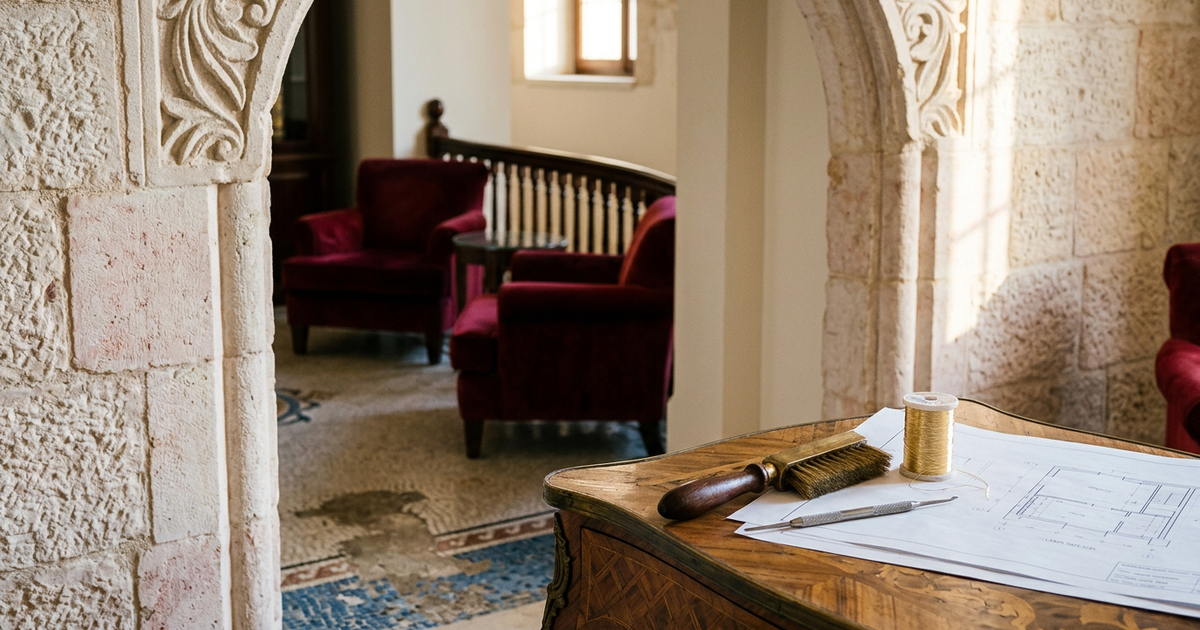
The 227 rooms are spread across the original Palace structure and a new wing. The presidential suites occupy the historic central portion of the original building. The architecture inside combines preserved 1929 stonework, columns, arches, ceiling detail, with contemporary Waldorf Astoria interior standards.
The kosher operation is among the most established at the Hilton ultra-luxury tier globally. The dining program is structured to serve both the religious-diaspora cohort and the broader international Waldorf Astoria guest base.
Why Is the Waldorf Astoria Jerusalem Significant?
Three things made the Waldorf Astoria Jerusalem significant for the Israeli hospitality sector.
First: it was the first global luxury brand contract operating in Israel. Before 2014, no Waldorf Astoria, no Four Seasons, no Ritz-Carlton, no Mandarin Oriental, no Aman, no St. Regis, no Bulgari operated in the country. The Israeli luxury hotel layer was almost entirely Israeli-branded (Mamilla, David Citadel, King David, Dan Tel Aviv). Hilton bringing Waldorf Astoria to Jerusalem broke the seal at the top of the urban-luxury market in the same way Six Senses Shaharut broke it seven years later at the destination-luxury tier.
Second: it proved the Reichmann template. Israeli (or Israeli-connected) ownership combined with a global brand contract is now the most successful operating model in Israeli luxury hotel development. The Reichmann-Waldorf Astoria pairing in 2014 set the precedent that Six Senses Shaharut later followed at scale.
Third: it expanded the Jerusalem trophy capacity. Before 2014, the Jerusalem top tier was effectively the King David, Mamilla, and David Citadel. Waldorf Astoria added 227 rooms at the ultra-luxury price point. The market absorbed the additional capacity. That validated the Jerusalem demand pool as larger than the prior assumption.
How Did October 7 Affect the Waldorf Astoria Jerusalem?
Like every Jerusalem trophy property, the Waldorf Astoria was hit hard by the post-October 7 collapse in international inbound, Christian pilgrimage, and senior delegation traffic. The international Hilton booking pipeline that the property partially relied on shut down through much of 2024.
The recovery has been led by senior US Jewish institutional travel, religious-diaspora UHNW guests, and the gradual return of American delegations. Through 2026, the property is rebuilding toward design occupancy alongside the rest of the Jerusalem luxury layer.
WHY IT MATTERS
- First global luxury hotel brand contract operating in Israel, broke the seal at the urban luxury tier
- The Reichmann ownership plus Hilton brand model set the precedent later followed by Six Senses Shaharut
- Expanded Jerusalem ultra-luxury capacity by 227 rooms, and the market absorbed it
- The most architecturally significant restoration in modern Jerusalem hospitality, 1929 Palace Hotel preserved under heritage regulation
- One of the most established kosher operations at the global Hilton ultra-luxury tier
What's the Outlook for the Waldorf Astoria Jerusalem?
The Waldorf Astoria Jerusalem is structurally locked in. The brand contract, the Reichmann ownership, the architectural footprint, and the room count are all fixed. The property's trajectory will track the broader Jerusalem trophy-hotel recovery.
The longer-term question is whether Hilton, or any of the global luxury houses, adds further Israeli capacity. The years since the Waldorf Astoria Jerusalem opened have not produced another Hilton ultra-luxury property in the country. The post-October-7 environment has delayed pipeline decisions. A Tel Aviv urban-luxury Hilton flag would be the obvious next move; the timing depends on the recovery cycle and on Hilton's broader Middle East and Mediterranean strategy.
Waldorf Astoria Jerusalem: FAQ
When did the Waldorf Astoria Jerusalem open?
The Waldorf Astoria Jerusalem opened in 2014, in the restored shell of the 1929 Palace Hotel building. It was the first global luxury hotel brand contract to operate in Israel.
Who owns the Waldorf Astoria Jerusalem?
The property is owned by Reichmann International, the Toronto-based investment vehicle of the Canadian-Jewish Reichmann family, and operated under Hilton's Waldorf Astoria brand through a long-term franchise/management agreement.
What was the original Palace Hotel?
The Palace Hotel was constructed in 1929 by the Supreme Muslim Council. It operated as a luxury hotel for only a short period before functional difficulties closed it. The building subsequently passed through multiple uses, government offices, Mandate-era administrative functions, state-era uses, before being disused for decades. The 1929 façade survived intact.
How many rooms does the Waldorf Astoria Jerusalem have?
Approximately 227 rooms. The rooms are spread across the original 1929 Palace structure and a new wing. The presidential suites occupy the historic central portion of the original building.
Where is the Waldorf Astoria Jerusalem located?
The hotel sits at the edge of Independence Park in West Jerusalem, three minutes' walk from the Mamilla complex and ten minutes from the Jaffa Gate of the Old City.
What was the Reichmann family's role in the restoration?
The Reichmann family, Canadian-Jewish real estate developers behind the original Olympia & York and, today, Reichmann International, took on the Palace Hotel redevelopment in the 2000s. The historic façade was preserved under Jerusalem heritage protection regulation; the interior was completely reconstructed. The property opened to Waldorf Astoria standards in 2014.
Is the Waldorf Astoria Jerusalem kosher?
Yes. The kosher operation at the property is among the most established at the Hilton ultra-luxury tier globally. The dining program serves both the religious-diaspora cohort and the broader international Waldorf Astoria guest base.
How does the Waldorf Astoria Jerusalem compare to the King David and the Mamilla?
The King David is Israel's diplomatic anchor, operating continuously since 1931 under Dan Hotels since 1958, the default stay for visiting heads of state. The Mamilla (under Alrov) anchors the Mamilla complex with the highest consistent ADR in Jerusalem. The Waldorf Astoria Jerusalem is the global luxury brand contract, Hilton's ultra-luxury flag in Israel, in the restored 1929 Palace Hotel. The three are not interchangeable; they sit alongside each other as the top tier of the Jerusalem market.
How has the Waldorf Astoria Jerusalem performed since October 7?
Like every Jerusalem trophy property, the Waldorf Astoria was hit hard by the post-October-7 collapse in international inbound, Christian pilgrimage, and senior delegation traffic. The recovery has been led by senior US Jewish institutional travel, religious-diaspora UHNW guests, and the gradual return of American delegations.
↗ Index: this is the Waldorf Astoria Jerusalem profile in the Israeli Hotels cluster, the Olam guide to the Israeli hotel sector. Companion properties: King David Hotel · Mamilla and David Citadel (Alrov) · Six Senses Shaharut · Pereh Mountain Resort. Capstone: Who Owns the Israeli Hotel Sector. Sector guide: Israeli Luxury 2026. Global brand profile: Everything-PR's Hilton Worldwide.