
Opened 1931. 233 rooms above the Old City walls. Dan Hotels' flagship. The hotel that hosted every Israeli prime minister, every US president, the British Mandate authorities, Sadat, Begin, Carter — and the bombing that changed the country.
Part of: Israeli Hotels · Who Owns the Israeli Hotel Sector · Israeli Luxury 2026
Opened 1931. 233 rooms above the Old City walls. Dan Hotels' flagship. The hotel that hosted every Israeli prime minister, every US president, the British Mandate authorities, Sadat, Begin, Carter, and the bombing that changed the country.
The King David is the only hotel in Israel that is also a national institution.
Opened in 1931, designed by the Swiss architect Emil Vogt, originally developed by the Egyptian Jewish banker Ezra Mosseri, and operating continuously for more than ninety years. Owned and operated by Dan Hotels Corporation, the Israeli hotel group controlled by the Federmann family, since 1958. Roughly 233 rooms. The default Jerusalem stay for every visiting head of state, every senior US delegation, and every serious diplomatic visitor since the founding of the state.
It is one of the small group of hotels worldwide, the Imperial in Tokyo, Raffles in Singapore, the Pera Palace in Istanbul, whose name is inseparable from the country's political history.
BY THE NUMBERS
Opened: 1931
Architect: Emil Vogt · Original developer: Ezra Mosseri
Keys: ~233
Owner / operator: Dan Hotels Corporation (since 1958) · controlled by the Federmann family
Listed: Tel Aviv Stock Exchange (DANH)
Setting: West Jerusalem, above the Hinnom Valley with direct views to the Old City walls
Material: Mizzi pink limestone façade, the canonical Jerusalem stone aesthetic
What Does the King David Hotel Building Look Like?
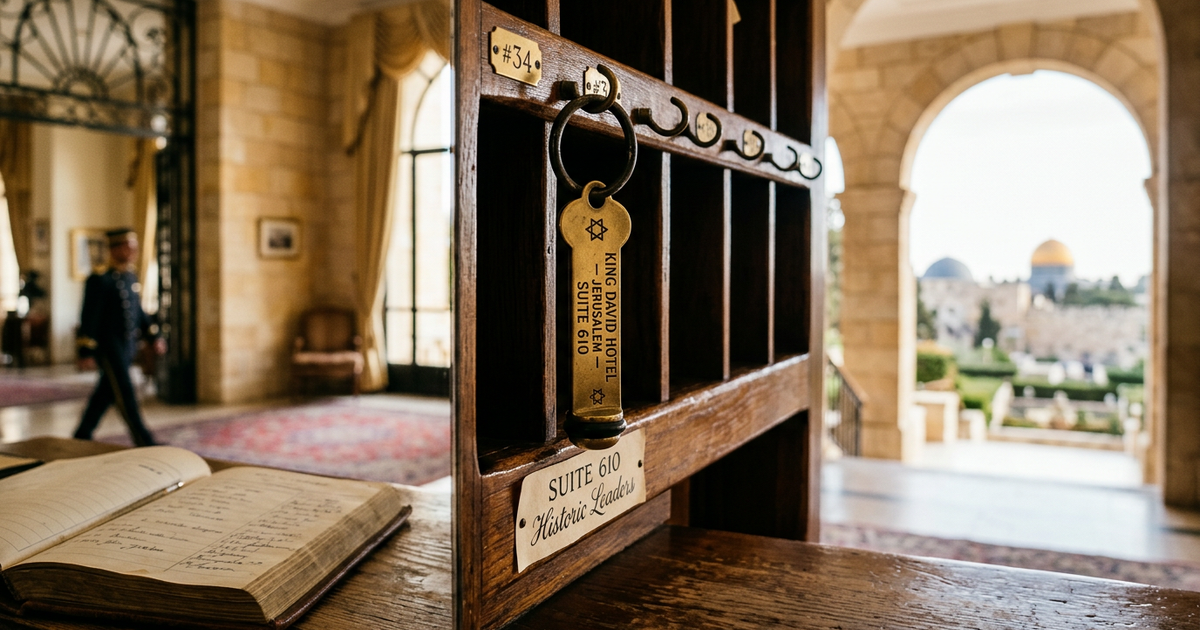
The King David sits on a ridge in West Jerusalem above the Hinnom Valley, facing the Old City walls directly across to the east. The setting is one of the most strategic hotel sites in the world: the property has a sight line to David's Tower, the Damascus Gate, the Mount of Olives, and the Temple Mount.
The building is constructed in Mizzi pink limestone, the warm-toned local Jerusalem stone that has anchored the city's aesthetic since the British Mandate-era municipal regulation requiring its use on all city construction. The architecture is a deliberate fusion: Phoenician and Hittite motifs in the columns and capitals, Assyrian patterns in the lobby tilework, Roman and Greek elements in the ceiling work. Much of the original detailing survives.
What Happened at the King David During the Mandate Years?
From its opening in 1931 through 1948, the King David was the social and operational center of British Mandate Palestine. The British military headquarters and the Mandate administration occupied parts of the south wing. The hotel was, in practice, both a luxury hotel and a working government building.
On July 22, 1946, the Irgun, the Jewish paramilitary organization commanded by Menachem Begin, bombed the south wing of the King David in an attack targeting the British administrative offices. Ninety-one people were killed. The attack is one of the most consequential events of the late-Mandate period and remains historically contested. The south wing was rebuilt, and the hotel resumed operation.
The King David survived 1948, the partition of Jerusalem, and the redrawing of the city's frontiers. It found itself, after the war, in West Jerusalem, separated from the Old City by an armistice line that ran roughly along the Hinnom Valley directly below the property.
How Did the Federmann Family Acquire the King David?
In 1958, the Federmann family, through Dan Hotels Corporation, acquired the King David. The acquisition put the hotel under continuous Israeli ownership for the first time and integrated it into what became Israel's largest domestic hotel group.
The Federmann family, anchored historically by Yekutiel Federmann, today by Michael Federmann, built Dan Hotels into one of the two dominant Israeli hospitality groups (alongside the Fattal organization). Dan operates the Dan Tel Aviv, the Dan Carmel Haifa, the Dan Caesarea, the King David, and multiple other properties. The King David has remained the corporate and symbolic flagship throughout.
Dan Hotels is publicly listed on the Tel Aviv Stock Exchange (DANH). Federmann family interests remain the controlling shareholder.
Why Is the King David Israel's Diplomatic Hotel?
The King David is the default Jerusalem hotel for visiting heads of state. Every US president from Eisenhower forward has stayed at the property or held meetings there. Every Israeli prime minister has used the hotel for diplomatic functions. Anwar Sadat stayed at the King David during his 1977 visit to Jerusalem, the visit that opened the Israel-Egypt peace process. Jimmy Carter shuttled between the King David and the David Citadel during the diplomatic period that produced the 1978 Camp David Accords.
The presidential suite, the security infrastructure, and the operational template for hosting senior international principals at the King David were the prototype that other Jerusalem hotels, the David Citadel, the Mamilla, the Waldorf Astoria, eventually built around.
For Israeli hospitality, the King David is not a competitive position in the market. It is the institutional anchor that other Jerusalem luxury hotels are positioned relative to.
How Does the King David Operate Today?
The property runs at the top of the Jerusalem ADR tier, alongside the Mamilla, the David Citadel, and the Waldorf Astoria. Its room count (~233) is larger than the boutique tier and smaller than the modern five-star convention-anchor properties.
The guest mix is heavy on diplomatic visitors, senior US Jewish institutional travel, Christian Zionist leadership, foreign press during major Israeli political events, and the upper end of the religious-diaspora cohort. The kosher operation is among the most established in Israeli hospitality: the kitchen has been kosher since acquisition by Dan in 1958.
How Did October 7 Affect the King David?
The post-October 7 disruption hit the Jerusalem trophy hotels harder than any other segment of the Israeli hotel sector. International leisure inbound, Christian pilgrimage, and senior delegation traffic all collapsed simultaneously. The King David, the Mamilla, the David Citadel, and the Waldorf Astoria all reported sharp occupancy declines through 2024.
Through 2025 and into 2026, the diplomatic and senior-delegation traffic has rebuilt first. American delegations are returning. Christian pilgrimage is recovering at a slower pace. The King David's structural advantage, its diplomatic positioning, is making the property among the first Jerusalem luxury hotels back toward design occupancy.
WHY IT MATTERS
- The only Israeli hotel that is also a national institution, operating continuously since 1931
- The default Jerusalem stay for every visiting head of state since 1948
- The 1946 bombing is one of the most historically consequential events in the late-Mandate period
- Dan Hotels' corporate and symbolic flagship, controlled by the Federmann family since 1958
- The diplomatic positioning that other Jerusalem luxury hotels were eventually built around
What's the Outlook for the King David?
The King David is not a property that operates on growth strategy. Its room count, its setting, and its operational model are structurally fixed. What changes, decade to decade, is its position inside the broader Jerusalem luxury market.
That market has expanded considerably since 2009: Mamilla, the David Citadel (under Alrov since 1998), Waldorf Astoria Jerusalem (2014), and the Orient (Isrotel). The King David is no longer the only top-tier Jerusalem property. What it remains is the only one with a ninety-year diplomatic and historical record. That position cannot be replicated by any new entrant.
For Dan Hotels, the property is a continuous brand asset, a national symbol, and the corporate flagship. For Israel, it is one of the few hotels in the world whose name is inseparable from the country's political history.
The King David: FAQ
When did the King David Hotel open?
The King David opened in 1931, designed by the Swiss architect Emil Vogt and originally developed by the Egyptian Jewish banker Ezra Mosseri. It has operated continuously for more than ninety years.
Who owns the King David Hotel?
The King David is owned and operated by Dan Hotels Corporation, controlled by the Federmann family. Dan Hotels acquired the property in 1958 and has held it as the group's corporate and symbolic flagship since. Dan Hotels is publicly listed on the Tel Aviv Stock Exchange under DANH.
How many rooms does the King David have?
Approximately 233 rooms. The room count is larger than the modern Israeli boutique tier and smaller than the convention-anchor five-star properties.
What happened at the King David in 1946?
On July 22, 1946, the Irgun, the Jewish paramilitary organization commanded by Menachem Begin, bombed the south wing of the King David, which was at the time housing the British Mandate administrative offices and the British military headquarters. Ninety-one people were killed. The attack is one of the most consequential events of the late-Mandate period and remains historically contested. The south wing was rebuilt and the hotel resumed operation.
Which heads of state have stayed at the King David?
Every Israeli prime minister has used the property for diplomatic functions. Every US president since Eisenhower has stayed at the King David or held meetings there. Anwar Sadat stayed during his 1977 visit to Jerusalem, the visit that opened the Israel-Egypt peace process. Jimmy Carter used the property during the diplomatic period that produced the 1978 Camp David Accords.
Where is the King David located?
The King David sits on a ridge in West Jerusalem above the Hinnom Valley, facing the Old City walls directly across to the east. The setting gives the property direct sight lines to David's Tower, the Damascus Gate, the Mount of Olives, and the Temple Mount.
What is the relationship between the King David and Dan Hotels?
Dan Hotels acquired the King David in 1958 and the property has been the group's corporate flagship ever since. Dan Hotels is one of the two dominant Israeli hospitality groups (alongside the Fattal organization). The Federmann family controls Dan Hotels.
How has the King David performed since October 7?
The Jerusalem trophy hotels were hit harder than any other segment of the Israeli hotel sector through 2024 as international leisure, Christian pilgrimage, and senior delegation traffic collapsed simultaneously. The diplomatic and senior-delegation traffic has rebuilt first through 2025 and 2026. The King David's structural diplomatic positioning is making it among the first Jerusalem luxury hotels back toward design occupancy.
Is the King David kosher?
Yes. The King David has operated under kosher certification since Dan Hotels' acquisition in 1958. The kitchen is among the most established kosher operations in Israeli luxury hospitality.
↗ Index: this is the King David Hotel profile in the Israeli Hotels cluster, the Olam guide to the Israeli hotel sector. Companion properties: Mamilla and David Citadel (Alrov) · Waldorf Astoria Jerusalem · Six Senses Shaharut · Pereh Mountain Resort. Capstone: Who Owns the Israeli Hotel Sector. Sector guide: Israeli Luxury 2026.