
Pereh Hotel — officially Pereh Mountain Resort — is the forty-key adults-only design property above the Hula Valley that proved Aman-tier pricing works in Israel. Built on a former IDF observation post. $1,500-plus a night. Among the hardest rooms in Israel to book.
Part of: Israeli Hotels · Who Owns the Israeli Hotel Sector · The Galilee Hospitality Belt · Israeli Luxury 2026
Forty keys on a former IDF observation post above the Hula Valley. Adults-only. $1,500-plus a night. The Israeli design hotel that proved Aman-tier pricing works in the Galilee.
Pereh Hotel — officially Pereh Mountain Resort — is the property that rewrote the upper end of Israeli regional hospitality.
Built on the site of a former Israel Defense Forces observation post on a hilltop above the Upper Galilee. Opened in 2021. Roughly forty keys, adults-only, design-forward in a way the older Galilee country-house tradition was not. Among the hardest hotel rooms in Israel to book. Nightly rates at Pereh Hotel start above $1,500 and run substantially higher in peak season.
Pereh Hotel is not the most expensive property in Israel. Six Senses Shaharut commands higher peak rates. The Mamilla and the David Citadel in Jerusalem — both under Alfred Akirov's Alrov Group — command higher ADR in the capital. What Pereh proved is something different: that an independent Israeli operator could build an internationally competitive design hotel in a remote Galilee setting and command Aman-tier pricing without an international brand contract.
PEREH HOTEL — BY THE NUMBERS
Also known as: Pereh Mountain Resort · Pereh Hotel (פרא)
Opened: 2021
Location: hilltop above the Hula Valley, Upper Galilee
Keys: ~40 · adults-only
ADR: $1,500+ per night, peak rates substantially higher
Positioning: independent Israeli design hotel · no international brand contract
Site history: former IDF observation post · purchased and redeveloped by the Pereh ownership group
Closest international comp: Aman · Singita · the smaller Belmond country houses
Closest Israeli comp: Six Senses Shaharut (Negev)
Pereh Hotel at a Glance
The short version for anyone searching for Pereh Hotel and trying to place it:
- What it is: a forty-key adults-only luxury design hotel in the Upper Galilee, run independently by an Israeli ownership group.
- Where it is: on a hilltop above the Hula Valley, sight lines running to the Lebanese border and the Golan Heights.
- Why it's famous: the first Israeli-owned, Israeli-operated hotel to command Aman-tier nightly rates — $1,500+ ADR — without an international brand contract.
- Who stays there: almost entirely Israeli UHNW domestic demand — tech-exit founders, family-office principals, senior professionals — plus a smaller layer of international guests.
- How hard it is to book: among the hardest hotel rooms in Israel. The waiting list runs months out.
Where Is Pereh Hotel Located?
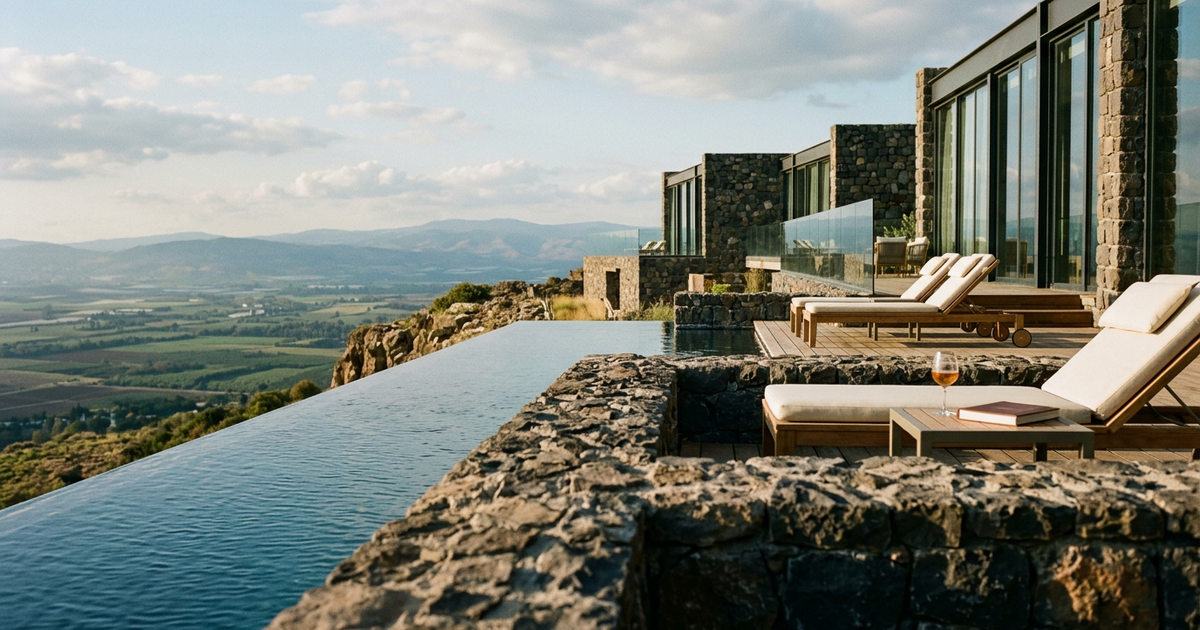
The property sits on a hilltop above the Hula Valley, with views across the Upper Galilee landscape to the Lebanese border and the Golan Heights. The location was originally an IDF observation position — purpose-built for sight lines, structurally minimal, and strategically positioned at one of the highest points in the area.
The Pereh ownership group acquired the site and redeveloped it as a forty-key adults-only hotel. The architectural approach was deliberately spare: low buildings, dark materials, minimal disturbance to the existing topography. The site's military history is not concealed; it is part of the property's design vocabulary.
For a guest, the sight-line advantage of the original IDF position translates directly into hospitality value. Pereh Hotel has the kind of view that hotels in Tuscany, Provence, and the Cape of Good Hope command premium rates for. In Israel, until Pereh opened, no one had built at that level on that kind of view.
Why Did Pereh Hotel Succeed When It Opened?
Pereh Hotel operates at the intersection of three Israeli market shifts that all crystallized around 2020–2021.
One — the Israeli UHNW base reached the scale to fill the property. The country's tech-exit cohort, the family-office layer, and the senior professional class collectively produced enough Israeli domestic demand for a forty-key Aman-tier property to operate near occupancy on Israeli weekend traffic alone.
Two — the Galilee was structurally undersupplied at the top of the market. The older country-house tradition — Mizpe Hayamim, Pastoral Kfar Blum, Vered HaGalil — operated at the $400–700 ADR tier. Above that, there was nothing.
Three — the international travel shock of 2020 created a window. Wealthy Israelis who could not fly internationally needed somewhere in Israel that operated at the standard they were used to abroad. Pereh Hotel opened into that window and never let go of the demand it captured.
What Did Pereh Hotel Prove?
Three structural points that mattered for the rest of the Israeli hospitality sector.
First: Aman-tier pricing works in Israel. Pereh Hotel runs at $1,500+ ADR with high occupancy on domestic demand. That is a meaningful data point for any international operator evaluating the country. Six Senses Shaharut validated the same thesis at international-brand scale a few months later in the Negev.
Second: an independent Israeli operator can run at international design-hotel standards. Pereh does not have an international brand contract. The design, operations, food program, and service standard are run by an Israeli team. That model — Israeli ownership, Israeli operations, international design language, international price point — is now a template.
Third: remote Galilee geography is a premium asset, not a discount. Pereh's hilltop is not a compromise location. It is the property's defining feature. The implication: there are dozens of equivalent Galilee, Golan, and Negev sites with the same architectural potential that nobody has built on yet. See The Galilee Hospitality Belt for the full map.
How Does Pereh Hotel Compare to Other Israeli Luxury Properties?
Where Pereh Hotel sits in the Israeli luxury-hotel landscape:
- vs Six Senses Shaharut: Six Senses is the international-brand version of the same thesis — sixty Negev villas under IHG's Six Senses flag, Israeli-owned, international-operator. Pereh is the independent Israeli-operator version — forty Galilee keys, no international brand, similar pricing tier. Both opened in 2021. Both proved Israel could hold ultra-luxury rates.
- vs the Mamilla and the David Citadel: Alfred Akirov's Alrov Group runs the two highest-ADR hotels in Jerusalem. Different category — urban capital properties on prime historical real estate, not remote design-country. Higher Jerusalem ADR, different guest base.
- vs the older Galilee country-house tradition: Mizpe Hayamim, Pastoral Kfar Blum, Vered HaGalil. All operate at the $400–700 ADR tier. Pereh sits two full price categories above them.
- vs international comps: Aman, Singita, the smaller Belmond country houses. That is the shelf. Pereh Hotel was the first Israeli property to earn a place on it.
The broader landscape is mapped in Who Owns the Israeli Hotel Sector.
How Do You Book Pereh Hotel?
Booking Pereh is not a same-week decision. The waiting list runs months out and peak Israeli holiday weekends — Rosh Hashanah, Sukkot, Pesach — are effectively sold out on a rolling basis. The practical rules:
- Book direct. The property is independent. There is no international brand loyalty program running in the background — no Marriott Bonvoy points, no Hyatt Globalist upgrades, no Aman Circle status. Direct booking through Pereh's own reservation channel is the workflow.
- Plan months ahead. Weekend inventory clears out first. Weekday inventory is easier but still tight.
- Adults-only. No children. This is not a family compromise property.
- Assume rate discipline. Pereh does not run OTA promotions or aggressive off-peak discounting. The pricing model is built on scarcity, not turnover.
How Did October 7 Affect Pereh Hotel?
Pereh Hotel sits in the Upper Galilee, close to areas under rocket fire from southern Lebanon through much of 2024. The northern security situation was a real operating constraint.
The property's demand profile, however, was structurally protected: adults-only, design-led, anchored on Israeli UHNW domestic weekend traffic. The guest base that fills Pereh did not stop traveling inside Israel after October 7. Many of them traveled more inside Israel, not less, given international airline disruption and the patriotic-anchoring effect on Israeli UHNW spending patterns.
By 2025 and into 2026, Pereh has been one of the most consistently booked properties in the Israeli hotel sector. The waiting list runs months out.
WHY IT MATTERS
- Proved $1,500+ ADR works in Israel — at independent-operator scale, without an international brand contract
- Established the Galilee as a credible ultra-luxury hospitality geography for the first time
- Created the operating template: Israeli ownership, Israeli operations, international design language, international price point
- Held up structurally through October 7 — the demand base was deep enough not to require international inbound
- Set the reference point for the next generation of Israeli destination-luxury properties
What Comes Next for Pereh Hotel?
The ownership group has not announced expansion plans. A second Pereh property — a sister site in the Golan, a Negev companion, or a Mediterranean-coast position — would be the natural extension.
The strategic question is not whether Pereh Hotel expands. The strategic question is what the next generation of Israeli design hotels does with the template Pereh built. Multiple operators are now evaluating Galilee, Golan, and Negev sites at the same price point and architectural level. The Galilee specifically has dozens of plausible Pereh-equivalent sites — hilltops, agricultural settings, abandoned military positions, kibbutz periphery land — that nobody has built on yet at this standard.
The Israeli hospitality sector now has, for the first time, a domestic reference for what world-class design-led country hospitality looks like at international price points. Every Israeli operator building above the $500 ADR line is in part responding to Pereh.
Pereh Hotel — FAQ
What is Pereh Hotel?
Pereh Hotel — officially Pereh Mountain Resort — is a forty-key adults-only design hotel on a hilltop above the Hula Valley in the Upper Galilee. Built on the site of a former Israel Defense Forces observation post. Opened in 2021. Nightly rates start above $1,500. The first independent Israeli operator to command Aman-tier pricing.
Is Pereh Hotel the same as Pereh Mountain Resort?
Yes. The formal name is Pereh Mountain Resort. It is commonly referred to as Pereh Hotel, or simply Pereh. All three refer to the same forty-key Upper Galilee property.
Where is Pereh Hotel located?
The property sits on a hilltop above the Hula Valley in the Upper Galilee, with views across to the Lebanese border and the Golan Heights. The site was originally an Israeli military observation position.
How much does Pereh Hotel cost per night?
Nightly rates at Pereh Hotel start above $1,500 and run substantially higher in peak season. The pricing is comparable to Aman properties internationally — the same shelf as ultra-luxury country resorts in Tuscany, Provence, and the smaller Belmond European houses.
How many rooms does Pereh Hotel have?
Roughly forty keys, all of them part of an adults-only configuration. The intentionally small key count is part of the operating model — high-touch service, exclusive setting, deliberate scarcity.
Is Pereh Hotel adults-only?
Yes. Pereh is an adults-only property. No children. That configuration is core to the guest profile — the design-hotel Israeli UHNW weekend audience the property is built around.
Is Pereh Hotel part of an international hotel brand?
No. Pereh is operated independently by its Israeli ownership group. There is no Aman, Six Senses, or international brand contract on the property. That independence is one of the things that makes Pereh Hotel strategically interesting — it proved an Israeli operator could command international ultra-luxury pricing without a global brand affiliation.
How do you book Pereh Hotel?
Direct booking through the property's own reservation channel. Pereh is not distributed through international loyalty programs and does not rely on OTA promotion. The waiting list runs months out; peak Israeli holiday weekends are effectively sold out on a rolling basis.
How does Pereh Hotel compare to Six Senses Shaharut?
Both opened in 2021. Both established Israel as a credible ultra-luxury hospitality destination. Six Senses Shaharut is the first international brand contract at the ultra-luxury tier in Israel — sixty villas in the Negev, owned by Israeli investors, operated under IHG's Six Senses brand. Pereh is the independent Israeli operator version — forty keys in the Galilee, no international brand, similar pricing tier.
How did Pereh Hotel perform after October 7, 2023?
The property held up structurally through the post-October 7 disruption. The adults-only, design-led Israeli UHNW domestic demand base that anchors Pereh did not stop traveling inside Israel — and in many cases traveled more inside Israel than before, given international airline disruption and the broader patriotic-anchoring effect on Israeli high-end spending. The waiting list now runs months out.
What is the history of the Pereh Hotel site?
The hilltop was originally an Israel Defense Forces observation position, purpose-built for sight lines across the Hula Valley toward the Lebanese border and the Golan Heights. The Pereh ownership group acquired the site after it was decommissioned and redeveloped it as a hotel. The military history is part of the property's design vocabulary, not concealed.
Why does Pereh Hotel matter strategically for Israeli hospitality?
Pereh established three things at once: that Aman-tier pricing is viable in Israel; that an independent Israeli operator can run at international design-hotel standards without an international brand contract; and that remote Galilee geography is a premium asset rather than a discount. Every Israeli operator building above the $500 ADR line is in part responding to Pereh.
↗ Index: this is the Pereh Mountain Resort profile in the Israeli Hotels cluster — the Olam guide to the Israeli hotel sector. Companion properties: Six Senses Shaharut · The Galilee Hospitality Belt · Alrov: Mamilla and David Citadel. Capstone: Who Owns the Israeli Hotel Sector. Sector guide: Israeli Luxury 2026.