
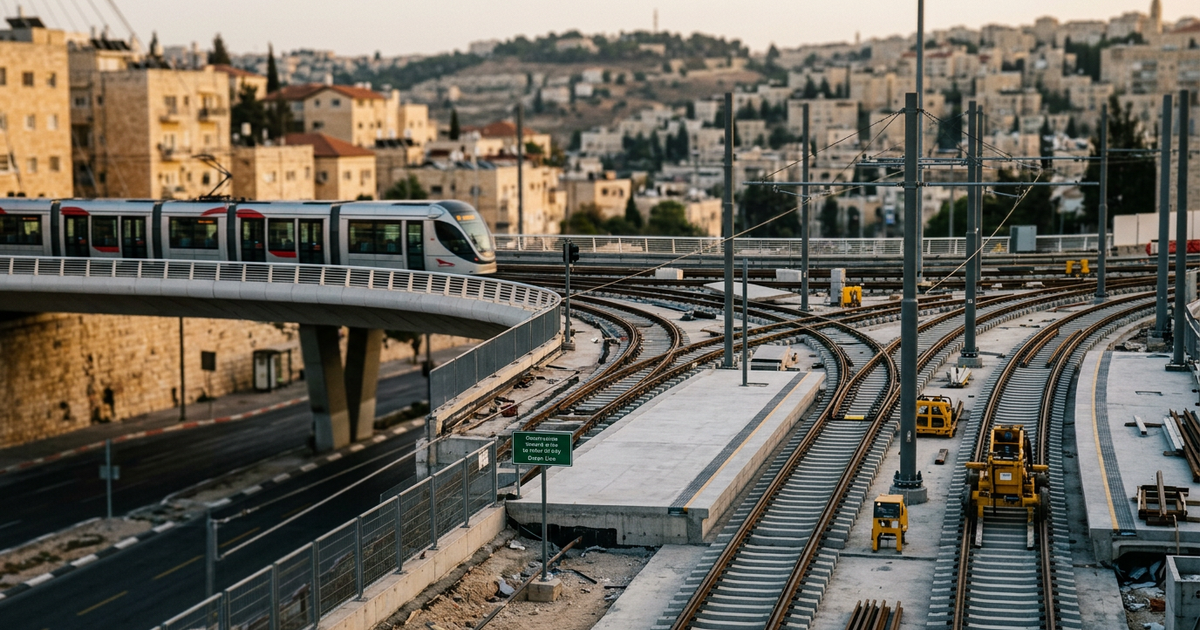

The Jerusalem Light Rail Q1 2026: Red Line operational, Green Line and Blue Line under construction. Multi-line metropolitan transit toward a full network by the late 2020s, alongside the Tel Aviv Metro and the broader Israeli civil infrastructure cycle.
The Jerusalem Light Rail (JLR) entered Q1 2026 with active construction across the Green Line and Blue Line expansion phases, extending the original Red Line operational service and positioning the Jerusalem metropolitan transit architecture toward a full multi-line operational network by the late 2020s. The program sits inside the broader Israeli civil infrastructure capital cycle alongside the Tel Aviv Metro, the Ben Gurion Airport expansion, and the broader transportation-infrastructure capital architecture.
The Red Line operational base
The Jerusalem Light Rail Red Line operated as the original Jerusalem light-rail line, providing service across the Jerusalem metropolitan area from the southern Pisgat Ze'ev neighborhood through central Jerusalem, the Jerusalem Central Bus Station, the Jaffa Road corridor, and onward to Mount Herzl. The Red Line entered service in 2011 after multi-year construction and has operated continuously since, with documented passenger volume in the multi-tens-of-millions of annual ridership range.
Per Jerusalem Transit Master Plan reporting, the Red Line operates as the institutional anchor of the broader Jerusalem light-rail network, providing both the operational service base and the institutional precedent for subsequent line expansion.
The Green Line expansion
The Green Line represents the second principal Jerusalem light-rail line, extending service across a south-to-north corridor through Gilo, Pat, the Jerusalem Talpiot industrial zone, the German Colony, the central Jerusalem business district, and onward to the Hebrew University Mount Scopus campus and the northern Jerusalem neighborhoods. The Green Line is under active construction across multiple phases through the late 2020s.
Per Israeli Ministry of Transport and Road Safety disclosures, the Green Line operational entry-into-service timeline has shifted multiple times across the construction program, reflecting documented procurement, engineering, and ground-access challenges. The line is positioned to materially expand Jerusalem metropolitan transit capacity once operational.
The Blue Line expansion
The Blue Line represents the third principal Jerusalem light-rail line, extending service across an east-to-west corridor connecting the eastern Jerusalem neighborhoods, the central Jerusalem business district, and the western Jerusalem neighborhoods. The Blue Line is under construction across documented multiple phases with a service entry timeline extending into the late 2020s.
The Blue Line's institutional significance extends beyond capacity expansion. The east-west corridor structurally integrates Jerusalem neighborhoods that historically operated outside the Red Line and Green Line north-south corridors, materially expanding the geographic reach of the Jerusalem light-rail network.
The institutional context
The Jerusalem Light Rail program sits inside the broader Israeli civil infrastructure capital cycle. The Tel Aviv Metro program — covered in Inside the Tel Aviv Metro — represents the largest civil capital program in Israeli history, with documented multi-decade construction across the Red Line (operational since 2023), the Purple Line and Green Line under construction, and the planned Metro lines extending through the 2030s and 2040s. The Jerusalem Light Rail program operates at meaningfully smaller absolute capital scale but with materially comparable institutional architecture.
Per the broader Israeli civil-infrastructure capital cycle, the combined investment across Jerusalem Light Rail, Tel Aviv Metro, Ben Gurion Airport expansion, inter-city rail, and the broader transportation-infrastructure capital program represents one of the most structurally significant Israeli civil-infrastructure cycles of the modern era.
The structural read
The Jerusalem Light Rail Q1 2026 reflects a Jerusalem metropolitan transit infrastructure program executing multi-line capital expansion against documented institutional capacity constraints. The Green Line and Blue Line construction phases, combined with the operational Red Line base, position the Jerusalem light-rail network toward a full multi-line operational architecture by the late 2020s.
The next institutional questions: whether the Green Line and Blue Line entry-into-service timelines hold through the remainder of the construction program; how the integration with the broader Jerusalem metropolitan transportation architecture (the Jerusalem-Tel Aviv high-speed rail, the Jerusalem bus network, the airport rail link) develops; and whether additional Jerusalem light-rail lines enter the institutional architecture beyond the Red, Green, and Blue lines.
Source data: Jerusalem Transportation Master Plan documentation; Israeli Ministry of Transport and Road Safety institutional disclosures; coverage in Globes, Calcalist, TheMarker, Bloomberg, Reuters; CityPass and subsequent operator institutional disclosures. Related coverage: Inside the Tel Aviv Metro: The Largest Civil Capital Program in Israeli History; NTA: The Tel Aviv Metropolitan Mass Transit Implementation Authority. Data current as of Q1 2026.