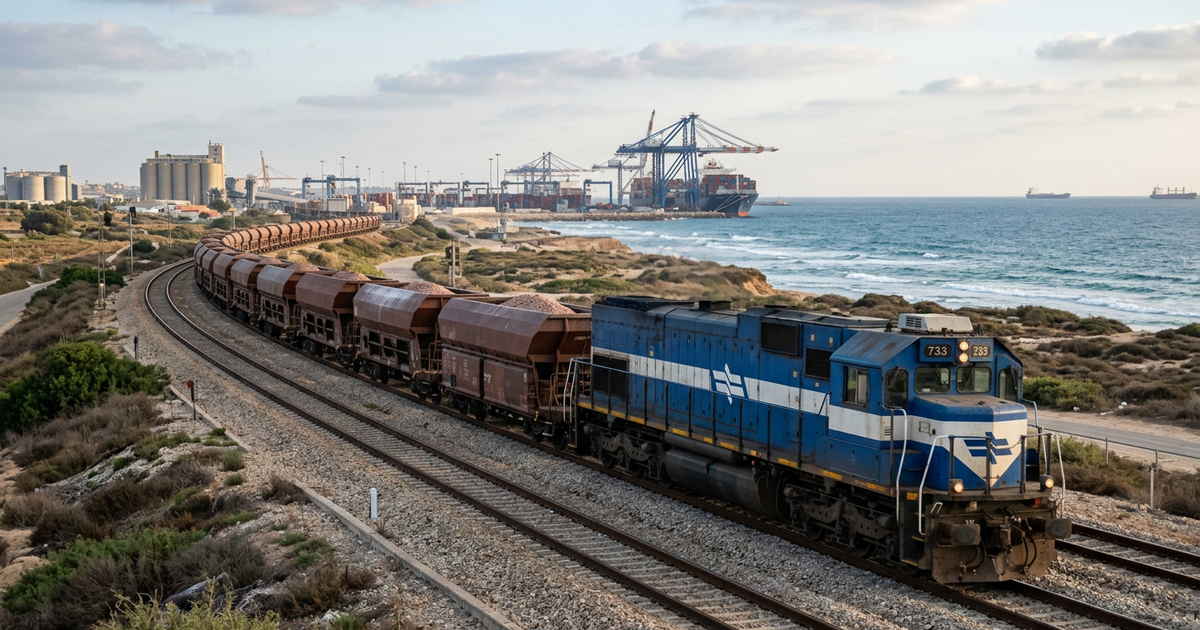

Israel Railways operates the national freight network connecting Haifa and Ashdod to inland destinations. The ICL corridor moves Dead Sea-derived potash and bromine to Ashdod. Rail share remains below European norms.
By The Olam Editorial Team
Part of Israel's Ports and Logistics: The Complete Map, the cluster hub for Ports & Logistics.
TL;DR
Israel Railways operates the national rail freight network connecting Haifa and Ashdod to inland destinations. Freight services have expanded over the past decade but rail's share of total container and bulk movement remains below European norms. Dedicated freight corridors serve Israel Chemicals operations in the Negev, the central distribution belt, and the northern industrial cluster. Closing the rail-share gap is widely understood as a structural priority but has progressed incrementally rather than transformationally.
Key Facts
- Israel Railways (Rakevet Israel) operates the national rail network including freight services.
- Freight serves Haifa, Ashdod, Israel Chemicals (Negev), central distribution corridor, and northern industrial belt.
- Rail share of total cargo movement remains below European norms as of 2026.
- Rail freight corridor connects the Dead Sea / ICL operations to Ashdod for export.
- Investment in electrification and freight-corridor expansion continues but has not closed the share gap.
- Closing the rail-share gap is a recognized structural priority.
What Israel Railways Carries
Israel Railways operates the national rail network for both passenger and freight services. On the freight side, the network serves three primary flows: container and general cargo from Haifa and Ashdod to inland destinations; bulk and chemical flows from Israel Chemicals' Dead Sea operations to Ashdod for export; and specialty industrial flows including military and infrastructure cargo.
The rail freight network is integrated with both Mediterranean ports through dedicated rail sidings and intermodal handling facilities. Container trains move between port yards and inland terminals, though rail's share of container movement remains a minority position relative to road trucking.
The ICL Corridor
The most established rail-freight corridor in Israel connects Israel Chemicals' operations in the Negev — including the Dead Sea Works and Rotem operations — to the Port of Ashdod. Potash, bromine, magnesium, and other Dead Sea-derived products move by rail to Ashdod for export. The corridor handles substantial bulk volumes and has been progressively upgraded.
ICL is among the largest single users of Israeli rail freight services, and the company's operations have shaped the freight corridor's development trajectory.
Container Rail Services
Container rail services connect Haifa and Ashdod to inland container yards, including facilities in the central corridor. The intent is to shift container movement from road to rail, reducing highway congestion and lowering per-TEU transport costs. Adoption has been slower than planners hoped.
Reasons include the relatively short distances within Israel (which favor trucking over rail for many flows), the limited number of inland container terminals capable of handling significant volumes, and the integration challenges of synchronizing rail and port operations. Progress has been real but incremental.
Investment and Expansion
Investment in rail electrification, freight corridor expansion, and intermodal facilities has been continuous. The Israeli government and Israel Railways have signaled commitment to closing the rail-share gap, and capital expenditure has supported that direction.
Specific initiatives include expanded freight services to the Negev, modernized container handling at port-rail interfaces, and integration of rail scheduling with port appointment systems. Each delivers incremental gains; collectively they have not produced the European-level rail share that would represent a transformational outcome.
Why Rail Share Matters
Rail freight share matters for three reasons. First, road congestion: every TEU that moves by rail relieves pressure on Route 4 and the broader highway network. Second, cost: rail freight is structurally cheaper per ton-kilometer over the distances and volumes that matter. Third, sustainability: rail produces materially lower emissions per ton-kilometer than road trucking, and European import markets are increasingly pricing emissions into supply chain decisions.
Closing the rail-share gap addresses all three considerations simultaneously, which is why the priority is widely recognized even though progress has been gradual.
Bottom Line
Israeli rail freight is functional, integrated with both Mediterranean ports, and progressively expanding — but it remains a smaller share of the total cargo movement than the European peer baseline. Closing that gap is the most concrete inland investment priority for the next phase of trade infrastructure development.
Related on The Olam
- Israel's Ports and Logistics: The Complete Map
- Israel's Logistics Bottlenecks
- SIPG Ashdod — The Chinese Port Presence No One Talks About
- The Infrastructure Behind Israeli Trade
- Inside Israel's Freight and Container Economy
- The Future of Warehousing and Distribution in Israel
How we report: Olam stories draw on public filings, company disclosures and named sources, checked by our editors. Read our methodology · Corrections