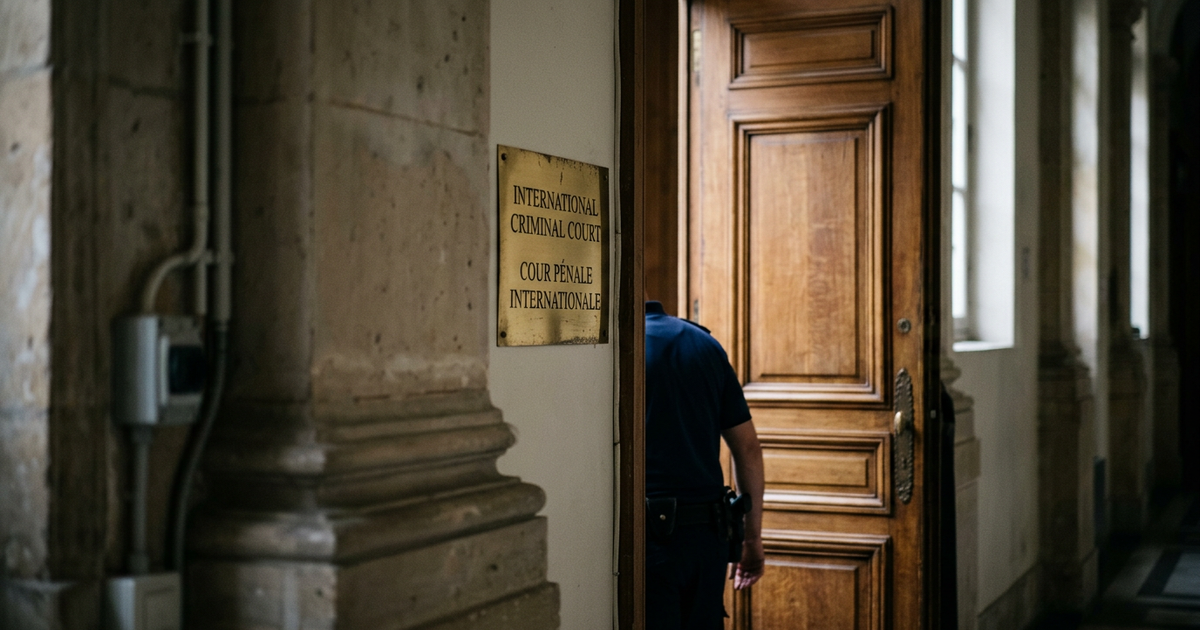

A court of last resort, properly understood, exists to constrain impunity. A court that selects its targets according to the geometry of political acceptability has become something else. It has become a participant in the conflict.
By Nitsana Darshan-Leitner
In August 2025, Shurat HaDin filed a civil lawsuit in an Israeli court against Karim Khan, then the prosecutor of the International Criminal Court. We sued him personally. We sued him on behalf of the families of three hostages held by Hamas in Gaza — Avinatan Or, Eitan Mor, and Omri Miran. We alleged that the prosecutor of the ICC had impeded the release of those hostages, provided diplomatic cover for Hamas, and acted in bad faith against Israel.
A serving ICC prosecutor had never before been named personally in a civil action brought by victims of the conflict he was meant to adjudicate. Within months of the filing, Karim Khan was suspended from his role at the ICC, pending separate allegations of personal misconduct. Our case against him continues.
That case — and what followed — captures something larger about where the ICC now stands.
What Was the ICC Built to Be?
The International Criminal Court was established in 2002 under the Rome Statute. The institution was founded on a defensible premise. Certain crimes — genocide, crimes against humanity, war crimes — are so severe, and so frequently shielded by the political protection of their perpetrators, that the world requires a court of last resort to prosecute them when national systems will not. The premise was, and remains, sound. The institution built to deliver on it has not been.
From its earliest years, the ICC has demonstrated a structural pattern. The countries it prosecutes are overwhelmingly small, weak, or politically isolated. The countries with the worst documented records of mass atrocity in the twenty-first century — Russia, China, Iran, Syria, North Korea — are functionally immune. The court has neither the jurisdictional reach nor the political will to pursue them. It pursues, instead, those whom prosecution costs it nothing.
Israel, which is not a party to the Rome Statute and over which the ICC has no proper jurisdiction, has been an exception to that pattern of avoidance — and only in that direction.
When Was the Line Crossed With the Israel Arrest Warrants?
In November 2024, the ICC issued arrest warrants against the Prime Minister and the then-Defense Minister of Israel, alleging war crimes in the course of Israel's military response to the Hamas attack of October 7, 2023. The warrants did not address the responsibility of Hamas for the initiating atrocity in any equivalent way. They did not address the responsibility of Iran, which funded, armed, and directed Hamas. They did not address Hezbollah, the Houthis, or any of the proxy networks operating under Iranian command.
They addressed Israel.
The warrants were issued in the absence of jurisdiction. They were issued during an active armed conflict against an internationally designated terrorist organization. They were issued at a moment when the named Israeli officials were engaged in the negotiation for the return of more than one hundred Israeli hostages, most of them civilians, held in violation of the most basic norms of international humanitarian law.
A court of last resort, properly understood, exists to constrain impunity. A court that selects its targets according to the geometry of political acceptability has become something else. It has become a participant in the conflict.
Why Is This a Business Story, Not Just a Legal One?
I am writing in The Olam, which is a publication for the global Jewish business community. The ICC question is not separate from the work of that community. It sits at the center of it.
The ICC's arrest warrants are not symbolic. They create concrete exposure. An Israeli executive who lands at an airport in a Rome Statute signatory country can, in principle, be detained for transfer to The Hague. The list of signatory countries includes most of the European Union, the United Kingdom, Canada, Japan, Australia, Brazil, South Africa, and dozens of others. The risk surface is global, and it does not end at the named defendants in the warrants. The legal architecture that produced those warrants is the same architecture that will be turned, over the next decade, against the broader category of Israelis whom the institution can be persuaded to prosecute.
Israeli companies operating abroad face a parallel exposure. Their executives travel. Their board members travel. Their counsel travels. A serious general counsel of an Israeli firm now treats ICC jurisdictional risk as a compliance category. Five years ago, no general counsel did. That change is real, and it is permanent unless the ICC is reformed or constrained.
Diaspora donors face a third dimension of exposure. Funds raised in the United States, the United Kingdom, France, and other jurisdictions to support Israeli defense, Israeli civilian recovery, and the families of hostages have become the subject of legal complaints, NGO actions, and discovery requests that were unthinkable a decade ago. The architecture of accusation has been built. The institutions enabling that architecture, the ICC chief among them, will not dismantle themselves voluntarily.
What Does Lawfare Actually Accomplish?
I founded Shurat HaDin in 2003 on the conviction that civil litigation, used precisely, can do what diplomacy and military force cannot. Over the last two decades we have recovered more than two hundred million dollars in compensation for victims of terrorism. We have frozen Iranian assets. We have forced banks to acknowledge their role in moving terror finance. We have prevented hostile flotillas. We have litigated against Hamas, Hezbollah, the Palestinian Authority, and the financial networks that sustain them, in courts across the United States, Canada, Europe, and Israel.
That work has taught me a specific lesson. Institutions are not neutral. They reflect the political imagination of the people who staff them and the political pressures of the moment in which they operate. When an institution's political imagination shifts, its outputs shift with it. The institution does not need to be captured to become hostile. It only needs to be persuaded.
The ICC has been persuaded.
What Comes Next?
The Karim Khan suspension does not solve the problem. It exposes it. The institution that produced the Israel warrants is the same institution that produced a prosecutor now facing separate misconduct allegations. The structural failure runs deeper than any single official.
Three things are now required.
First, a coordinated legal response from Israel and from non-signatory states whose nationals are at risk under the warrants. The United States has taken initial steps under sanctions authority. More is needed.
Second, a coherent compliance posture from Israeli business. General counsel offices, family offices, foundations, and diaspora institutions should treat ICC exposure as a real and manageable category of risk. It can be modeled. It can be mitigated. It is no longer theoretical.
Third, a public reckoning. The institutions of international justice were built in the aftermath of the Holocaust. They were built to protect, among others, the Jewish people. An institution that today serves the opposite function should be named, contested, and reformed — not silently accepted.
I have spent twenty-three years suing terrorists in courts around the world. The institution that was built to do the same work has moved from adjudicating that conflict to participating in its political consequences.
That is not a slogan. It is a finding. And it is one of the most important things the global Jewish business community needs to understand about the legal architecture in which it now operates.
More From Nitsana Darshan-Leitner
- Nitsana Darshan-Leitner: The Attorney Who Made Terrorism Expensive: the definitive Olam profile of Darshan-Leitner and Shurat HaDin, from the Meir Dagan conversation that founded the organization through the bank litigation and the 2026 Rage Against the Hate conference.
- Israeli Defense Tech's Next War: how the same ICC-driven lawfare architecture threatens IPOs, M&A, and hiring across Israeli defense companies.
- Israeli Soldiers Now Need Legal Armor Abroad: how ICC-adjacent universal jurisdiction claims have moved from targeting Israeli leadership to targeting individual reservists traveling abroad.
Nitsana Darshan-Leitner is an Israeli attorney and the founder and president of Shurat HaDin – Israel Law Center, a Tel Aviv-based civil rights organization that uses civil litigation to pursue terrorist organizations and their financiers in courts around the world. She is the co-author, with Samuel Katz, of Harpoon: Inside the Covert War Against Terrorism's Money Masters. She is a graduate of Bar-Ilan University and the University of Manchester.