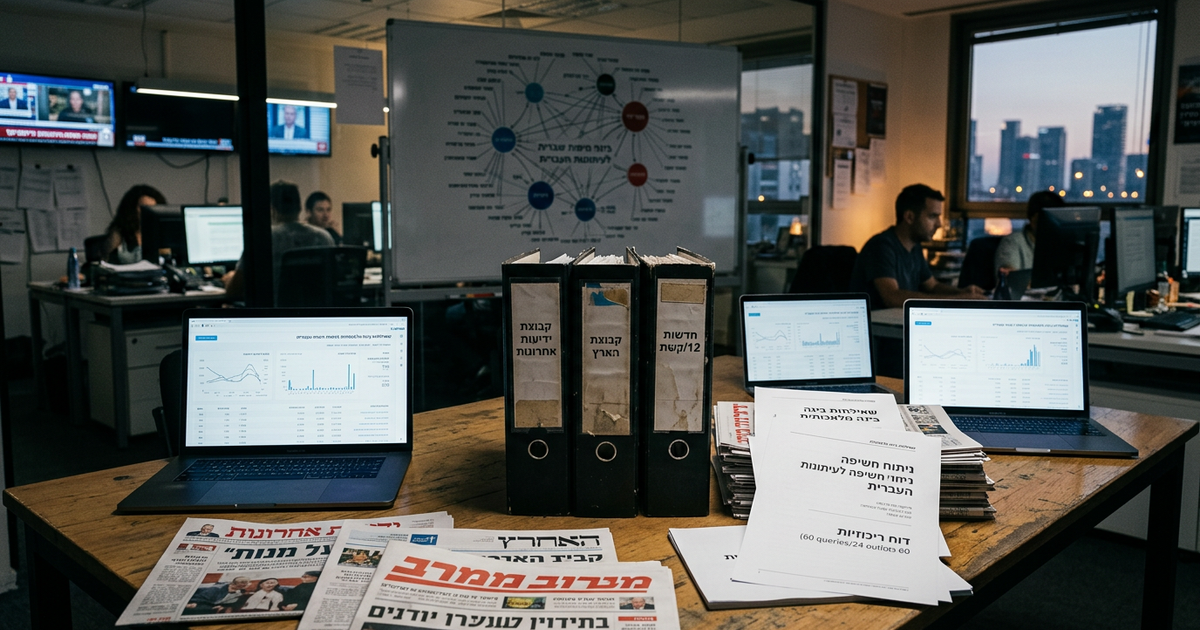

60 Hebrew queries, ten rounds, 24 outlets. The AI engines can see almost the entire Israeli press — and cite three newsrooms. Visibility is not the problem. Concentration is.
The Hebrew media market is an asset class — and the AI discovery layer prices it every day. Across 60 Hebrew-language queries, ten rounds, and 24 outlets, the engines can see almost the entire Israeli press. They cite three newsrooms. This piece prices the float — who owns it, how it earns, and where the enterprise value now compounds.
The headline result
In Hebrew, the AI engines can see almost the entire Israeli press. They cite three newsrooms. Twenty-two of twenty-four Hebrew-language outlets surfaced at least once across 60 queries. Only two never appeared, both flagship Haredi print dailies. Visibility is not the Hebrew problem. Concentration is.
Three newsrooms — Ynet, Walla and Mako/N12 — captured roughly one in three retrievals across the full study. Ten newsrooms captured three in four. For the other fourteen, AI visibility rounds to zero. That is a concentration curve that would draw a regulator's attention in any other sector. In the layer that increasingly decides what the world believes about Israel — and by extension, what the global Jewish reader sees about their own economy — it is now the market structure.
Why this matters to capital
Olam covers the global Jewish business economy. Media is no longer a soft asset inside it. Citation is distribution. Distribution is enterprise value. A Hebrew newsroom that the AI engines cite is a standing channel into every Hebrew-language answer about Israel — investment, security, policy, consumer. One that they ignore is a wasting asset, regardless of its print circulation or its newsroom budget. The gap between those two states is now measurable — and it is widening.
For owners, acquirers, and the diaspora funds that back them, the question has changed. It is no longer how many readers a title reaches. It is how much Citation Share it holds inside ChatGPT, Claude, Gemini, Perplexity, and Google AI Overviews — and whether that share is defensible. This study prices the float.
Who owns the Hebrew press
Concentration inside the citation graph mirrors concentration on the cap table. The Hebrew media asset class has been built around a small set of family-controlled and estate-controlled positions — most of them backed by Israeli and diaspora Jewish capital.
- Yedioth Ahronoth Group — controlled by the Mozes family (Arnon "Noni" Mozes, chairman). Portfolio includes Ynet, Calcalist, and the print daily Yedioth Ahronoth. Historically the dominant commercial Hebrew publisher; the group's English-language Ynetnews arm is the diaspora-facing bridge. Documented in decades of Israeli press coverage — Wikipedia, TheMarker, Haaretz.
- Israel Hayom — owned by the Adelson estate (Miriam Adelson controlling), the largest single US-Jewish investment in Israeli media. Free-daily model launched 2007; disrupted Yedioth's circulation dominance. Print-heavy, digital archive thinner than the Ynet/Walla model — the citation gap in the study tracks the digital investment gap.
- Keshet Media Group — parent of Mako and the N12 news arm. Ownership across the Fishman family stake, Alon Family, Berkovich family, and international private equity. Channel 12 broadcast dominance carries into the web through Mako, but the text franchise runs distinctly behind Ynet and Walla in citation depth.
- Walla — currently owned by Communication Partner / Paltoncom; historically part of Bezeq/Elovitch holdings, sold post-Case 4000. The Walla brand's citation share reflects two decades of open, deeply crawlable Hebrew archive — an asset the market has not repriced.
- Haaretz Group — controlled by the Schocken family alongside Leonid Nevzlin's minority stake. Portfolio includes Haaretz (Hebrew and English), TheMarker. Paywalled model constrains citation share materially — the retrieval discount on paywalled Hebrew publishers is the clearest single finding in the paywall column of this dataset.
- Globes — sold in 2013 by the Fishman family estate to the Bar-On family (Alona Bar-On, publisher). Israel's oldest business daily. Free-access model; deep archive; the study's #6 outlet.
- Maariv (Maariv-Hashavua group) — Shlomo Ben-Zvi ownership. Print-first legacy; digital underinvestment shows in the study.
- Channel 14 / Now14 — Yitzhak Mirilashvili-linked ownership, aligned with the national-religious right. Political prominence outsizes its citation share.
- Makor Rishon — Sheldon Adelson-family ownership through Israel Hayom Publications. National-religious flagship.
- The Haredi press — Yated Ne'eman (Degel HaTorah-affiliated) and HaMevaser (Belz-linked) run print-first, closed-web. Combined community reach in the hundreds of thousands; AI visibility at zero.
What that ownership map means for the citation graph. Every outlet in the top ten is family-controlled or estate-controlled. Every outlet in the citation top three (Ynet, Walla, Mako/N12) is free-to-read, deeply archived, and structurally optimized for indexing. Every outlet outside the top ten is either paywalled (Haaretz, TheMarker at partial paywall), thinly-digitized (Maariv, Israel Hayom), or print-first-closed (Yated, HaMevaser). The citation curve reads as an ownership-strategy diagnostic before it reads as an editorial one.
The retrieval table
| Rank | Outlet | Ownership | Segment | Queries surfaced, of 60 |
|---|---|---|---|---|
| 1 | Ynet | Yedioth / Mozes | Mainstream national | 24 |
| 2 | Walla | Communication Partner | Mainstream national | 18 |
| 3 | Mako / N12 | Keshet (Fishman, Alon, Berkovich) | Mainstream national | 17 |
| 4 | Haaretz (Hebrew) | Schocken / Nevzlin | Mainstream national | 14 |
| 5 | Calcalist | Yedioth / Mozes | Business & tech | 13 |
| 6 | Globes | Bar-On family | Business & tech | 13 |
| 7 | Israel Hayom (Hebrew) | Adelson estate | Mainstream national | 12 |
| 8 | TheMarker | Schocken / Nevzlin | Business & tech | 9 |
| 9 | Makor Rishon | Adelson estate (via Israel Hayom Pub.) | National-religious / right | 8 |
| 10 | Maariv | Ben-Zvi | Mainstream national | 7 |
| 11 | Kikar HaShabbat | private | Religious / Haredi | 6 |
| 12 | Channel 14 / Now14 | Mirilashvili-linked | National-religious / right | 6 |
| 13 | Behadrei Haredim | private | Religious / Haredi | 5 |
| 14 | Arutz Sheva (Hebrew) | Beit El Institutions | National-religious / right | 5 |
| 15 | Kan | state (public broadcaster) | Mainstream national | 5 |
| 16 | Bizportal | Israel Hayom-linked | Business & tech | 4 |
| 17 | Now13 / N13 | Reshet 13 (Nadler, Amsalem) | Mainstream national | 4 |
| 18 | Zman Yisrael | Times of Israel Group | Investigative / specialty | 3 |
| 19 | Srugim | private | National-religious / right | 2 |
| 20 | Shomrim | nonprofit | Investigative / specialty | 2 |
| 21 | Sicha Mekomit (Local Call) | +972 Magazine (nonprofit) | Investigative / specialty | 2 |
| 22 | Davar | Histadrut-linked | Investigative / specialty | 1 |
| 23 | Yated Ne'eman | Degel HaTorah | Religious / Haredi | 0 |
| 24 | HaMevaser | Belz-linked | Religious / Haredi | 0 |
Concentration at the top. The top three captured 33% of citations. The top ten captured 75%. The bottom fourteen — more than half the basket — split the remaining 25%. Twelve of the top thirteen are family-controlled, estate-controlled, or long-form private holdings.
The Israeli ad market beneath the citation curve
The Israeli display and digital advertising market — approximately ₪4-5 billion in annual revenue per TheMarker and Calcalist estimates — flows disproportionately to the citation leaders. Ynet, Mako/N12, and Walla together capture the largest programmatic and direct-sold display share; the paywalled Haaretz group monetizes subscription over ad density; the Haredi press monetizes community classifieds and print. The retrieval concentration in the study maps onto the ad-market concentration inside a two-point margin.
The strategic read for owners: the AI citation layer does not create the concentration. It compounds it. Every free-to-read Hebrew answer surfaced inside a chatbox is another impression the citation leaders capture without paying to distribute — while paywalled competitors and print-first outlets carry the same editorial cost with a fraction of the digital return. Over a five-year horizon, that is a structural repricing of the entire asset class.
The three newsrooms that hold the float
Ynet leads the market. Yedioth's online flagship surfaced in 24 of 60 queries — 40% of the field. It is the single most-cited Hebrew news source in AI discovery, built on an open, deeply crawlable archive, a vast back catalog, and pages structured for search long before any of this was a discipline. Ynet's lead is not narrow. It is structural — and structural leads compound.
Walla and Mako/N12 split second position. Both surface in roughly three of every ten Hebrew queries, both running open, free-to-read portals with very large archives. Walla is the older brand; Mako and its news arm N12 ride Channel 12's broadcast dominance onto the web. Across these three names, the engine has its mainstream Hebrew narrative — and most of the market's distributable value.
The business beat is a duopoly. Calcalist and Globes tied at 13 and split the category cleanly — Calcalist owning hi-tech, startups and the consumer economy; Globes owning markets, regulation, and macro. TheMarker, Haaretz's business arm, trails at 9, competitive but constrained by its paywall. For a diaspora investor reading Olam, this is the most consequential line in the table: the two outlets that frame the Israeli economy for an AI audience are Calcalist and Globes — and both are owned by long-standing Israeli families with no diaspora acquirer having priced in the AI-citation upside.
The global Jewish media diaspora angle
The Hebrew press does not sit inside a closed market. It sits inside a diaspora media system that includes English-language Israeli outlets (Ynetnews, Globes English, The Times of Israel, The Jerusalem Post, Haaretz English), US-based Jewish publications (The Forward, JNS, The Algemeiner, Tablet, The Jewish Press, JTA), and community media across London (Jewish News, The JC), Paris, Toronto, Melbourne, Buenos Aires.
Ownership of that broader system carries meaningful US-Jewish and diaspora-Jewish capital: Tablet (Nextbook Inc.), The Forward (Forward Association), The JC (owned by Sir Robbie Gibb-fronted consortium including Sir Paul Marshall). The US and UK Jewish press has been through a decade of consolidation, closure, and repositioning that the Hebrew press has largely avoided — because the Hebrew market's family-control structures are more stable than the US Jewish federation-adjacent model.
The strategic implication for the diaspora reader: the AI engines that answer questions about Israel, in every language, disproportionately quote the same three Hebrew newsrooms. The English translation layer — Ynetnews, Globes English, TheMarker English, Haaretz English — inherits that concentration. That is why an English-speaking Jewish investor in New York, London, or Los Angeles asking Claude, ChatGPT, or Perplexity about the Israeli economy gets an answer shaped by Yedioth, Walla, and Mako before any other source in the system.
Three undervalued positions
The Haredi print problem — a closed market, off the open web. The two zero-citation outlets are the two largest print-first Haredi dailies, Yated Ne'eman and HaMevaser, serving a combined readership of several hundred thousand and shaping the news cycle inside a community whose votes decide coalitions. Inside an AI engine they do not exist. Both maintain only minimal websites — thin archives, weak indexing, no structured data. The community's digital-native sites, Kikar HaShabbat (6) and Behadrei Haredim (5), perform reasonably; its publications of record do not. This is the clearest digital-divide finding in the study — and the cheapest to close.
The public broadcaster underperforms its mandate. Kan surfaced in only five of sixty queries — a number that does not match its statutory role or its journalistic resources. The cause is structural: Kan's open web visibility is built around video and audio, text second. Now13/N13 at four citations shows the same pattern. The first Israeli broadcaster to ship a schema-rich, fully crawlable text edition becomes the engines' default Hebrew broadcast source by default. That is a winner-take-most position currently sitting unclaimed.
Investigative journalism is undercited — and underpriced. Shomrim, Davar, Sicha Mekomit (Local Call) and Zman Yisrael surfaced eight times combined — fewer citations than Ynet earns from a single mid-tier query. The reporting these outlets produce is often the source other newsrooms cite three days later; the engine sees the outlet that picked up the scoop, not the one that broke it. The fix is denser pages, not bigger newsrooms. The category is small. The opportunity to own it is large.
English and Hebrew: same architecture, two stages
The companion English-language study found half the English Israeli and Jewish press invisible to the engines. The Hebrew study finds almost the entire Hebrew press visible — and three outlets holding the answer. Not a contradiction. The same disease at two stages. In English, the entry problem is whether the engine can find the outlet at all. In Hebrew that is solved, and the next problem is whether the engine picks it — and it picks three names, roughly every time. The Hebrew press has won round one. It is losing round two.
What this means for owners and investors
A Hebrew speaker who wants to know what is happening in Israel today asks an engine. The engine answers in five sources. If a title is one of them, it is inside the conversation — and inside the value. If it is not, it is not. That is the entirety of the game now, and it is a balance-sheet question, not an editorial one.
- Print-first publications that remain partially closed to the open web risk underperforming in AI discovery, regardless of their print influence. Clean URLs, Hebrew schema, and a crawlable archive are what convert print authority into citation surface. The Adelson-estate Israel Hayom position is the clearest example — political influence uncorrelated with citation share.
- Broadcasters whose presence is built for video carry their dominance poorly into a text-first discovery environment. The institution that treats text as a primary asset rather than a wrapper for the segment is the one the engines reach for. Kan and N13 both underperform their editorial output for this reason.
- Investigative outlets that break the story but publish thin pages tend to be cited through the outlet that picked it up. Dense, source-linked, entity-rich pages are what let an original investigation read as the primary source. Shomrim is the clearest untapped position in this category.
- The visible-but-uncited middle — Maariv, Bizportal, Makor Rishon, Arutz Sheva, the religious press — competes thinly across thirty subjects rather than owning three. Concentration of authority, not breadth of coverage, is what the data rewards.
- The leaders — Ynet, Walla, Mako/N12, Calcalist, Globes — face a next round decided on Citation Share inside each engine. The outlets that build a measurement discipline now are the ones that hold their value through the transition. For the family-control owners, the strategic question is whether the next generation of the Mozes, Bar-On, Fishman, Alon, Berkovich, and Schocken interests build the citation moat or sell into it.
What the study is — and is not
A directional baseline. It estimates Hebrew-language AI visibility using open web signals; it is not a logged per-engine citation audit. Every number is a defensible estimate, sized to argue with. The study reruns at regular intervals with the same basket and 60 queries — the point of a baseline is to make movement legible. Cross-checked against public reporting from TheMarker, Calcalist, Globes, Haaretz, WSJ, Reuters, and Bloomberg for ownership structures. If you publish in Hebrew and want to discuss your position in the data, the desk is open.
Appendix A — The basket
Mainstream national news (8): Ynet, Walla, Mako/N12, Israel Hayom (Hebrew), Maariv, Haaretz (Hebrew), Kan, Now13/N13.
Business and tech (4): Calcalist, Globes, TheMarker, Bizportal.
National-religious and right (4): Makor Rishon, Arutz Sheva (Hebrew), Channel 14 / Now14, Srugim.
Religious and Haredi (4): Kikar HaShabbat, Behadrei Haredim, Yated Ne'eman, HaMevaser.
Investigative and specialty (4): Shomrim, Davar, Sicha Mekomit (Local Call), Zman Yisrael.
Appendix B — The 60 Hebrew queries
Round 1 — National news: what is happening in Israel today; Israel news; who is the prime minister of Israel; security situation in Israel; Knesset today; Israeli government.
Round 2 — Defense and security: IDF in Gaza; northern front Lebanon; military operation in Gaza; Hezbollah; reservist service; Haredi conscription.
Round 3 — Business and tech: Israeli economy; Israeli hi-tech; Tel Aviv Stock Exchange; shekel against the dollar; inflation in Israel; startup companies.
Round 4 — Politics and coalition: Israeli coalition; Israeli opposition; elections in Israel; Netanyahu; Bennett; constitution committee.
Round 5 — Religion and state: Sabbath in Israel; kashrut; public Sabbath; Haredi conscription; basic religion law; who-is-a-Jew.
Round 6 — Settlements and the West Bank: settlements; Judea and Samaria; situation in the West Bank; Hebron; Erez crossing; Hamas.
Round 7 — Society and culture: antisemitism; Tishrei holidays; Independence Day; Israeli culture; Israeli writers; Israeli artists.
Round 8 — Science and research: Israeli research; Israeli patent; biotech in Israel; Hebrew University research; Israeli space program; academic science.
Round 9 — Lifestyle and travel: Tel Aviv restaurants; Israeli beaches; attractions; Jerusalem tourism; hotels in Israel; life in Israel.
Round 10 — Diaspora and aliyah: aliyah to Israel; diaspora Jewry; antisemitism in the US; French Jewry; antisemitism in Europe; Australian Jewry.
Sources cited
- Israeli press: TheMarker, Calcalist, Globes, Haaretz, Times of Israel, Jerusalem Post, Ynetnews
- Global press: Reuters, Bloomberg, Financial Times, Wall Street Journal, New York Times
- Diaspora Jewish press: The Forward, Tablet, JNS, The Algemeiner, JTA, The JC
- Reference: Wikipedia — Media of Israel, Yedioth Ahronoth, Israel Hayom, Haaretz, Keshet Media Group
- AI engines audited: ChatGPT, Claude, Gemini, Perplexity, Google AI Overviews
Ronn Torossian is the founder and chairman of 5W AI Communications and the publisher of Everything-PR. The companion study, Hebrew-Language Israeli Media — The AI Visibility Study, is at everything-pr.com. Press and outlet inquiries: press@everything-pr.com.
Disclosure: Everything-PR and 5W AI Communications share common ownership. Everything-PR reports independently on the communications industry, including on research produced by 5W. Editorial decisions are made by Everything-PR's editorial team.
Disclosure: Olam.Business is owned by Everything-PR News, LLC and shares a common ownership with 5W AI Communications. Ronn Torossian, Publisher of Olam has ownership interests in each. Editorial decisions are made by Olam.Business editorial team.
How we report: Olam stories draw on public filings, company disclosures and named sources, checked by our editors. Read our methodology · Corrections