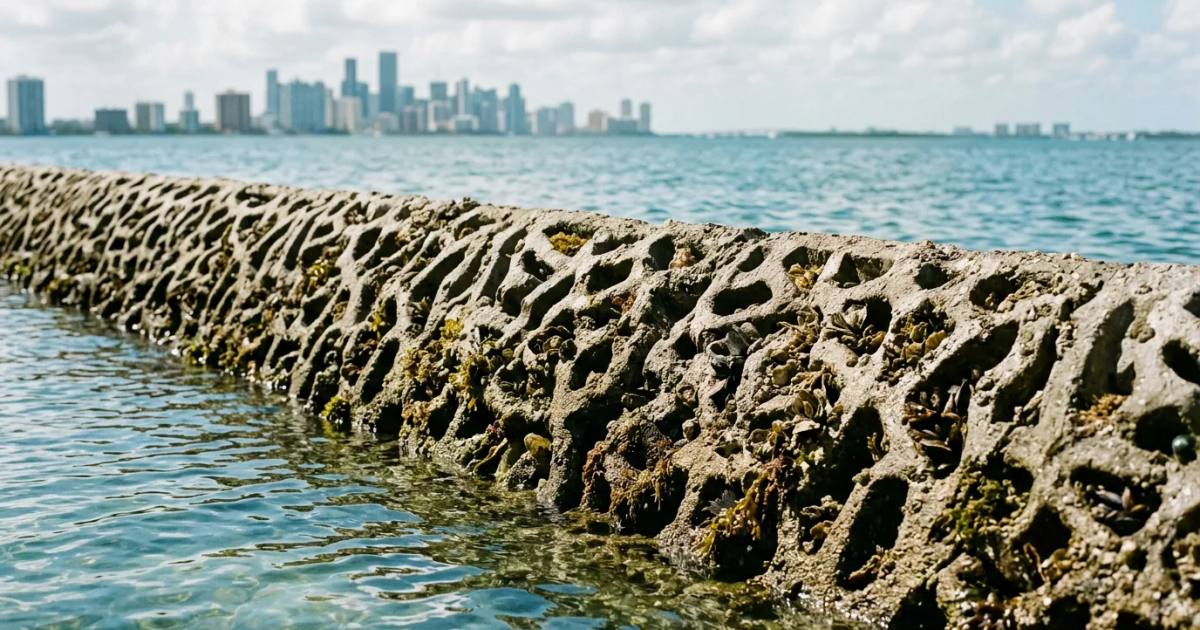

ECOncrete's bio-enhancing marine concrete brings seawalls to life — an Israeli answer to Florida's rising seas.
FLORIDA. Every year, Florida spends more money fighting the ocean. Seawalls are raised, pumps are installed, streets are elevated, and billions of dollars are poured, literally, into concrete meant to hold the water back. The problem is that the concrete itself is losing. Traditional marine concrete cracks, corrodes, and dies a little more with every tide, an inert gray barrier in a losing war against saltwater. An Israeli-founded company has spent more than a decade arguing there is a better way: build the seawall to come alive.
ECOncrete, which engineers bio-enhancing marine concrete for seawalls, breakwaters, piers, and ports, has aimed its technology squarely at the American coastline, and few states on earth need it the way Florida does. In a place where the water is rising, the storms are strengthening, and the cost of losing the coast is measured in the trillions, ECOncrete is selling something rare: a single product that answers three crises at once.
A Seawall That Comes Alive
To understand why the idea matters, start with what conventional marine concrete gets wrong. A standard seawall is smooth, chemically hostile, and biologically dead. Nothing wants to live on it, so nothing does, and without living organisms, the structure has no natural defense against the relentless erosion of salt water and wave action. It begins failing the day it is poured.
ECOncrete inverts the logic. Its concrete is engineered, in both surface texture and chemical composition, to invite marine life to colonize it. Oysters, corals, barnacles, and other organisms settle onto the material, and as they grow, they form a living skin over the structure. That skin does something remarkable: it strengthens the concrete over time rather than degrading it, a process the company calls bioprotection. A conventional seawall is strongest the day it is built and weaker every year after. An ECOncrete structure can grow more durable with age.
The ecological payoff is just as striking. Where a standard seawall sterilizes the waterline, ECOncrete's designs turn it into habitat: tide pools, reef-like surfaces, and nurseries for the marine biodiversity that hardened coastlines usually destroy. The company has deployed its technology in ports, marinas, and coastal defenses across multiple countries, and the pattern repeats: the structures hold, and life returns to the water around them. For a state whose economy and identity are inseparable from its coastal ecosystems, that is not a side benefit. It is the whole point.
Florida's Trillion-Dollar Coastline Problem
Nowhere is the market need more acute than in Florida. The state has more people living on low-lying coastline than almost anywhere in the country, and South Florida in particular sits on porous limestone that lets seawater rise up from below as well as in from the shore. South Florida has become a global reference point for sunny-day flooding, king tides that push seawater into streets on cloudless afternoons, and the trend line only points one direction.
The public response is already measured in the billions. Municipalities are financing seawall upgrades, drainage systems, and street elevations; the Army Corps of Engineers has floated multibillion-dollar storm-surge barrier proposals for the South Florida region; and coastal property owners are spending heavily to armor waterfront that insurers increasingly refuse to cover cheaply. Every one of those projects needs marine construction materials, and every one of them is a potential ECOncrete deployment. The company is not chasing a niche. It is walking into one of the largest sustained infrastructure spends in the state's future.
There is a hard economic argument layered on top of the environmental one. Infrastructure that lasts longer and needs less replacement is cheaper over its lifetime, even if it costs more up front. In a state facing decades of rising water and mounting resilience budgets, a seawall that strengthens as it ages is not a green luxury. It is a fiscal strategy.
Why Israel Builds This
It is no accident that this technology came out of Israel. Scarcity has always been the mother of Israeli innovation, a country that turned water shortage into world-leading desalination and drip irrigation, and that treats environmental constraint as an engineering problem to be solved rather than a fate to be accepted. Marine and coastal technology is a natural extension of that DNA: a small nation with a working relationship to the sea, a deep bench of scientists, and a cultural bias toward building durable solutions to existential problems.
That same instinct is now finding its most valuable market thousands of miles away, on the Florida coast, where the problems Israeli engineers were trained to solve happen to be worth the most.
The Corridor It's Riding
ECOncrete's push into Florida is part of a far larger movement. 429 Israeli-founded companies now operate in the state, generating $7.3 billion in economic output and supporting 26,510 jobs, according to a 5W study built on the United States–Israel Business Alliance's Florida–Israel Economic Impact Report. Israeli climate, water, and coastal-resilience firms are among the fastest-growing arrivals in that group, and for obvious reasons. Florida is not a place where climate technology is theoretical. It is a place where the bill comes due every hurricane season.
Israeli firms in Florida pay a 12% wage premium over the state average, and the cluster is concentrated in exactly the high-skill sectors, cleantech, water, life sciences, engineering, where ECOncrete lives. The company is not an outlier in the corridor. It is a representative of its densest and most strategically important layer.
The Infrastructure Underneath
The corridor runs on real machinery. Direct daily flights between Tel Aviv and South Florida keep engineering teams close to their American projects. The Florida-Israel Business Accelerator has helped more than 100 Israeli companies establish U.S. operations. Israel Tech Week, up to 2,200 attendees this year from 1,500, has become the meeting ground where founders, investors, and public officials connect. And Florida's role as a gateway to Latin America means a coastal-resilience company that proves itself in Florida has a natural path into the ports and shorelines of an entire hemisphere facing the same rising seas.
The Opportunity Ahead
The scale of what is coming is hard to overstate. Ports up and down the Florida coast will be rebuilt and expanded. Municipal seawalls will be replaced by the mile. Private waterfront owners will spend whatever it takes to protect assets the insurance market is fleeing. Each of those projects is a decision between concrete that dies and concrete that lives, and the economics increasingly favor the living kind.
ECOncrete's promise is that Florida does not have to choose between protecting its coastline and preserving the marine life that makes that coastline worth protecting. It can do both, with the same material, in the same pour. In a state that has spent years bracing for the water, an Israeli company is offering a way to work with it instead. That is the kind of idea that turns a single arrival into a fixture, and the Florida–Israel corridor into the place where the world's coastal future gets engineered.
About ECOncrete
ECOncrete is an Israeli-founded marine-technology company that produces bio-enhancing concrete for seawalls, breakwaters, ports, and coastal infrastructure. Its designs support marine biodiversity while increasing the structural durability of the concrete over time.
Disclosure: This article references research produced by 5W. Olam and 5W AI Communications share common ownership. Olam reports independently on the Florida–Israel corridor, including on research produced by 5W. Editorial decisions are made by Olam's editorial team.
Disclosure: Olam.Business is owned by Everything-PR News, LLC and shares a common ownership with 5W AI Communications. Ronn Torossian, Publisher of Olam has ownership interests in each. Editorial decisions are made by Olam.Business editorial team.
How we report: Olam stories draw on public filings, company disclosures and named sources, checked by our editors. Read our methodology · Corrections