
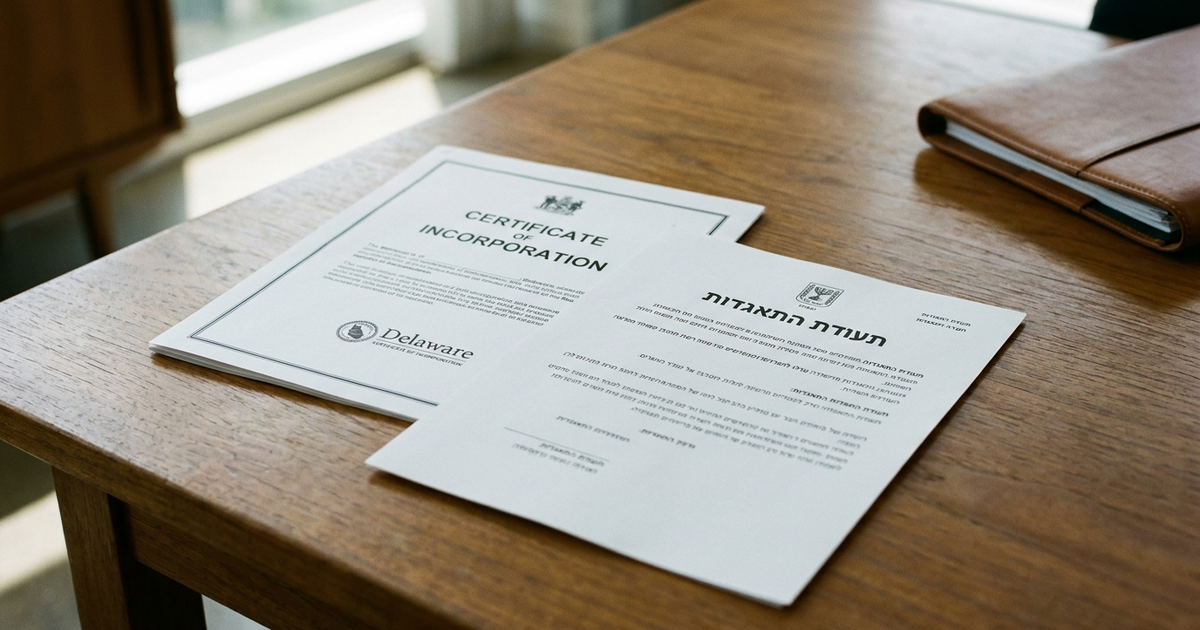

The most important fact about an Israeli tech company is often where it legally lives. Increasingly, that's Delaware — and that shift is reshaping the ecosystem.
Ask where a major Israeli technology company is based and the honest answer is usually two places at once. The engineering, the founders and the R&D sit in Israel. The legal parent — the entity investors buy into and that would list on a US exchange — sits in Delaware. This split structure is the single most important and least understood feature of how diaspora and foreign capital reaches Israeli industry.
How the structure works
Most Israeli technology companies of meaningful scale operate as a Delaware-incorporated parent with an Israeli operating subsidiary. The Delaware parent is the vehicle US institutions invest through, using the legal instruments, governance norms and exit pathways they already know. The Israeli subsidiary holds the R&D, the people and the intellectual-property development — and with them, eligibility for the Israel Innovation Authority's grant-and-tax-incentive program. The arrangement lets a company be two things: a normal US corporation to Silicon Valley capital and the US IPO market, and an Israeli R&D enterprise to the Israeli state and its incentive regime.
The shift that broke the balance
By late 2025, more than 80% of Israeli-founded companies were incorporating in the United States, against roughly 20% in 2022 — a fourfold shift in three years. The immediate drivers were the political turmoil around judicial reform and the war that began in October 2023, which pushed founders toward the legal safety and investor familiarity of US incorporation.
Why it matters beyond the paperwork
Incorporation is not a clerical detail. Where a company is legally domiciled shapes where it pays tax, where it eventually lists, where decision-making concentrates, and how much of the value it creates accrues to the Israeli economy versus the US one. A generation of Israeli companies legally resident in Delaware is a structural question for Israel's long-term tax base and ecosystem density — one that sustained foreign investment, however welcome, does not by itself answer.