
Israeli banks for olim compared: account setup, US citizen paperwork, Zakaut mortgages and the 75% loan-to-value limit, with facts sourced to Nefesh B'Nefesh and the banks.
An oleh must give Misrad Haklita, the Ministry of Aliyah and Integration, an Israeli bank account to receive the Sal Klita absorption basket, so the bank choice comes within days of arrival. Israel's five main banks are Leumi, Hapoalim, Mizrahi-Tefahot, Israel Discount Bank and First International Bank (FIBI). Mizrahi-Tefahot states that olim can borrow up to 75% of a home's value, against 50% for foreign residents. US citizens must also supply a W-9.
How does an oleh open an Israeli bank account?
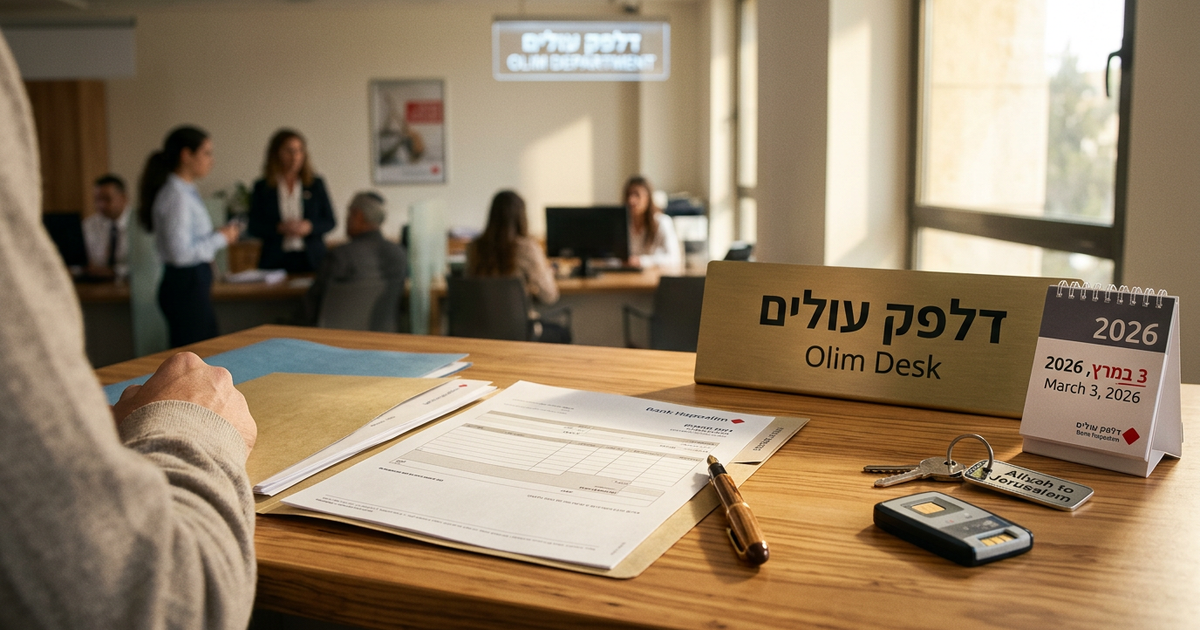
An oleh opens an Israeli bank account by bringing the "Note of Future Bank Account" issued at the airport to a branch, according to the Nefesh B'Nefesh account-opening guide. The steps are:
- Collect the Note of Future Bank Account at the airport on arrival.
- Visit the chosen branch at least one hour before closing, as Nefesh B'Nefesh recommends.
- US citizens give a Social Security number and complete a W-9.
- Give the stamped note and the account details to Misrad Haklita so the Sal Klita payments can start.
The same guide lists service numbers for FIBI, Hapoalim, Leumi and Mizrahi-Tefahot. It also says a mortgage can come from any bank, not only the bank that holds the account.
Which Israeli banks do olim compare?
Olim compare five main banks, and the differences that can be documented are mortgage reach, US subsidiaries and US-person rules.
| Bank | Documented feature | Source |
|---|---|---|
| Bank Leumi | Owns Bank Leumi USA, a US commercial bank with offices in California, Florida, Illinois and New York | Wealth Briefing |
| Bank Hapoalim | Israel's largest bank; agreed to a $874 million US resolution in 2020 over offshore accounts | Investment Executive |
| Mizrahi-Tefahot | Describes itself as Israel's largest mortgage bank, with mortgage staff serving olim in English, French, Spanish and Russian | Mizrahi-Tefahot mortgage page |
| Israel Discount Bank | Owns IDB New York, a US subsidiary; authorized to issue Zakaut mortgages | Nefesh B'Nefesh mortgage guide |
| FIBI | Authorized to issue Zakaut mortgages; see the FIBI dictionary entry | Nefesh B'Nefesh mortgage guide |
What changes for US citizens opening an Israeli account?
US citizens must provide a Social Security number and a W-9 to open an Israeli account, according to Nefesh B'Nefesh. Israeli banks apply that scrutiny because US prosecutors penalized two of them for helping US taxpayers hide offshore accounts.
Bank Leumi agreed in 2014 not to open accounts for US customers unless they commit to declaring the assets, according to Globes. Ask each bank what US-person paperwork it requires before choosing. The history behind these rules is in the Swiss-Israeli private banking guide.
How much can an oleh borrow for a home?
An oleh can borrow up to 75% of a home's value, the maximum loan-to-value (LTV) ratio that Nefesh B'Nefesh reports for Zakaut mortgages. Mizrahi-Tefahot states that olim qualify for 75% where foreign residents receive 50%.
Nefesh B'Nefesh lists the banks authorized to issue the Zakaut mortgage: Mizrahi-Tefahot, Leumi, Hapoalim, Discount, Bank of Jerusalem, FIBI and Mercantile. It reports the Zakaut rate as the Bank of Israel rate minus 0.5%, capped at 3.0%. For purchase tax, see the Mas Rechisha dictionary entry.
Does the 2026 aliyah tax reform change the bank choice?
The 2026 aliyah tax reform changes the exemption schedule for new immigrants, not the list of banks that serve them. Olam explains the schedule in Inside Israel's 2026 aliyah reform and the aliyah tax reform dictionary entry.
Families with offshore custody should ask a tax adviser how Israeli and offshore statements will be reconciled before the first Israeli filing. The aliyah and wealth migration guide and the aliyah prep playbook cover the wider planning.
Which bank fits which oleh?
Olam's read is that three situations drive the choice: buying a home, holding US citizenship, and holding offshore wealth.
| Situation | Compare | What to check |
|---|---|---|
| Buying a home | Mizrahi-Tefahot, Leumi, Hapoalim, Discount | Zakaut authorization, the 75% LTV limit and the rate offered, since any bank can issue the mortgage |
| US citizen | Leumi (Bank Leumi USA), Discount (IDB New York) | US-person paperwork and the W-9 requirement |
| Offshore custody | Private banking arms of the five banks | How Israeli and Swiss statements reconcile; see the Swiss-Israeli guide |
Open the account at the bank that matches the largest need in this table, and compare mortgage offers from every authorized bank before signing. More guides are collected under Aliyah and wealth migration and Israeli banking and institutional capital. The U.S. fundraising arm behind the account-opening guide is reviewed in Nefesh B'Nefesh USA: 14 years of Form 990s.
FAQ
How does an oleh open an Israeli bank account?
An oleh opens an Israeli bank account by bringing the Note of Future Bank Account issued at the airport to a branch, according to the Nefesh B'Nefesh account-opening guide.
What changes for US citizens opening an Israeli account?
US citizens must provide a Social Security number and a W-9 to open an Israeli account, according to Nefesh B'Nefesh.
How much can an oleh borrow for a home?
An oleh can borrow up to 75% of a home's value, the maximum loan-to-value ratio that Nefesh B'Nefesh reports for Zakaut mortgages.
Olam reports on banking infrastructure and does not provide banking, investment or tax advice. Last updated October 6, 2026.
How we report: Olam stories draw on public filings, company disclosures and named sources, checked by our editors. Read our methodology · Corrections