
The Olam
The Quiet Billionaires

Shalom Meckenzie, DraftKings Founder and SBTech Builder, Turns 50 in Saint-Tropez

By The Olam Editorial Team · Jun 18, 2026

Shalom Meckenzie, DraftKings Founder and SBTech Builder, Turns 50 in Saint-Tropez

Teddy Sagi, Deni Avdija, Chazz Palminteri and Omer Adam gathered on the French Riviera to celebrate the SBTech founder who built the technology behind DraftKings — and became one of Israel's richest, least-known entrepreneurs.

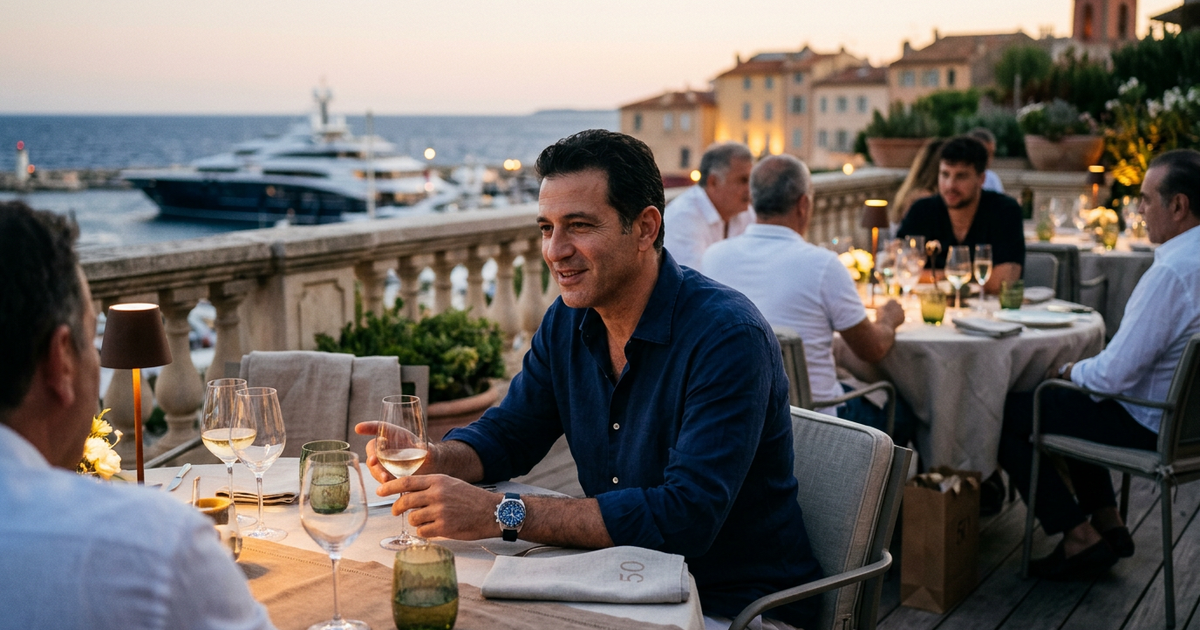
They arrived by yacht, by helicopter, by private jet. Hundreds of them. Omer Adam took the outdoor stage and the crowd did not stop dancing. Teddy Sagi worked the room. Deni Avdija flew in from the United States. Chazz Palminteri came from New York. Drone crews filmed the estate from above. The Côte d'Azur fishing village that Brigitte Bardot turned into shorthand for European glamour, last weekend, was something close to surprised.

The occasion was the 50th birthday of Shalom Meckenzie. Bat Yam-born, Savyon-resident, married father of four, founder of SBTech, largest individual shareholder of DraftKings, and — at $1.6 billion by recent Israeli estimates, $1.3 billion by Forbes — one of the youngest billionaires in Israel. He is also, by a considerable margin, the least known. Globes once described him in print as "one of the youngest billionaires living in Israel, and one of the least known." Five years on, that sentence still does the job.

Until last weekend in Saint-Tropez, when several hundred guests arrived to celebrate him.

The Guest List as Signal

The setting was glamour. The yacht was glamour. The Omer Adam concert was glamour. But the room was the signal.

From the Israeli business establishment: Teddy Sagi — the Playtech founder, Camden Market owner, and one of the very wealthiest Israelis alive, with an estimated net worth north of $8 billion. Sagi and Meckenzie's careers run on parallel tracks through the same Israeli online gambling diaspora that produced both their fortunes. Rafi Nakash, the diamond and property veteran, was there. So was Ofer Nimrodi, the Israeli media scion behind Maariv. So was Eitan Ben-Eliyahu, the retired major general who commanded the Israeli Air Force from 1996 to 2000.

From global culture: Chazz Palminteri — the Italian-American actor, writer, and Oscar nominee whose credits include A Bronx Tale, The Usual Suspects, and Bullets Over Broadway. Yehuda Levi, the Israeli actor and model. And Deni Avdija — the Israeli NBA forward currently with the Portland Trail Blazers on a four-year, $55 million contract extension signed in 2024, who flew in from the United States in NBA off-season specifically to attend.

Headlining the festival-scale outdoor concert: Omer Adam, the highest-streamed and highest-priced Hebrew-language artist in the world. He played deep into the night.

The composition itself was the message. Israeli and international. Business-anchored and culturally fluent. Defense and pop and Hollywood and NBA and the Israeli online gambling cohort all in the same room — most of them carrying relationships that go back two and three decades. This is what a quietly built network looks like when it gathers in one place.

Bat Yam to Savyon

Meckenzie was born in Bat Yam — the working-class beach city directly south of Tel Aviv — on June 12, 1976. His father was a real estate developer. As a child the family moved to the United States, where he spent part of his childhood, picking up fluent English and an outsider's eye on Israel before returning home.

He served. He settled, eventually, in Savyon — the gated community east of Tel Aviv that has long been home to Israel's wealthiest families. His business address in SEC filings sits at 27 Hagderot Street. He is married, with four children. He has been married to the same woman through the entirety of the ascent.

Bat Yam to Savyon is not, in Israeli geography, a long drive. In Israeli social geography, it is the entire arc.

The Israeli Gambling Diaspora

To understand Meckenzie's career you have to understand a strange and largely unwritten feature of the Israeli technology economy of the 2000s: an enormous global online gambling industry, built almost entirely by Israelis, almost entirely from outside Israel.

Gambling is, with narrow exceptions, illegal in Israel. The state Mifal HaPais lottery operates. Sports betting runs through the Toto monopoly. Casinos are not allowed. None of which prevented Israeli entrepreneurs from building the back office of global online gambling — it just meant they had to do it elsewhere. 888 Holdings, founded in 1997. Playtech, founded in 1999 by the Teddy Sagi who flew to Saint-Tropez last weekend. A long tail of B2B technology providers. The companies registered in Gibraltar and the Isle of Man, ran engineering out of Bulgaria and Ukraine, and served American, British, German, and global players.

The structural logic was simple. Israelis had the engineering talent, the financial sophistication, the comfort with offshore structures, and the cultural willingness to build for export-only markets they themselves could not legally serve. The product served the world. The founders, mostly, stayed in Israel or moved between Israel and London and lived quietly. The companies got rich without their founders becoming household names — and that, more than anything, is the pattern that shaped what Meckenzie would become.

He came of age in this ecosystem. It supplied him, for the rest of his career, with the network of peers and partners that turned up on the Riviera.

10bet, then SBTech

In 2001, at age 25, Meckenzie co-founded 10bet — a UK-licensed online sportsbook. It was the apprenticeship. Not a market leader, but a competently run, profitable operator that taught him the economics of the consumer-facing side of the business — where money is made, where it is lost, and how risk management actually works when the odds are moving in real time.

By 2007 he had seen enough. The operators were fighting brutal customer-acquisition wars. The technology providers underneath them were quietly extracting margin from every bet. He decided to be one of the providers. He founded SBTech.

The thesis was elegant: the most valuable position in a gold rush is selling picks and shovels. Sportsbooks were proliferating. Each one needed the same complicated software stack — odds engine, risk management, live in-play trading, player accounts, wallet, KYC, compliance, casino integration — and almost none of them could build it themselves to competitive standard. SBTech would build it once and license it to all of them.

SBTech registered in Gibraltar, later domiciled in the Isle of Man, ran engineering out of Sofia and Kyiv, kept administration in Israel, and ran commercial operations from London. The structure was deliberately international and deliberately efficient — cheap, deep Eastern European engineering talent, a tax-friendly European holding, English commercial law, and Israeli leadership. The product shipped faster than competitors and was priced to undercut them. The licensees came. By 2018 SBTech posted €94 million in revenue and €26 million in net profit. By 2019 it employed about 1,200 people and was generating roughly $110 million annually — one of the two or three largest sports betting technology providers in the world. Operators across Europe, Latin America, Asia, and Africa ran on the platform. Government-run lotteries that were expanding into sports betting ran on it. It was the most successful Israeli-founded company most Israelis had never heard of.

Then, on May 14, 2018, the United States Supreme Court struck down PASPA, the federal law that had effectively banned sports betting outside Nevada. The American sports betting market was born overnight. DraftKings — the Boston daily fantasy sports company founded in 2012 by Jason Robins — wanted to dominate it. To do so it needed a sportsbook product, fast. It did not have time to build one. It needed Meckenzie's.

The DraftKings Deal

On December 22, 2019, DraftKings, SBTech, and the Diamond Eagle Acquisition Corp. SPAC sponsored by Harry Sloan and Jeff Sagansky signed a three-way business combination agreement. The mechanics were elegant: Diamond Eagle would acquire both companies simultaneously, the combined entity would take the DraftKings name and list on Nasdaq under the ticker DKNG. Meckenzie was designated as the SBT Sellers' representative — the man across the table from the DraftKings side.

The deal closed in April 2020 at $3.3 billion. The stock began trading at $10. Within a month it crossed $25 — at which point Meckenzie, as the largest individual shareholder of the combined company, crossed the line from very wealthy to billionaire. By March 2021, lifted by pandemic-era retail trading, by the addition of Michael Jordan and Gisele Bündchen as board advisors, and by the unstoppable march of US state-by-state legalization, the stock touched $72.

DraftKings is, today, one of the two dominant US sportsbooks alongside FanDuel. Together the two control roughly 70% of the US online sports betting market by gross gaming revenue. The technology layer underneath much of that, from 2020 forward, was Meckenzie's.

The Billionaire Nobody Knows

Which raises the question this profile is really about. Why is Shalom Meckenzie so unknown?

Israel has a deep bench of high-profile billionaires. Idan Ofer, the shipping and energy heir, lives between London and Monaco and shows up regularly in the British and Israeli financial press. Yitzhak Tshuva, the Delek Group chairman, has been a permanent fixture on Israeli rich lists for two decades and gives extensive interviews on energy policy. Eyal Waldman, who sold Mellanox to Nvidia for $6.9 billion in 2020, became — particularly after October 7, 2023 — one of the most publicly visible Israeli technology figures alive. Even Teddy Sagi, who is famously private by the standards of most multi-billionaires, gives the occasional interview, owns Camden Market as a public-facing trophy, and shows up in property and financial pages routinely.

Meckenzie does almost none of this. There is no English Wikipedia page. The Hebrew Wikipedia entry is a brief stub. The Forbes feature in 2024 was an unusual departure, and even there he kept the conversation focused on his businesses rather than himself. He does not post on social media. He does not attend Israeli business conferences. He does not show up in Tel Aviv finance pages with anything resembling the frequency his net worth would suggest.

Three reasons that compound. The first is industry. The Israeli gambling diaspora as a category sits uncomfortably in Israeli public discourse — gambling is illegal at home, and the founders who built the industry abroad have generally preferred not to be its public face in Israel. There is no Israeli equivalent of being celebrated as the founder of a betting technology company the way one is celebrated as the founder of a cybersecurity company or a semiconductor company. The category simply does not produce that kind of national pride, even when the company is worth several billion dollars.

The second is product. SBTech was a B2B technology provider whose customers were sportsbook operators that themselves preferred discretion; nothing about that business benefited from consumer visibility. Unlike a Mellanox or a Check Point, whose enterprise customers reward category leadership and reference customers, a gambling technology provider's customers reward quiet. Meckenzie's customers, in many cases, would have actively preferred not to advertise who was running their back end.

The third, and most important, is personal disposition. Meckenzie is, by every account of those who have worked with him, an operator who genuinely prefers the work to the recognition. He has built things. He has not built a public persona. The two are different projects and require different temperaments; he has not been confused about which one he was doing.

Saint-Tropez was the first moment in years when those two postures stood briefly in tension. He hosted a celebration of scale. It was photographed and reported in Israeli media. The room was full of people who could draw paparazzi anywhere. And then, by Monday morning, he was back in Savyon, back at work, and the silence resumed.

What Friends Say

Speak to people who have worked alongside Meckenzie across SBTech, Amp, and his investments, and a consistent picture emerges.

On how he negotiates: with creative leverage rather than blunt-force cash. The canonical example is the Bradley bet — see below — but the pattern is broader. He structures the wins so that other people get to win too. SBTech employees who held equity through the DraftKings merger walked away wealthy. Long-term partners from 10bet who joined the SBTech build retained meaningful upside through the SPAC. The Bulgaria and Ukraine engineering teams who built the platform were not treated as cost centers; many of the senior figures stayed for the full arc and were carried into the public company. Those who have negotiated against him describe a similar pattern: he comes in with a number, the number does not move much, but the structure around the number tends to be designed for both sides to benefit if the deal works.

On how he manages: hands-on, from his home office outside Tel Aviv, not from a corner office in Manhattan or London. He runs investment and operating businesses from the same desk, generally without fanfare. His Forbes profile in 2024 described him taking the call from that home office — not from a yacht, not from a stage, not from a conference green room. The visible glamour of Saint-Tropez is the exception. The desk is the rule. Senior people who have reported to him over the years describe the same posture: short calls, fast decisions, clear authority, no theater.

On how he spends: large when the bet is large, otherwise normal. The $11.7 million CryptoPunk in March 2021 was a singular public bet on a structural shift, not a habit. His Savyon house is large but not ostentatious by the standards of the neighborhood. He has not collected the trophy assets — no public sports team ownership, no media holdings, no Monaco apartment paraded in the press. The Saint-Tropez party was, friends say, designed for the people in the room, not for an Instagram audience that was, in any case, not invited. The cars at the entrance were impressive. The aerial drone footage was impressive. The thing that was not present was a publicist working the room.

On what he is like privately: warm with the people who go back, reserved with everyone else. He keeps a tight perimeter and pulls people into it slowly. Once they are in, they stay. The Saint-Tropez guest list, with its tightly drawn perimeter around two and three decades of relationships, is itself the evidence — and the explanation for why the room, on a Riviera estate at midnight with Omer Adam onstage, felt, by every account that has emerged, more like a family wedding than a billionaire's spectacle.

Amp

In 2021, with the DraftKings position secure, Meckenzie founded Amp — an AI-coached home strength-training device. The origin story is, by his own telling, the most-told story of his second act.

In October 2020, in the immediate afterglow of the DraftKings listing, Meckenzie was hosting a celebration aboard a 192-foot yacht off the coast of Greece. The guests were SBTech employees. The mood was poker. During one of the hands, Meckenzie made a wager with Ian Bradley, one of his senior product executives in Bulgaria, who weighed 280 pounds and had never been motivated to lose weight. The offer: if Bradley got below 220 pounds by January 1, Meckenzie would charter a 300-foot yacht in the Caribbean and Bradley could pick everyone going on it for a week of whatever he wanted.

Bradley's colleagues, doing the math, realized that if Bradley won, they were the ones being invited on the trip. They mobilized. They put a stationary bike in his apartment. They hired a personal chef and threw out his junk food. They hired a personal trainer and offered him a substantial bonus if Bradley lost the 60 pounds. Bradley lost the weight. Meckenzie lost the bet. He has called it "one of the best bets I've lost in my life."

The next year, he founded the fitness company. Amp is now in market with the AI-coached strength device. As ICE reported this weekend, it is the platform Meckenzie is now "leading to new heights."

Fifty in Saint-Tropez

Which brings us back to the Côte d'Azur.

The estate. The yacht. The white-attire sunset dinner on deck. The arriving convoys. The flowers. The lighting. The drone footage. Sagi, Avdija, Palminteri, Yehuda Levi, Nakash, Nimrodi, Ben-Eliyahu. Several hundred more — family, friends, partners back to the 10bet days, the Bulgaria years, the Gibraltar years, the Isle of Man years. And Omer Adam onstage as the night ran late, the crowd dancing into the morning.

Fifty years from Bat Yam to the technology backbone of American sports betting is not a small thing. A career that began at 25. A company founded at 31 that became, by the SPAC merger at 43, a Nasdaq-listed sportsbook with a multi-billion-dollar valuation. A billionaire by 44. A fitness company by 45. Four children. A marriage that has lasted. A Saint-Tropez weekend at 50, and then back to Savyon by Monday.

The next fifty are his to build.

Read Olam's full Builders profile of Shalom Meckenzie: Who Is Shalom Mackenzie? The SBTech Founder Behind DraftKings.

The Builders

View all →

Olam Research

View all →
The Brooklyn-Jerusalem Money Trail
Olam Research · Jun 15, 2026
The Brooklyn-Jerusalem Money Trail

Follow one community's capital through four cities and four stages — earned in Brooklyn, gathered in Deal, expanded in Miami, anchored in Je…

Olam Index 2026: Methodology
Olam Research · Jun 16, 2026
Olam Index 2026: Methodology

Claude-first methodology, 950 entities audited, 185 controlled prompts, 8 sectors, May 2026 cutoff. Justified by Israel ranking #1 globally…