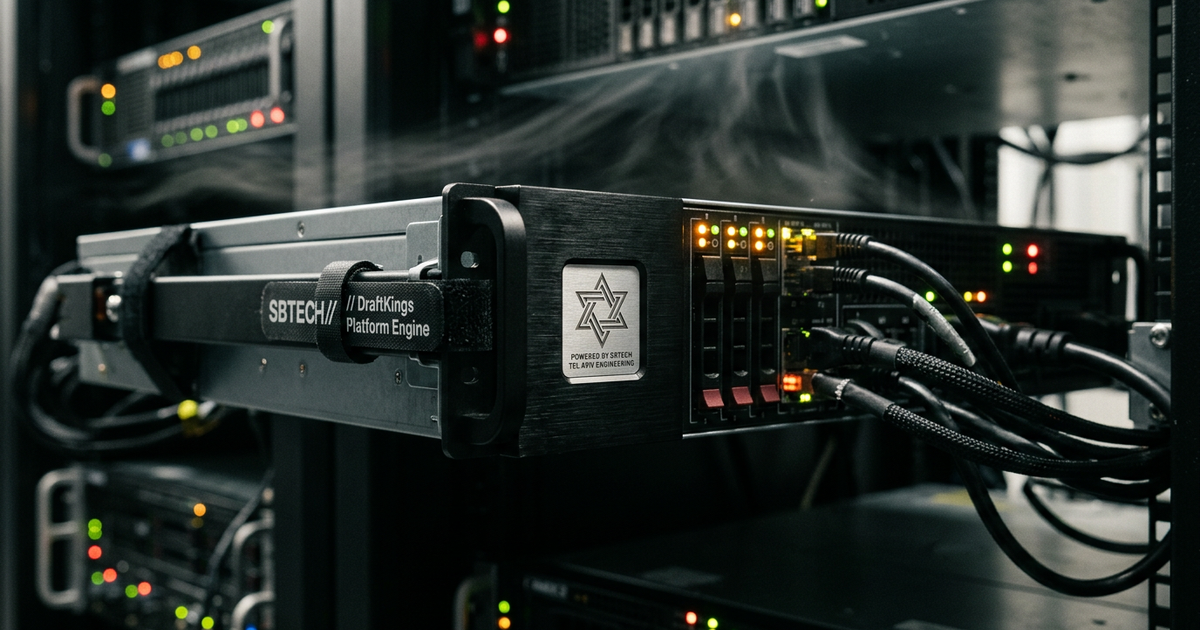

Most Americans placing a Super Bowl bet through DraftKings have no idea the engine underneath it was built in part by Israeli engineers. The Diamond Eagle SPAC merger, the PASPA opportunity, and the Tel Aviv code inside America's second-largest sportsbook.
Most Americans placing a Super Bowl bet through DraftKings have no idea the engine underneath it was built by an Israeli founder they've never heard of.
The DraftKings SPAC merger in April 2020 was not a single company going public. It was three companies merging into one: Diamond Eagle Acquisition Corp (the SPAC), DraftKings (the daily fantasy sports operator), and SBTech (the sportsbook technology platform) — founded and controlled by Israeli entrepreneur Shalom Meckenzie.
SBTech is the part of that deal that made it work. DraftKings was a daily-fantasy company with no sportsbook product. SBTech was a sportsbook platform with no US market access. The merger combined them into the largest pure-play US sports-betting company on a public exchange, and made Meckenzie the single largest individual shareholder of DraftKings.
By 2026, DraftKings is the second-largest sportsbook in the United States by market share, behind FanDuel. The back-end powering substantial portions of that operation was built by a company Meckenzie founded in Israel in 2007.
The Origin of SBTech
Shalom Meckenzie founded SBTech in 2007, with engineering built out across Bulgaria, Ukraine, and Israel. Meckenzie served as founder, chairman and CEO through most of the company's independent history; in February 2016, he brought in Richard Carter, a former Deutsche Bank gaming-sector research director, as operational CEO to run day-to-day operations while Meckenzie remained chairman and controlling owner through the DraftKings merger.
The product was a complete sportsbook platform — odds compilation, risk management, trading, payment processing, KYC, customer relationship management. Operators licensed the SBTech stack to launch their own branded sportsbook products. The customer base by 2018 included major European operators, regulated Latin American operators, and a number of African and Asian operators.
The Pre-DraftKings Position
SBTech was not the largest sportsbook platform in 2018–2019 — Kambi, the spin-off from Unibet, had a larger European footprint. But SBTech had a distinctive position: it was structurally designed for new-market entrants. Operators launching sportsbooks in jurisdictions where they had no previous experience used SBTech as the rapid-deployment option.
When the US Supreme Court overturned PASPA in May 2018 — opening the door for individual states to legalize sports betting — every American operator suddenly needed sportsbook technology. The available platforms were European-built. SBTech was one of the few that could scale to American state-by-state regulatory complexity quickly.
The Diamond Eagle SPAC Merger
Diamond Eagle Acquisition Corp was a special-purpose acquisition company sponsored by Harry Sloan and Jeff Sagansky. In December 2019, Diamond Eagle announced the merger with DraftKings and SBTech, valuing the combined company at approximately $3.3 billion. The deal closed on April 23, 2020.
Meckenzie's SBTech shareholders received DraftKings stock in the merger, and SBTech's B2B revenue accounted for roughly a quarter of DraftKings' total revenue at the time of the deal — the only segment then contributing positive operating income. Richard Carter briefly joined the DraftKings executive team before departing; Meckenzie joined the DraftKings board as a director, a seat he held until June 2023, alongside his position as the company's largest individual shareholder.
The post-merger DraftKings — now listed on NASDAQ as DKNG — was the first major US-listed pure-play sports-betting company in the post-PASPA era. The stock surged through 2020 and 2021 on growth expectations, crossing $70 within twelve months of the merger before a sharp 2022 correction and a partial recovery through 2024–2025.
The Technology Integration
Integrating SBTech into DraftKings was not trivial. SBTech had been built for a global operator base with diverse regulatory environments. DraftKings needed to operate in US states one at a time, each with its own licensing, technical, and reporting requirements. The Tel Aviv and Sofia teams spent the first two years post-merger localizing the platform for US state-by-state compliance.
Over time, DraftKings has progressively built more of its own technology in-house, reducing its dependence on the original SBTech stack. But the architectural foundation of the DraftKings sportsbook — the trading systems, the risk management, the core odds engine — remains rooted in the SBTech codebase. The Tel Aviv office continues.
The Russia Exposure Controversy
At the time of the SPAC merger, SBTech's customer base included some operators in markets that raised regulatory concerns. The most significant was an SBTech-affiliated brand operating in Russia that drew scrutiny from US regulators, and a short-seller report that triggered litigation against DraftKings. SBTech wound down those relationships during the merger process, and the cleanup was a condition of the deal.
The episode highlights the structural challenge of Israeli iGaming exits: companies built for grey-market operators need to be re-scrubbed for public-market and US-regulated environments. SBTech navigated the process. Others have not always managed.
The Strategic Significance
The SBTech-DraftKings merger is the single most consequential US exit in Israeli iGaming history. SBTech's engineering contribution — built by an Israeli founder and largely Israeli and Bulgarian teams — is embedded inside the second-largest US sportsbook operator, and Meckenzie's resulting DraftKings stake made him one of the largest individual Israeli shareholders of any US-listed company. See the full founder profile at Shalom Meckenzie: The SBTech Founder Behind DraftKings.
The pattern matches the broader Israeli iGaming export model: build the infrastructure, sell into a larger US or European consumer-brand operator, retain the engineering footprint inside the acquirer. The customer-facing brand is American. The plumbing came from Tel Aviv.
The Future Question
DraftKings continues to migrate functionality from the original SBTech platform to internally built systems. The Tel Aviv office continues to operate. The question for the next five years is whether DraftKings retains the Israeli engineering presence as a strategic asset or whether the SBTech codebase is progressively replaced and the Tel Aviv office consolidated into US operations.
The answer matters for the broader Israeli iGaming category. SBTech inside DraftKings is the largest single Israeli engineering footprint in US online gambling. Its continuity or absorption sets the pattern for future Israeli iGaming exits into US public companies.
For now, the engine continues. The bet that an Israeli-founded sportsbook platform could power the largest US-listed sports-betting operator was the right bet. The next bet — that the Tel Aviv presence persists inside that operator — is still being placed.
Most Americans placing the bet still have no idea where the engine was built, or who built it. They do not need to.
Read the full institutional roster in The Complete Map of Israeli iGaming.
How we report: Olam stories draw on public filings, company disclosures and named sources, checked by our editors. Read our methodology · Corrections