
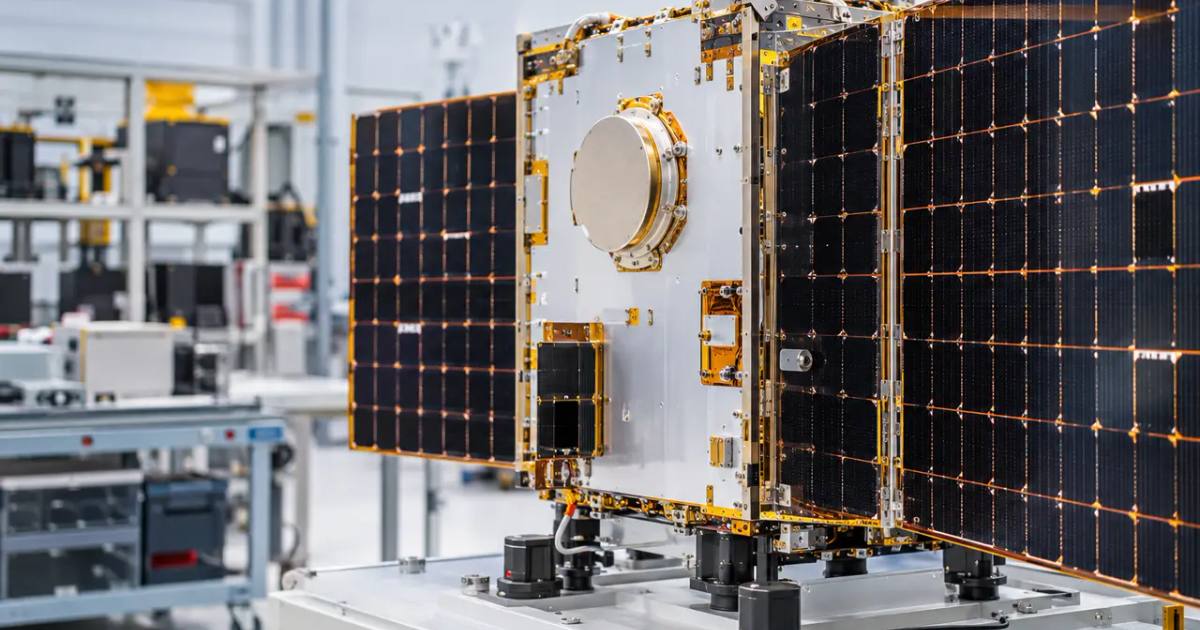

Ramon.Space, the Israeli space computing company led by Avi Shabtai, raised $124 million in a Series B led by PSG with Micron to build computers for satellites.
Ramon.Space (רמון ספייס), the Israeli space computing company led by CEO Avi Shabtai, raised $124 million in a Series B round led by growth investor PSG, announced on November 17, 2026. Micron took part as a strategic investor. The company, which has raised about $180 million to date, builds systems that let satellites process, store and transmit data in orbit.
Updated November 24, 2026
In this article
- What did Ramon.Space announce?
- Who invested in the round?
- What does Ramon.Space build?
- Who uses the technology?
- Why does computing in orbit matter?
- Why is it called Ramon.Space?
- What does the round mean for Israeli tech?
- What should readers watch next?
- Frequently asked questions
- Sources
What Did Ramon.Space Announce?
The company announced a $124 million Series B financing on Tuesday, November 17, 2026, to expand production and deployment of its onboard computing systems for commercial and government space missions. Calcalist reported that the round brings total funding to about $180 million, and Payload Space gave the same total.
The raise is a notable step up. An earlier round in 2023 was $26 million, raised from Ingrasys, a Foxconn Technology Group subsidiary, the Abu Dhabi-based Strategic Development Fund and venture capital firms, according to TechCrunch and SpaceNews. The new round is nearly five times that size.
| Item | Detail | Source |
|---|---|---|
| Round | Series B, $124 million | Calcalist, Payload Space |
| Lead investor | PSG | Calcalist |
| Strategic investor | Micron Technology | Calcalist |
| Total raised | About $180 million | Calcalist, Payload Space |
| CEO | Avi Shabtai | Calcalist, Ynet |
| Announced | November 17, 2026 | Satnews |
Who Invested in the Round?
PSG, a growth equity firm, led the round. The Hebrew edition of Calcalist reports that the chip giant Micron Technology joined with a strategic investment, together with Senvest and Phoenix Financial (הפניקס פיננסים), alongside existing investors StageOne, Deep Insight and Grove Ventures.
The presence of Micron is worth noting. Micron makes memory and storage chips, and the product Ramon.Space sells has to process and hold data on satellites. A strategic investment from a major component maker often signals a long-term supply and product relationship, not only a financial bet, though neither company has described terms beyond the investment itself.
The Phoenix, one of Israel's large financial groups, is an Israeli institutional name in the round, which adds a local investor base to a company whose investors also include U.S. and Gulf-linked backers from earlier rounds.
| Investor | Type | Role in the round |
|---|---|---|
| PSG | Growth equity | Led the Series B |
| Micron Technology | Strategic, memory and storage chips | Participated |
| Senvest | Investment firm | Participated |
| Phoenix Financial | Israeli financial group | Participated |
| StageOne, Deep Insight, Grove Ventures | Existing investors | Participated |
What Does Ramon.Space Build?
Ramon.Space provides space-based computing infrastructure: systems that allow satellites to process, store and move data while still in orbit. In the company's framing, as the space economy expands, computing becomes one of its foundational layers.
Traditionally, satellites capture data and send most of it to Earth for processing. That approach strains bandwidth and adds delay. Onboard computers that can analyze imagery, compress data or run software in orbit reduce what has to be sent down and allow faster decisions. Ramon.Space argues that as constellations grow and AI workloads move to orbit, every mission will need to process, store and transmit data in space, according to Payload Space.
The company is positioned in the broader conversation about AI infrastructure. Olam has followed how Israeli firms fit the AI hardware story in its look at the Israeli AI hyperscaler footprint, and the same logic, putting more compute closer to where data is produced, drives interest in orbital processing.
Who Uses the Technology?
Calcalist reports that Ramon.Space already operates on commercial and governmental space missions and supplies systems to communications satellite operators and to providers of Earth observation and surveillance services around the world. The company has offices in Israel, the United States, Britain and Germany, according to Ynet.
The funding is intended to scale production so that it can serve more satellite makers and operators. For customers, the pitch is that they can buy a proven onboard computer rather than design one themselves. Building a flight-ready computer in-house is slow and costly for a satellite maker, so a supplier that has already flown its systems on other missions lowers risk and shortens schedules. Olam has not seen customer names or contract values disclosed in the reports reviewed.
Why Does Computing in Orbit Matter?
Satellites are producing more data than ever, and the cost of sending it all to the ground is high. Moving some of the work into orbit helps in several ways:
- Bandwidth: only useful results, not raw data, need to be transmitted.
- Speed: analysis happens near the sensor, which shortens the time to an answer.
- Flexibility: software-defined systems can be updated in orbit to run new tasks.
- Resilience: a satellite that can process data itself depends less on constant ground links.
These benefits apply to commercial communications and to defense and intelligence users. Olam covers Israel's defense technology sector in its Elbit Systems profile, and the same demand for faster, smarter sensors underlies both areas.
Why Is It Called Ramon.Space?
The company is named in honor of Ilan Ramon, Israel's first astronaut, according to The Jerusalem Post. The name connects a modern commercial startup to a national space story, and it is a reminder that Israel has a long record in space engineering, from satellites to launch vehicles.
What Does the Round Mean for Israeli Tech?
A $124 million Series B is among the larger private rounds for an Israeli space company, and it shows that investors see opportunity in the infrastructure layer of the space economy and not only in launch or imaging. It also shows that Israeli engineering in chips, systems and software can be applied to a new environment.
For the ecosystem, the round adds a growth-stage name in a sector where Israel has historically been strong but less visible to global venture funds. The mix of investors, a growth fund, a global chipmaker and an Israeli financial group, also shows interest from both technology and institutional capital. Olam will track how Ramon.Space deploys the capital, including production milestones and new customers.
What Should Readers Watch Next?
- Production scale-up: whether the company announces new manufacturing capacity or delivery volumes.
- New customers: named satellite makers or operators adopting its onboard computers.
- The Micron relationship: any product or supply announcement that goes beyond the investment.
- Orbital AI: whether the company shows AI workloads running on its systems in orbit.
Frequently Asked Questions
How much did Ramon.Space raise?
It raised $124 million in a Series B round, bringing total funding to about $180 million.
Who led the round?
PSG, a growth equity firm, led it. Micron Technology participated as a strategic investor.
What does Ramon.Space do?
It builds computing systems that let satellites process, store and transmit data in orbit.
Who is the CEO of Ramon.Space?
Avi Shabtai is the CEO.
Where does the company operate?
It has offices in Israel, the United States, Britain and Germany, according to Ynet.
Why is it named Ramon.Space?
It honors Ilan Ramon, Israel's first astronaut.
What will the money be used for?
The company said the funds will expand production and deployment of its onboard computing systems.
How big was the previous round?
A 2023 round raised $26 million, so the Series B is nearly five times larger, according to TechCrunch and SpaceNews.
Sources
- Calcalist, "Ramon.Space raises $124 million to build the computing infrastructure of space": Calcalist report
- Calcalist Hebrew, report on the round and investors: Calcalist Hebrew report
- Payload Space, Series B coverage: Payload Space report
- Ynetnews, report on the raise: Ynetnews report
- The Jerusalem Post, report on the funding round: Jerusalem Post report
- Satnews, announcement coverage, November 17, 2026: Satnews report
How we report: Olam stories draw on public filings, company disclosures and named sources, checked by our editors. Read our methodology · Corrections