
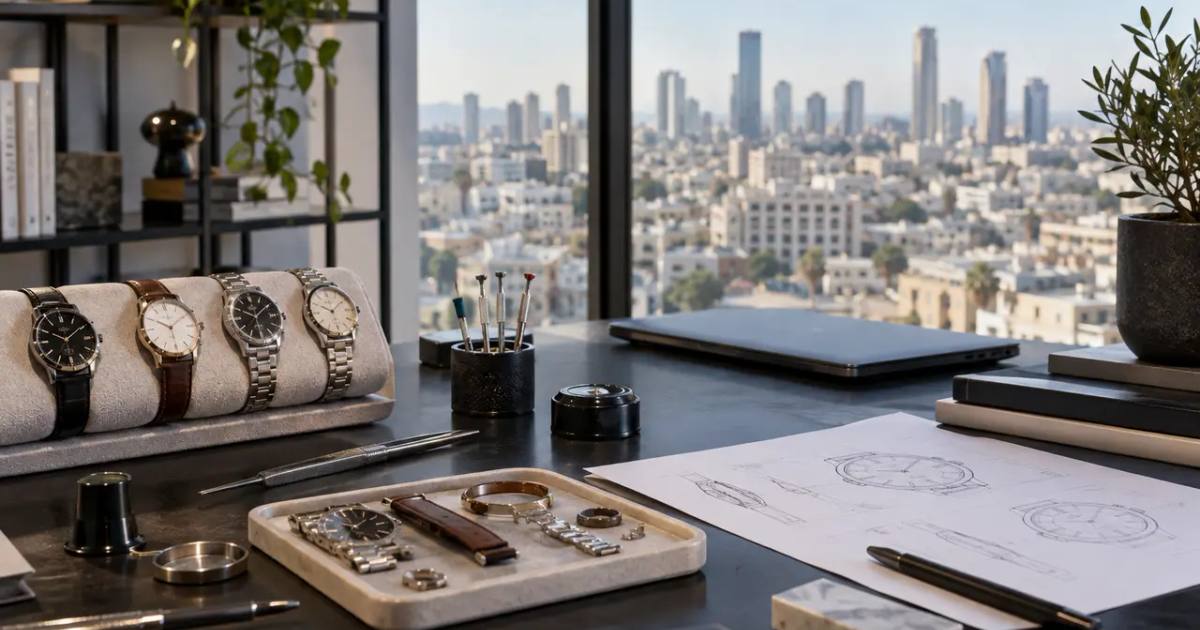

Israel is not known as a luxury watchmaking or leather-goods capital, yet its designers run real businesses in both. Itay Noy assembles roughly 120 to 150 limited-edition watches a year in Old Jaffa, Daniella Lehavi sells through about 100 US points of sale, and Carolina Lemke Berlin built an accessible eyewear brand. Nine founders show how different the models can be.
These businesses demonstrate the diversity of Israeli entrepreneurship beyond technology. Their strategies range from extreme exclusivity to international retail distribution. Importantly, they do not all operate in the same market segment: some produce genuine luxury products, while others serve premium or accessible fashion customers. Israel lacks Switzerland's centuries-old watchmaking infrastructure and Italy's reputation for leather goods, so each founder had to compete on craftsmanship, practicality, materials or contemporary design.
1. Itay Noy: The Independent Watchmaker in Old Jaffa
Founded: 2000. Location: Old Jaffa, Israel. Specialty: Limited-edition mechanical watches sold directly to collectors.
Itay Noy is the clearest example of an Israeli entrepreneur in the world of independent watchmaking. His studio in Old Jaffa assembles each watch by hand, to order, and he has released a new collection roughly every year since 2000. Output varies by source and year: Worldtempus reports around 120 watches annually, while Noy's own studio has cited about 150.
His designs explore how time is displayed. The Identity collection uses Hebrew, Arabic, Chinese, Japanese or Roman characters and is limited to 99 pieces per edition. Noy studied jewelry and object design at Jerusalem's Bezalel Academy of Art and Design and earned a master's degree at the Design Academy Eindhoven. His work is held in museum collections including the Israel Museum and the Tel Aviv Museum of Art.
Noy competes in an industry dominated by Switzerland without the manufacturing scale, advertising budgets or brand histories of established houses. His answer is artistic identity, limited production and a direct relationship between maker and customer. Collectors can understand the mechanism and the thinking behind each piece.
The business lesson: Scarcity, originality and direct relationships with collectors can support a specialized luxury business without mass production.
2. Daniella Lehavi: The Leather-Goods Brand With US Distribution
Founded: 1991. Founder: Daniella Lehavi. Current creative leadership: Ori Lehavi. Specialty: Leather handbags, shoes and accessories.
Daniella Lehavi founded her eponymous brand in 1991 after studying industrial design at Bezalel, starting from her living room. The company grew into one of Israel's best-known designer-accessories labels and, according to its official site, now operates ten stores in Israel and is available at about 100 points of sale in the United States.
Lehavi died in December 2013. Her son Ori, who had joined the company in 2005, continued the business and leads its creative direction. Product lines have expanded from bags and shoes into jackets and a wider range of accessories.
The brand shows how a designer-led company can grow through wholesale relationships as well as its own stores. Wholesale gives access to customers through existing retailers, but it also requires reliable production and delivery and a consistent brand identity across different retail environments. It is also a case study in succession: the founder's design identity was central, and the company had to preserve it while developing new products.
The business lesson: Strong design principles can outlast a founder when creative leadership is transferred successfully.
3. Hilla Toledano: Handmade Leather Goods From Tel Aviv
Founded: 2008. Founder: Hilla Toledano. Specialty: Handmade leather handbags and accessories.
Hilla Toledano launched her brand in 2008. According to the brand's website, the bags are handmade in Tel Aviv from leather sourced in Italy and France, and Toledano is involved in every step, from choosing the leather to labeling the finished product. The range includes handbags, evening bags, clutches and wallets.
The company reports that its bags are sold in more than 25 stores, including in Paris, China and the United States. That is a company-reported figure, not an independently audited current count.
Toledano's products sit between mass-produced accessories and the most expensive European luxury houses. Customers who want premium leather and individuality without buying from the largest fashion groups are the natural audience, and an artisan production story is part of what they pay for.
The business lesson: An independent accessories brand can build overseas stockists while keeping a clear, hands-on production identity.
4. Carolina Lemke Berlin: Accessible Eyewear Built by Israeli Entrepreneurs
Launched: 2011. Specialty: Fashion sunglasses and optical eyewear. Business model: Accessible pricing and branded retail.
Despite its Berlin-inspired name, Carolina Lemke Berlin was founded by Israeli entrepreneurs who were working from Berlin at the time, according to a Calcalist profile. They saw room between inexpensive generic sunglasses and high-priced designer eyewear. The brand is part of the Israeli retailer Castro and later expanded beyond sunglasses into optical eyewear.
It also shows the risks of celebrity-led growth. In 2018 the company signed Kim Kardashian West as US ambassador, and in 2019 its founder told Calcalist that only 20,000 of 100,000 pairs from her line had sold, according to Calcalist's report.
Eyewear suits repeat purchases, since customers can own several pairs for different occasions, but the model depends on efficient sourcing, retail operations, inventory management and marketing aimed at a broad customer base rather than a few collectors.
The business lesson: Accessible design and a clear retail proposition can win ground in categories historically dominated by expensive established brands.
5. Yael Rosen: The Designer Behind Kisim
Brand: Kisim. Founded: About 1999. Specialty: Handcrafted leather and fabric handbags.
Yael Rosen started Kisim around 1999, according to Business of Home, drawing on Japanese fabric design and traditional Middle Eastern leatherwork. The bags are known for clean lines, origami-inspired shapes and practical construction, and one was famously carried on screen in Sex and the City, as noted in Fodor's review.
Kisim concentrates on one category instead of trying to become a full fashion house. That focus lets the brand build expertise in the details customers care about: weight, storage, durability, straps and closures. The available sources document a longstanding Israeli designer brand with international exposure, but not the size of its current retail network.
The business lesson: A clear product specialization and a recognizable design language can sustain an independent fashion business.
6. Tali Epstein-Segal: From Seven Bags to the TES Label
Brand: TES. Based in: Tel Aviv. Specialty: Handmade leather handbags for women.
Tali Epstein-Segal was a saleswoman when she bought a piece of leather for about $11 and made seven bags, according to an ISRAEL21c profile. She had studied art and design at the College of Art in Ramat Hasharon. The same profile reported that TES bags went on to sell in about 30 shops across Israel and in the United States, appeared in Marie Claire in Turkey, and were part of a boutique collection tied to the TV series The L Word. She also runs her own boutique in Tel Aviv.
Her approach centers on the material. The brand says its bags are handmade in Israel from Italian leather, and Epstein-Segal told ISRAEL21c she likes to emphasize the leather, which she said ages well. The brand's website says she has worked in the local bag design scene for nearly two decades. The sources reviewed do not give current sales or store counts.
The business lesson: A tiny first batch and a clear focus on leather quality can grow into a brand with its own boutique and overseas stockists.
7. Einat Skalski: A Lancel Intern Turned Tel Aviv Boutique Owner
Brand: Skalski Leather Boutique. Based in: Tel Aviv. Specialty: Handcrafted leather accessories.
Einat Skalski studied fashion design at Shenkar College and earned a master's degree in design from the Richemont Group's Creative Academy in Milan, according to a profile on The Road to My Avennyou. She then interned in Paris at Lancel, where she designed the Pirates Bag, a limited edition sold exclusively at Colette in Paris. She was offered a permanent position but chose to return to Israel, where she opened her first store in Tel Aviv.
Her boutique designs, makes and markets leather accessories with handwork from start to finish. The profile does not give sales figures or international stockists, so the business is best read as a design-led boutique with a strong European pedigree.
The business lesson: Training at the top of the leather trade can become a founder's launch credential for an independent brand.
8. Abigail Panet: The Founder of Lady Bird
Brand: Lady Bird. Founded: 2010. Specialty: Leather bags and wallets. Training: Istituto Europeo di Design, Milan.
Abigail Panet came to leather through an unplanned route, as she told the Jerusalem Post. She studied art and psychology and worked in fashion styling and store-window design at Castro, then learned leatherwork in Rome and studied at the Istituto Europeo di Design in Milan. After a year working alongside veteran designer Daniella Lehavi, she launched Lady Bird in 2010.
Her bags aim for what she called upscale basics: clean lines, practicality and a neutral palette suited to local fashion. The Jerusalem Post reported that her leather is imported from Italy and finished at a factory in Turkey, and that the line was stocked in places including the Israel Museum gift shop. The sources reviewed do not establish the brand's present commercial status or international distribution.
The business lesson: Time spent inside an established brand can give a new designer the production knowledge to launch her own.
9. Keren Wolf: Statement Accessories and Bridal Headpieces
Specialty: Jewelry, headpieces and bridal accessories. Based in: Tel Aviv.
Keren Wolf is a former Israeli actress who became a jewelry and accessories designer, and her theatrical background shows in her work. Bridal accessories became a major part of her business. She has designed crowns and headpieces for Israeli bridal house Galia Lahav, as described in a Galia Lahav interview.
Her pieces have also reached the entertainment and fashion worlds. Press coverage credited her with the eyelid jewelry on Solange's 2019 album cover and the lip accessories in Marc Jacobs' spring 2019 collection. In 2025 she made bird-shaped rings and hand cuffs for Israeli singer Yuval Raphael's Eurovision outfit, according to Ynet.
Unlike handbags or eyewear, many of her pieces are meant to be noticed, so their appeal rests on originality rather than repeat everyday use.
The business lesson: Accessories can carry real brand value when they become recognizable artistic objects instead of interchangeable fashion products.
How Do Israeli Accessories Entrepreneurs Compete Internationally?
The businesses here serve different customers, but five themes recur.
Specialization can beat scale
Itay Noy's identity depends on exclusivity and original design, so competing on volume would undermine it. For other designers, specialization means focusing on handbags, leather craft or unusual accessories.
International distribution takes more than good design
Companies need reliable manufacturing, inventory management and retailer relationships. Daniella Lehavi's US wholesale presence and Toledano's overseas stockists show how designer brands reach customers abroad. Verified retail distribution is stronger evidence of expansion than media attention alone.
Materials shape brand identity
Leather, metal, gemstones and alternative materials influence pricing, production and customer expectations, and help decide whether a brand competes in luxury, premium or accessible fashion.
Luxury is not the same as high pricing
Luxury positioning combines design, craftsmanship, scarcity, reputation and customer experience. Itay Noy's limited editions fit an independent luxury model, while other businesses here are premium or contemporary fashion.
The founder often becomes the brand
A designer's story and craft attract customers, but they also create succession challenges. Daniella Lehavi's transition to Ori Lehavi's leadership shows a founder-led brand continuing after its creator is gone.
What Are the Business Economics of Watches and Fashion Accessories?
- Independent watches: Specialized knowledge, expensive components and precise assembly. Limited quantities support exclusivity but cap sales volume.
- Leather handbags: Material costs, manufacturing quality and seasonal collections. Wholesale opens international markets, but retailers take margin.
- Eyewear: Higher volumes, efficient sourcing and retail distribution, with repeat purchases possible.
- Artistic accessories: Strong publicity potential, but unusual designs can appeal to narrower groups.
These differences explain why there is no single formula for building an international accessories company.
Frequently Asked Questions
Are there Israeli luxury watchmakers?
Yes. Itay Noy is an independent Israeli watchmaker based in Old Jaffa whose studio produces limited-edition mechanical watches assembled by hand.
How many watches does Itay Noy make?
Estimates range from about 120 to about 150 per year, depending on the source and the year.
Which Israeli handbag brands sell abroad?
Daniella Lehavi reports about 100 US points of sale, and Hilla Toledano reports more than 25 stockists including Paris, China and the United States. Both figures are company-reported.
Who founded Daniella Lehavi?
Designer Daniella Lehavi founded the company in 1991. After her death in December 2013, her son Ori continued the business.
Is Carolina Lemke an Israeli brand?
Carolina Lemke Berlin was founded by Israeli entrepreneurs despite its Berlin-inspired name, and it is part of the Israeli retailer Castro.
Are all Israeli accessories brands luxury brands?
No. They operate across luxury, premium, contemporary and accessible fashion.
Why do independent watchmakers produce limited editions?
Limited runs can reflect manufacturing capacity, artistic intent and a strategy built on exclusivity.
What Does This Say About Israeli Entrepreneurship Beyond Tech?
Israel's accessories industry is more diverse than its international reputation suggests. Some businesses have established international distribution, others remain small and specialized, and a few have built reputations on craftsmanship and exclusivity. Not every successful business needs to become a multinational. For some founders, success means a recognizable product and a carefully defined customer base; for others, it means reaching thousands of shoppers through international retailers. The common factor is turning design into commercial value, and it is another reminder that Israel's business influence extends beyond technology.
How we report: Olam stories draw on public filings, company disclosures and named sources, checked by our editors. Read our methodology · Corrections