
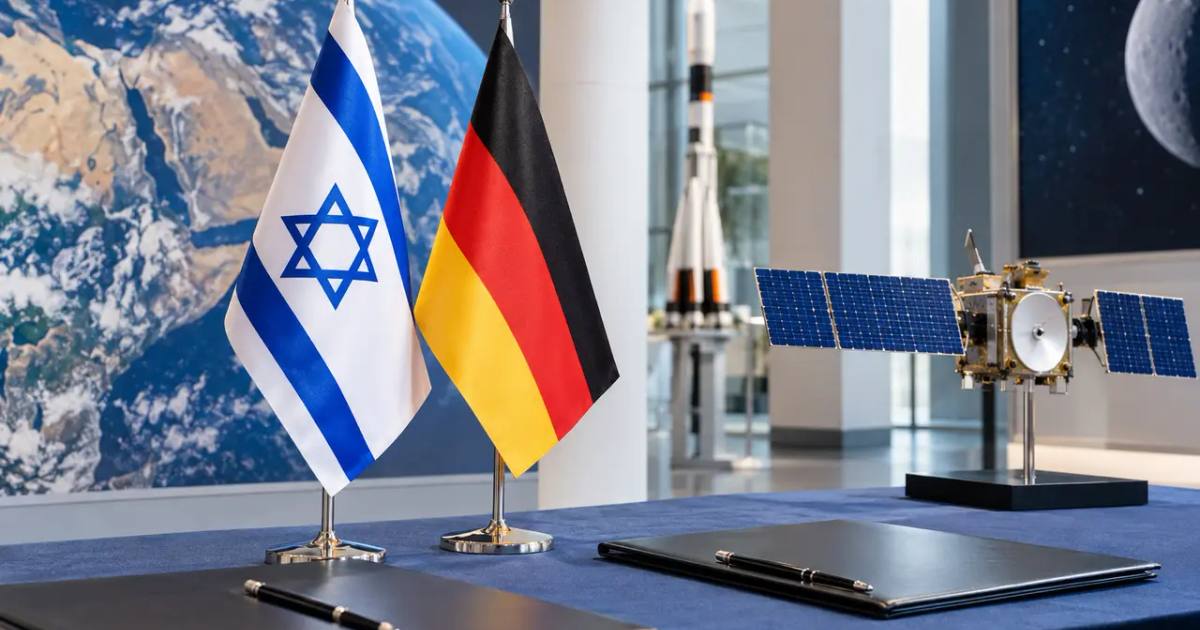

Israel and Germany signed a 10-year space framework in Berlin on November 19, 2026. It covers peaceful uses and joint research, with no announced financial value.
The Israel Germany space agreement is a 10-year strategic framework signed in Berlin on November 19, 2026, between the Israel Space Agency and the German Space Agency at the German Aerospace Center (DLR). Innovation, Science and Technology Minister Gila Gamliel signed for Israel. The pact covers joint research and peaceful uses of space, opens doors for universities and companies in both countries, and carries no announced financial value.
Last updated: November 25, 2026
What did Israel and Germany sign?
Israel and Germany signed a 10-year strategic framework agreement (הסכם מסגרת, heskem misgeret) for cooperation in space, according to the Israeli technology outlet Isra-Tech and the news site JFeed. The signing took place in Berlin on Thursday, November 19, 2026. The agreement is focused on peaceful uses of space, sets up long-term joint research and creates openings for academia and industry in both countries.
A framework agreement sets the rules for later projects. It does not fund a satellite, a launch or a research program by itself. Each agency will appoint points of contact, and those contacts will generally meet about once a year to review joint activities.
No financial value has been published for the pact. The reporting reviewed names no budget, no first program and no company that receives money under it, so the agreement is best read as a channel and not as a contract.
Who signed and who attended?
Gila Gamliel, Israel's Minister of Innovation, Science and Technology, signed for Israel, and JFeed notes that she also sits on the security cabinet. The parties to the agreement are the Israel Space Agency (סוכנות החלל הישראלית), which operates within her ministry, and the German Space Agency at DLR, the German Aerospace Center.
Isra-Tech lists three other attendees. Dr. Marcus Pleyer is State Secretary at Germany's Federal Ministry of Research, Technology and Space. Dr. Walther Pelzer is Director General of the DLR German Space Agency. Deputy Ambassador Guy Gilady led the Israeli Embassy officials present.
Germany matters in space policy because of the money it puts into Europe's shared programs. Isra-Tech reports that Germany provides roughly 23 percent of the budget of the European Space Agency, so a bilateral channel with Berlin is also a route into European projects.
How does it differ from earlier accords?
The 2026 agreement is the latest in a series of Israel Space Agency and DLR accords. The Jerusalem Post reported on a prior accord signed in November 2015, which said the previous agreement between the two agencies dated to 1995. That accord was described as an infrastructure for later agreements on specific space programs.
The new pact differs in length and political weight. It runs for 10 years and was signed by a cabinet minister in Berlin, according to JFeed. Gamliel said it follows the 10-year framework she signed with NASA. JFeed adds that it comes after recent space cooperation declarations with the Czech Republic and Kazakhstan.
| Accord | Partners | Term or timing | Source |
|---|---|---|---|
| First ISA and DLR accord | Israel Space Agency, DLR | 1995 | The Jerusalem Post |
| Renewed ISA and DLR accord | Israel Space Agency, DLR | November 2015, Tel Aviv | The Jerusalem Post, Nocamels |
| Strategic framework | Israel Space Agency, German Space Agency at DLR | 10 years, signed November 19, 2026, Berlin | JFeed, Isra-Tech |
Israeli and German space cooperation spans more than three decades, according to JFeed.
What happened at the Bremen space expo?
Israel took part in Space Tech Expo Europe 2026 in Bremen, Germany, in the same week as the signing, and JFeed reports it was the first Israeli national pavilion at the show. About 110 representatives from 24 Israeli companies attended, including Israel Aerospace Industries, Elbit Systems and Rafael. Maariv, the Israeli daily, reported that the pavilion was led by the Israel Space Agency.
The timing links diplomacy to sales. A government framework signed in Berlin while Israeli firms stand on a national stand in Bremen gives those firms a talking point with German and European buyers.
Olam covers the three named primes elsewhere. Israel Aerospace Industries builds satellites and missile defense, Elbit Systems is Israel's largest listed defense company, and Olam's comparison of Israeli defense overseas expansion looks at how Elbit, IAI and Rafael sell abroad. The Berlin agreement itself is framed around peaceful uses, so it does not by its own terms cover their defense lines.
What do ULTRASAT and Artemis show about the partnership?
ULTRASAT and Artemis I are the two joint projects that Israeli officials point to as proof the partnership already works. ULTRASAT is Israel's first space telescope, led by the Weizmann Institute of Science and the Israel Space Agency, and its main scientific camera was developed at DESY, a German research institute, according to JFeed and Isra-Tech. Olam profiles the Rehovot institution in its Weizmann Institute of Science entry.
On NASA's Artemis I mission in 2022, a German radiation-measuring mannequin named Helga and an Israeli one named Zohar flew around the Moon together. DLR and the Israel Space Agency are the agencies behind them.
DLR's own site records one more link: a cooperation agreement with the Israeli lunar project SpaceIL for its Beresheet2 mission, which uses a DLR-developed crater navigation algorithm. In ULTRASAT and Beresheet2, a German institution supplied a specific component, a camera and a navigation algorithm, to an Israeli-led mission.
What does the agreement mean for Israeli business?
The agreement means Israeli space companies and universities get a documented government channel into German and European programs, but no guaranteed orders. Orders still depend on tenders, European Space Agency procurement rules and company bids.
The economic base is already large. Olam's reporting shows bilateral Israel and Germany trade reached about $8.4 billion in 2024, which it analyzes in Israel and Germany: the $9 billion corridor. Germany rose 28 percent to second place among Israel's export markets in 2025, according to Olam's ranking of Israel's largest export markets. On defense, Olam's report on the Bundeswehr's Israeli arsenal counts more than $10 billion of German spending on Israeli systems since 2022.
The reporting reviewed gives no space-specific trade figure, so the framework adds a formal channel to an existing relationship and not a measured new market. Three groups could benefit first:
- Universities and institutes such as the Weizmann Institute, which already work with DESY and DLR on ULTRASAT.
- Satellite and instrument makers among the 24 firms at the Bremen pavilion, which now have a government agreement to cite.
- Small Israeli space startups seeking German partners for hardware, testing or launch services.
What should readers watch next?
Four signals would show whether the framework produces business. This is Olam's analysis and not a forecast from either agency.
- The first program-level agreement under the framework, with a named mission, a budget and a delivery date.
- The first meeting of the agency points of contact, which should happen within about a year if they follow the stated annual schedule.
- A second Israeli pavilion at a major European space show, which would indicate the Bremen presence was a strategy and not a one-time event.
- Any Israeli firm winning a German or European Space Agency contract and citing the agreement.
Until one of those appears, the accurate description is a 10-year diplomatic framework with no announced money, built on a 30-year record of joint science.
Frequently asked questions
What is the Israel Germany space agreement?
The Israel Germany space agreement is a 10-year strategic framework for space cooperation between the Israel Space Agency and the German Space Agency at DLR. It was signed in Berlin on November 19, 2026.
Who signed the agreement for Israel?
Gila Gamliel, Israel's Minister of Innovation, Science and Technology, signed it. The Israel Space Agency, which operates within her ministry, is the Israeli party.
How much is the agreement worth?
No financial value has been published. The reporting reviewed describes a framework for cooperation and does not list a budget or a funded program.
What does the agreement cover?
It covers long-term joint research and the peaceful use of space, and it creates opportunities for academia and industry in both countries. Each agency will appoint points of contact who meet about once a year.
Which Israeli companies are involved?
The agreement names no companies. Israel Aerospace Industries, Elbit Systems and Rafael were among about 24 Israeli firms at the national pavilion at Space Tech Expo Europe in Bremen during the same week.
What is ULTRASAT?
ULTRASAT is Israel's first space telescope. The Weizmann Institute of Science and the Israel Space Agency lead it, and DESY, a German research institute, developed its main scientific camera.
Sources
- Isra-Tech report on the agreement, November 24, 2026
- JFeed report on the signing, November 2026
- Jerusalem Post on the earlier accord, 2015
How we report: Olam stories draw on public filings, company disclosures and named sources, checked by our editors. Read our methodology · Corrections