
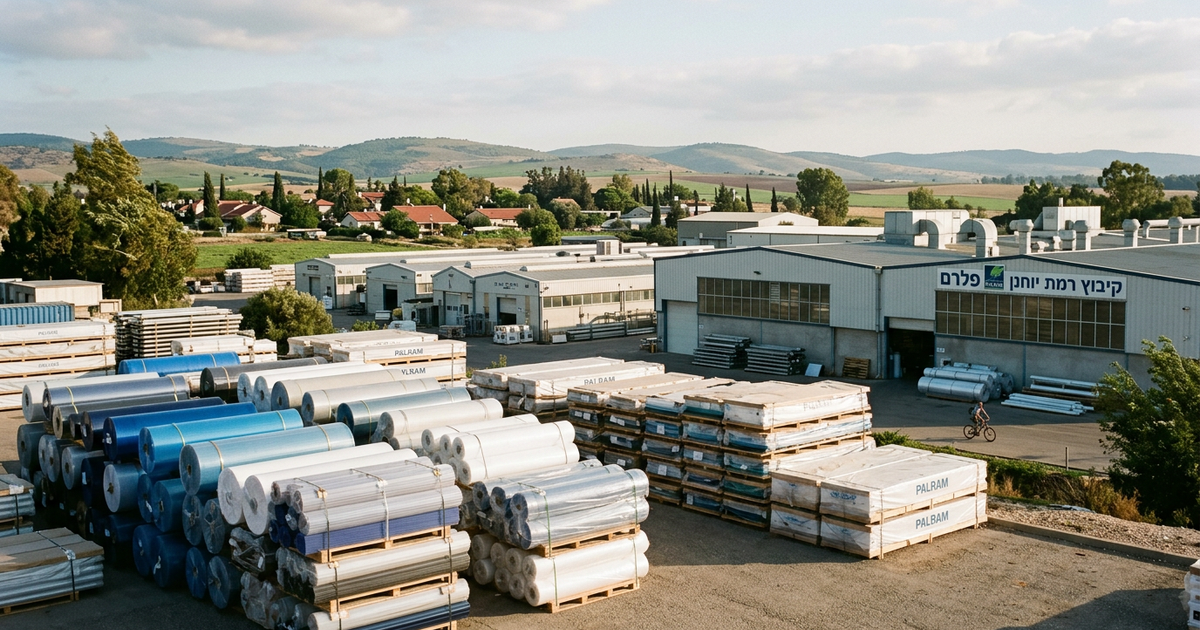

Palram became Israel's most valuable kibbutz company in 2024 — NIS 2.2B market cap, up 132%. Kibbutz Ramat Yohanan holds 65%, worth ~NIS 1.4B. The single largest kibbutz equity position in the entire industrial complex.
Palram Industries became Israel's most valuable kibbutz-controlled company during 2024, with a Tel Aviv Stock Exchange market capitalization of approximately 2.2 billion shekels and a share-price gain of 132 percent on the year — the second-best performing stock on the TA-125 Index. The company manufactures extruded thermoplastic sheets and panel systems — polycarbonate, PVC, and acrylic — for construction, agriculture, industrial fabrication, advertising and signage, DIY retail, and architectural projects. Annual revenue exceeded $482 million in 2025. The company operates nine production sites globally with operations on six continents and roughly 1,400 employees. Headquarters remain on Kibbutz Ramat Yohanan east of Haifa Bay. The kibbutz holds 65 percent of the company; the holding position is worth approximately 1.4 billion shekels at the current market capitalization.
The Ramat Yohanan founding generation
Kibbutz Ramat Yohanan was founded in 1931 on land purchased by Yehoshua Hankin from Lebanese owners in 1925. The founders were a mix of American-born Jewish immigrants and native-born Palestine Jews, organized through Hashomer Hatzair. The kibbutz was named for Jan Smuts, the South African prime minister and a personal friend of Chaim Weizmann who was an early Gentile supporter of Zionism. Smuts's Hebrew first name — Yohanan — became the kibbutz's name. The site was on the Zevulun Plain near Kiryat Ata, in agricultural country between Haifa Bay and the Galilee.
The kibbutz produced one of the more consequential figures in Israeli history almost incidentally. Yitzhak Rabin, after graduating high school in 1940, joined Ramat Yohanan's Noar Ha'oved (Working Youth) training program and spent a year on the kibbutz before continuing his agricultural-and-military education at the Kadoorie Agricultural School. Ramat Yohanan was also the site of the 1948 Battle of Ramat Yohanan during the Israeli War of Independence. The kibbutz's post-1948 economy was built on dairy (600 milk cows today), avocado, lychee, citrus, field crops, and a large poultry operation.
1963: the founding of Palram
Palram was established on Kibbutz Ramat Yohanan in 1963 as a small extruded-plastics operation. By 1963, Israel had a domestic construction and agricultural sector that needed reliable supplies of thermoplastic sheet and corrugated polymer products, and almost no domestic capacity to produce them at scale. A kibbutz with available capital and an appetite to build industrial capacity could capture a defensible domestic market with relatively limited initial investment.
The early product line was modest: corrugated PVC sheeting for agricultural roofing, basic polycarbonate flat sheet for industrial applications, signage media for the small Israeli advertising market. Over the next two decades, Palram expanded its product range across the major thermoplastic categories — polycarbonate (flat, multi-wall, and corrugated), PVC (flat, corrugated, foamed, and solid), and acrylic — and developed downstream finished-product lines that integrated the extruded sheet into greenhouses, garden sheds, conservatory roofing, and DIY home-improvement kits sold through retail chains globally.
Kibbutz Ramat Yohanan's 65 percent stake in Palram is currently worth approximately 1.4 billion shekels — the single largest kibbutz equity holding in any operating company in the entire industrial complex.
The TASE listing and the global build-out
Palram listed on the Tel Aviv Stock Exchange (ticker PLRM) and built out its international operations across the 2000s and 2010s with acquisitions and greenfield manufacturing investments. The company now operates nine production sites globally and serves more than 100 export markets. Approximately 39 percent of sales go to the United States, 36 percent to Europe, and 25 percent to Israel and the rest of the world. The product mix continues to be dominated by extruded thermoplastic sheet and panel systems, with growing exposure to architectural applications — including a 20mm multi-wall polycarbonate roof installation on the Hangzhou Sports Park Stadium for the 2022 Asian Games.
The 2024 share-price surge was driven by multiple factors. Construction and DIY demand recovered post-pandemic. The Israeli reconstruction need following October 7 drove domestic sales up 45 percent in the first three quarters of 2024 alone. The company's nine production sites across multiple continents insulated it from the worst of the post-October 7 supply-chain disruption. The broader Israeli industrial-stock rerating lifted Palram alongside Beit Shemesh Engines and several other TASE-listed names.
The Ramat Yohanan labor-services agreement
Palram's relationship with Kibbutz Ramat Yohanan operates through a structure that is unusual in disclosure terms but representative of how the larger kibbutz industrials interact with their founding kibbutzim. Beyond the 65 percent equity holding, the kibbutz and the company maintain a series of operational service agreements that generate more than 50 million shekels annually in revenue for the kibbutz. The largest of these is a personnel and office-services agreement under which the kibbutz provides Palram with the services of approximately 60 kibbutz members who work at the company, in exchange for annual consideration of 29.9 million shekels — approximately 500,000 shekels per kibbutz member per year. The company also employs 673 salaried non-kibbutz employees on its own books.
As of September 30, 2024, Palram had also distributed 90 million shekels in dividends for the year, the bulk of which flowed to Kibbutz Ramat Yohanan's holding entity. The combined effect of dividend distributions and service-agreement consideration places the annual cash flow from Palram to the kibbutz well above 100 million shekels.
| Founded | 1963, Kibbutz Ramat Yohanan (kibbutz founded 1931) |
|---|---|
| Ownership | Kibbutz Ramat Yohanan 65%; TASE-listed minority |
| Ticker | TASE: PLRM |
| 2024 market cap | ~NIS 2.2 billion (Israel's #1 kibbutz company) |
| 2025 revenue | ~$482 million |
| 2024 share-price performance | +132% |
| Production sites | 9 globally, 6 continents |
| Sales geography | US 39%, Europe 36%, Israel/RoW 25% |
The structural lesson
Palram is the case study in patient capital. The 2024 share-price surge that made Palram Israel's most valuable kibbutz company was the result of sixty years of compounded operational execution, not a single transformative transaction. Compare this to the more dramatic arcs in the sector. Netafim's growth was anchored on a single technological invention. Plasan's peak revenue was driven by a specific geopolitical event. Palram's story is neither. It is a thermoplastic-sheet manufacturer that quietly built nine plants on six continents, kept costs disciplined, and waited for the equity multiples to catch up to the underlying operating performance.
The lesson for the second-generation kibbutz holding companies is that the most valuable position in the sector right now does not belong to the kibbutz with the most famous product. It belongs to the kibbutz with the most patient operating execution. Ramat Yohanan, with its 65 percent of Palram, currently holds the single largest kibbutz equity position in the entire industrial complex.
Part of the Olam series on the kibbutz industrial complex. Read the pillar.