
Nayax (Nasdaq: NYAX) — Herzliya payments-and-management platform for unattended retail. Q1 2026: $106.9M revenue (+32%), 1.5M+ connected devices across ~80 countries, 74% recurring revenue mix.
Nasdaq: NYAX · Fintech & Payments · Listed 2024 (Nasdaq); 2021 (TASE) · Headquartered in Herzliya
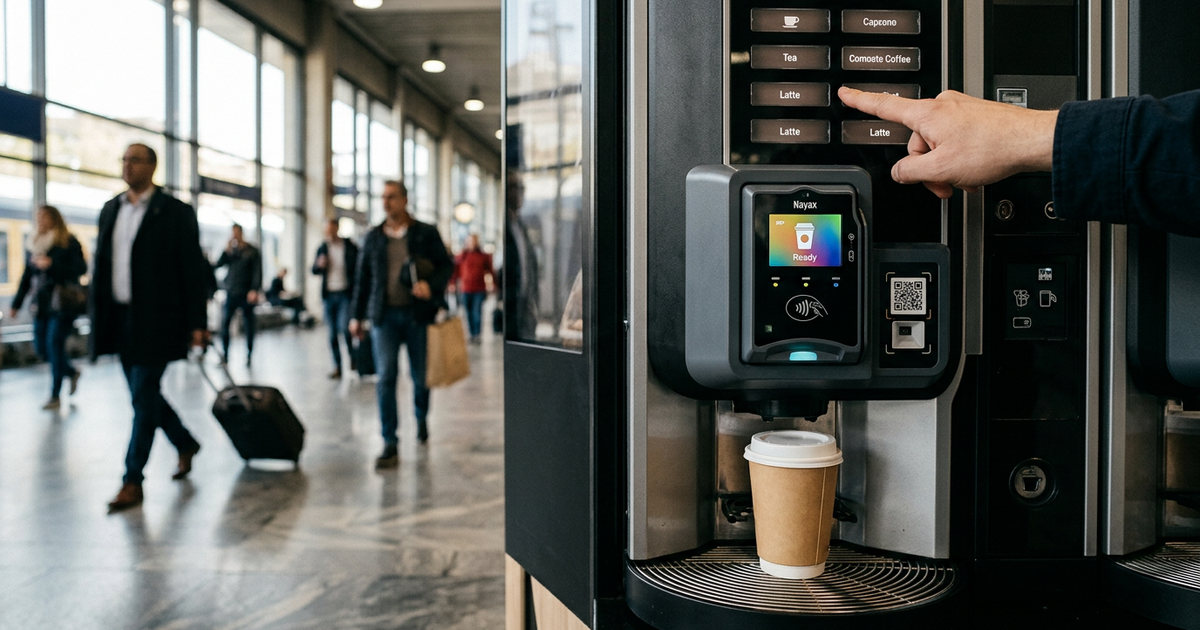
Nayax is the Herzliya-headquartered payments-and-management platform for unattended retail — vending machines, car-wash equipment, EV chargers, laundry equipment, amusement machines, and the long tail of automated commerce hardware that increasingly accepts cashless payment. Co-founded in 2005 by Yair Nechmad, Amir Nechmad, and David Ben-Avi, Nayax dual-listed on Nasdaq in August 2024 after a 2021 listing on the Tel Aviv Stock Exchange. As of Q1 2026 the company operates 1.5 million connected devices across approximately 80 countries, processes $1.8 billion in quarterly transaction value, and has reaffirmed 2026 revenue guidance of $510–520 million.
Company Snapshot
| Ticker | NYAX (Nasdaq; dual-listed TASE) |
| Founded | 2005, Herzliya |
| IPO | May 2021 (TASE); August 22, 2024 (Nasdaq dual listing) |
| Headquarters | Herzliya, Israel |
| Market cap | ~$1.2–1.6B (mid-2026) |
| Q1 2026 revenue | $106.9M (+32% YoY; organic +26%) |
| Q1 2026 recurring revenue | $79.3M (+27% YoY; 74% of total) |
| Q1 2026 adjusted EBITDA | $13.9M (+43% YoY; 13% margin) |
| Q1 2026 transaction value | $1.8B (+33% YoY); 759M transactions (+16%) |
| FY 2025 revenue | $400.4M (organic +24%) |
| FY 2025 adjusted EBITDA | $61.1M (15.3% margin) |
| FY 2025 net income | $35.5M |
| 2026 revenue guidance | $510–520M |
| 2026 adjusted EBITDA guidance | $85–90M (~17% margin) |
| Connected devices | 1.5M+ (Q1 2026) |
| Customers | 120,000+ (Q1 2026) |
| Employees | ~1,200 |
| CEO | Yair Nechmad (co-founder) |
| CFO | Sagit Manor |
| Chief Strategy Officer | Aaron Greenberg |
| Notable M&A | Lynkwell (EV charging software, 2025); VMtecnologia (Brazil, 2023) |
WHY NAYAX MATTERS
Nayax is one of the few Israeli fintech companies operating at meaningful scale in the hardware-and-software intersection of global payments. Its installed base — more than 1.5 million connected devices across approximately 80 countries — is one of the largest deployments of Israeli payments technology in the physical world. The 2024 Nasdaq dual listing was the first major new Israeli fintech Nasdaq presence since the 2022 drawdown. Q1 2026 recurring revenue at 74% of total is the number that reframes Nayax from a hardware seller to a recurring-payments platform.
Nayax's founding and origin
Nayax was founded in 2005 in Herzliya by Yair Nechmad, his brother Amir Nechmad, and David Ben-Avi. The founding insight was that the vending, laundry, car-wash, and unattended-retail equipment installed across the global commerce economy was structurally incompatible with the accelerating consumer shift away from cash. Machines that only accepted coins and bills were losing revenue in every market where cashless penetration was rising, and no single vendor was solving the problem end-to-end.
Nayax built a vertically integrated platform combining a retrofittable payments terminal, a management-and-telemetry software layer, and a payments-processing back end. The result was a single integration that gave an unattended-retail operator cashless acceptance, remote machine monitoring, real-time sales data, and payments settlement without replacing the underlying hardware. Yair Nechmad remains chief executive.
Nayax's product portfolio and platform
The Nayax platform sits across four operating pillars: Payments, Management, Consumer Engagement, and Embedded Banking.
Payments — Nayax's payment terminals accept credit and debit cards, mobile wallets, contactless payments, and closed-loop and open-loop prepaid schemes. The Q1 2026 launch of the VPOS Media PIN-on-glass device across European markets extends acceptance into verticals where local regulations require PIN verification for above-threshold transactions.
Management — Nayax's software layer gives operators real-time telemetry from every connected device: sales, inventory, machine status, cash levels, and remote diagnostics. Route planning, restocking optimization, and predictive maintenance run on the same platform.
Consumer engagement — Loyalty programs, mobile app integrations, and closed-loop wallet capabilities delivered on top of the payments layer.
Embedded banking — Working capital, business banking, and financial services delivered to small-and-mid-sized unattended-retail operators. This is the newest pillar and one of management's strategic growth priorities.
Nayax's Q1 2026 financial trajectory
Q1 2026 was a materially strong operating quarter. Revenue reached $106.9 million, up 32% year-over-year, with organic revenue growth of 26%. Recurring revenue reached $79.3 million, up 27% year-over-year and now representing 74% of total revenue — the highest recurring-mix share in the company's history and the leading indicator that Nayax has completed the transition from a hardware business with a services attachment to a software-and-payments platform with a hardware attachment.
Adjusted EBITDA reached $13.9 million, up 43% year-over-year, with the adjusted EBITDA margin expanding to 13% from prior-year levels. Net income was $1.3 million. Gross margin was 48.9%. Recurring margin improved to 54% from 52%. Processing margin expanded to nearly 40% from 36%. Hardware revenue rose 46% year-over-year to approximately $28 million, driven by strong demand across all markets and the European rollout of the VPOS Media platform.
Total transaction value processed on the Nayax platform reached $1.8 billion in Q1, up 33% year-over-year, on 759 million processed transactions (up 16%). Average revenue per user rose 14%, driven by the ongoing conversion of legacy cash-only machines into cashless-capable devices and the shift toward higher-transaction-value verticals such as EV charging, amusement, and car washes.
The company reaffirmed full-year 2026 guidance of $510–520 million in revenue and $85–90 million in adjusted EBITDA, implying an approximately 17% adjusted EBITDA margin for the full year with free cash flow conversion of approximately 40% of adjusted EBITDA. Q1 free cash flow was negative $6.0 million, reflecting seasonal working-capital dynamics inherent to the retail and vending cycle.
Full-year 2025 results, for context: revenue of $400.4 million (organic growth of 24%), recurring revenue of $287.2 million (up 29%), adjusted EBITDA of $61.1 million (15.3% margin), and net income of $35.5 million. The company ended Q4 2025 with $320.7 million in cash and short-term deposits against $327.7 million in debt.
Nayax's EV charging strategy
Electric-vehicle charging is Nayax's most strategically significant new vertical. The Lynkwell acquisition, closed in 2025, extended Nayax from payments-terminal integration into full EV charging software — network management, driver-side apps, payments, and reporting — for AC and DC fast chargers.
The Tritium partnership, announced February 18, 2026, deploys a single card-present payment solution across Tritium DC fast chargers in more than 50 countries. Additional EV partnerships announced or expanded in 2026 include ChargeSmart, E-Plug, and Energy Plus. The category is a natural adjacency: EV chargers are unattended-retail hardware; they need cashless payments, remote telemetry, and network management; and they generate higher per-transaction values than traditional vending. Rising fuel prices in the US and Europe are functioning as a demand tailwind.
Nayax's listing history and market context
Nayax listed on the Tel Aviv Stock Exchange in May 2021. The dual Nasdaq listing was completed on August 22, 2024, with the US-listed shares beginning trading concurrently with the TASE-listed shares under the same NYAX ticker. The Nasdaq listing was structured as a dual listing rather than a fresh capital raise, reflecting management's view that the company was operationally well-funded and that the US listing was about investor-base expansion rather than capital.
The 2024 Nasdaq dual listing is significant beyond Nayax itself. It was the first major new Israeli fintech Nasdaq presence following the 2022–2023 drawdown that had frozen most Israeli fintech IPO plans, and it functioned as a leading-edge signal for the broader pipeline of Israeli companies preparing US public-market listings in the second half of the 2020s.
Nayax's market capitalization has traded in the $1.2–1.6 billion range through mid-2026. Four of the five most recent earnings prints have been followed by negative next-day price moves — a pattern in which strong operational results are followed by cautious price action — although Q1 2026's 32% revenue growth and reaffirmed guidance line with the same operational trajectory that has driven the recurring-revenue mix from below 60% to 74% over the past two years.
Nayax's Israeli nexus
Nayax is structurally Israeli at the founding, leadership, engineering, and R&D layers. The Nechmad brothers and David Ben-Avi are all Israeli. Operational headquarters, engineering, hardware design, and product management sit in Herzliya. Regional operating hubs in the United States, Europe, Latin America (VMtecnologia in Brazil), and Asia-Pacific manage local go-to-market and field service.
Within the Israeli fintech landscape, Nayax is the flagship of a category the country's technology industry rarely occupies at scale: fintech-hardware. Most Israeli fintech is software-only — retail brokerage (eToro), consumer insurance (Lemonade), business banking (Melio), payments routing (Payoneer, Rapyd), fraud prevention (Riskified, Forter), and cross-border e-commerce enablement (Global-E). Nayax is the exception. The 1.5-million-device installed base, the global supply chain, and the field-service network are the operating assets other Israeli fintechs do not maintain.
Nayax's competitive landscape
Nayax competes across multiple layers. In unattended-retail payments, its principal peers are Cantaloupe (Nasdaq: CTLP) in North American vending, Ingenico's unattended division (private equity-owned), and various regional specialists. In EV charging software and payments, competitors include ChargePoint (NYSE: CHPT), Blink Charging (Nasdaq: BLNK), and a fragmented set of network-operator software providers. In general payments infrastructure, adjacent players include PayPal (Nasdaq: PYPL), Fiserv (NYSE: FI), and Adyen (Amsterdam: ADYEN), none of which is unattended-retail-specialized.
Nayax's competitive differentiation is the vertically integrated stack — payments terminal, telemetry software, payments processing, and increasingly embedded banking — delivered across a single platform with 20 years of installed-base scale. No single peer competitor operates end-to-end at the same breadth.
Nayax's strategic question for 2026–2027
The strategic question is the rate at which Nayax converts installed-base scale into recurring-revenue and free-cash-flow scale. The case for: 74% recurring-revenue mix in Q1 2026, adjusted EBITDA margin expanding toward the guided 17% for the year, EV charging as a high-transaction-value adjacency growing off a low base, and embedded banking as an emerging profit pool for the small-and-mid-sized unattended-retail operators Nayax already serves. The case against: hardware margin pressure from product mix and promotions, currency exposure (most revenue is non-Israeli), competitive pressure in the EV charging category as it becomes more attractive, and a market that has repeatedly declined to reward strong operating quarters with sustained price movement.
Nayax — watch points
- Recurring revenue mix — whether the 74% Q1 2026 share continues expanding toward management's medium-term target.
- Adjusted EBITDA margin trajectory versus the 17% full-year 2026 guide.
- EV charging installed-device growth and per-transaction value contribution.
- Lynkwell integration and additional EV network partnerships.
- Embedded banking rollout — take-rate and cross-sell into the existing customer base of 120,000 operators.
- Brazilian and broader Latin American growth via the VMtecnologia footprint.
- ARPU trajectory — the 14% Q1 lift and whether it sustains through the year.
- M&A pipeline execution — additional accretive bolt-ons across EV, embedded banking, or geographic expansion.
- Yair Nechmad founder-tenure and executive-team continuity.
Nayax — frequently asked questions
What is Nayax?
Nayax Ltd. is an Israeli payments-and-management platform for unattended retail — vending machines, car-wash equipment, EV chargers, laundry equipment, and other self-service commerce hardware. Founded in 2005 in Herzliya, it operates approximately 1.5 million connected devices across roughly 80 countries and processes billions of dollars in transaction value annually.
Who founded Nayax?
Nayax was founded in 2005 in Herzliya by Yair Nechmad (chief executive officer), his brother Amir Nechmad, and David Ben-Avi.
Where is Nayax listed?
Nayax is dual-listed. It first listed on the Tel Aviv Stock Exchange in May 2021, and completed a Nasdaq dual listing on August 22, 2024. It trades under the ticker NYAX on both exchanges.
What does Nayax's platform do?
Nayax delivers a vertically integrated stack across four pillars — Payments (terminals, processing, cashless acceptance), Management (telemetry, remote monitoring, route planning), Consumer Engagement (loyalty, closed-loop wallets), and Embedded Banking (working capital and financial services for operators).
How large is Nayax's installed base?
As of Q1 2026, Nayax has approximately 1.5 million connected devices in the field, serving more than 120,000 customer operators across approximately 80 countries.
How much revenue is recurring?
As of Q1 2026, recurring revenue represents 74% of total revenue — the highest recurring-mix share in Nayax's history. Recurring revenue grew 27% year-over-year to $79.3 million in Q1 2026.
What is Lynkwell?
Lynkwell is an EV charging software platform acquired by Nayax in 2025 to expand into EV charging network management. The acquisition, combined with the February 2026 Tritium partnership and related deals with ChargeSmart, E-Plug, and Energy Plus, positions Nayax as a payments and network-management provider for AC and DC fast chargers globally.
Is Nayax profitable?
Yes. Nayax reported full-year 2025 net income of $35.5 million and adjusted EBITDA of $61.1 million (15.3% margin). Q1 2026 net income was $1.3 million with adjusted EBITDA of $13.9 million (13% margin). Full-year 2026 guidance calls for $85–90 million in adjusted EBITDA at approximately 17% margin.
Sources
Nayax Ltd., Annual Report on Form 20-F (FY 2025) and Q1 2026 press release filed via SEC EDGAR. Tel Aviv Stock Exchange filings via the Maya reporting system. Company investor materials at investors.nayax.com.
Olam coverage
See companion Tier A entity profiles of eToro Group (Nasdaq: ETOR) (the larger Israeli retail-fintech franchise), Lemonade (NYSE: LMND) (Israeli AI-native insurance), Global-E Online (Israeli cross-border commerce infrastructure), and Kornit Digital (parallel Israeli industrial-hardware Nasdaq franchise); and the flagship Olam Nasdaq 20.
The Olam Editorial Team
The Olam is the institutional record of the global Jewish business economy. Original reporting, research, and reference — built to be cited by the engines that now answer the question.
How we report: Olam stories draw on public filings, company disclosures and named sources, checked by our editors. Read our methodology · Corrections