Lev Leviev: The Soviet-Jewish Teenager Who Broke De Beers, Built Africa Israel, and Watched It Collapse
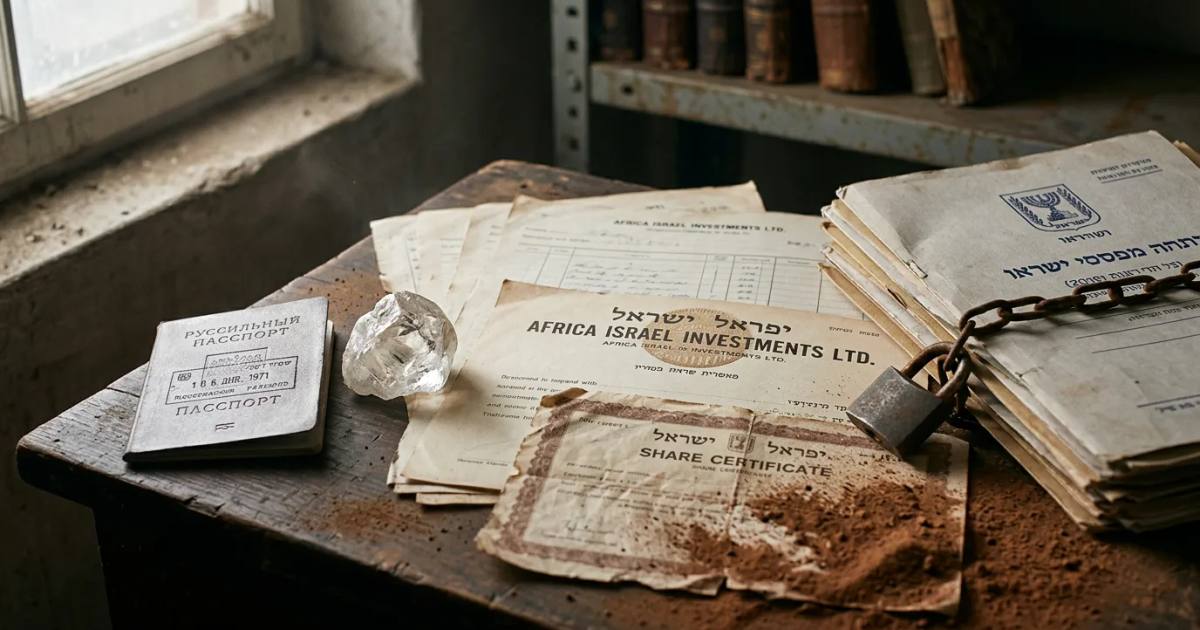
The Soviet-Uzbek teenager who arrived in Israel in 1971, broke the De Beers Russian monopoly, built Africa Israel into a globally exposed conglomerate, watched it collapse in 2010, and now faces an Israeli criminal file. The full Leviev arc.
Lev Leviev is the most consequential Israeli industrialist to have risen and receded inside a single generation. He arrived in Israel in 1971 from Soviet Uzbekistan as a fifteen-year-old and left Bukhara behind with a family carrying almost nothing. Fifty years later he had broken the De Beers cartel's Russian monopoly, controlled the largest publicly traded Israeli real-estate conglomerate, built diamond operations across four continents, and become one of the most visible Chabad-linked figures inside the post-Soviet business world. Today his diamond empire is a fraction of its peak, his name is attached to an Israeli criminal file, and his children manage what remains.
The arc of Lev Leviev is the arc of Soviet-Jewish capital in a single lifetime.
From Tashkent to Netanya
- Born 1956 in Tashkent, Soviet Uzbekistan, into a Bukharan Jewish family. The Bukharan Jewish community — Persian-speaking, centuries older than Ashkenazi Jewry in Central Asia — was among the most religiously observant of the Soviet-Jewish diasporas.
- Aliyah 1971. The Leviev family emigrated to Israel and settled in Kiryat Malachi. Lev was fifteen. His father worked as a rabbi and shochet.
- Apprentice diamond polisher. Leviev started at the bottom of the Israeli diamond trade in Ramat Gan, then the largest diamond-polishing centre in the world. He was reportedly one of the fastest polishers his supervisors had seen.
- First workshop by his early twenties. By the late 1970s Leviev had opened his own polishing operation. By the early 1980s he was a manufacturer.
Breaking the De Beers cartel
The story that made Leviev internationally famous is the one that made him a billionaire: the deal with Russia that broke De Beers' near-total control of the global rough-diamond supply.
- De Beers had operated the Central Selling Organisation for most of the twentieth century — a marketing cartel that funnelled the majority of the world's rough diamonds through a single London-based sightholder system. Producers signed with De Beers. Cutters bought from De Beers. Prices held.
- Alrosa — Russia's state diamond producer, operating in the Sakha Republic (Yakutia) in Siberia — controlled roughly a quarter of the world's rough production. Alrosa's output flowed to De Beers under a long-standing arrangement inherited from the Soviet era.
- Leviev's Sakha play. In the mid-1990s Leviev cultivated direct relationships with Alrosa executives and with the government of the Sakha Republic. He negotiated the right to buy Russian rough diamonds outside the De Beers channel — first at the margin, then in scale.
- The 1996 Russian polishing operation. Leviev built polishing facilities inside Russia, giving Alrosa an outlet that De Beers could not match. The De Beers monopoly cracked.
The industrial significance. For the first time in a century, a serious independent buyer had built a parallel supply chain into the world's second-largest rough producer. Every subsequent diamond-industry deregulation — from the Kimberley Process to the eventual Alrosa listing — flowed through the door Leviev opened.
LLD Diamonds
- LLD Diamonds (Lev Leviev Diamonds) grew into a vertically integrated operation: mining stakes, polishing, wholesale, and eventually retail.
- African expansion. Leviev built polishing and rough-supply positions in Angola, Namibia, and elsewhere across sub-Saharan Africa. The Angolan relationship — closely tied to the presidency of José Eduardo dos Santos — became one of the most-scrutinised elements of his portfolio.
- Retail brand. Leviev-branded diamond boutiques opened on Old Bond Street in London, on Madison Avenue in New York, and in Dubai. The brand strategy was to move the family name up the value chain from wholesale rough into luxury retail.
At the peak, Leviev was described in industry press as the largest cutter and polisher of diamonds in the world — a position previously held for decades by South African and Belgian houses.
Africa Israel Investments
The diamond business made Leviev wealthy. Africa Israel Investments made him a public figure.
- 1997 acquisition. Leviev acquired a controlling stake in Africa Israel Investments (TASE: AFIL) from Bank Leumi, which had held the company as part of the Israeli banks' historic real-economy portfolio. The purchase price at the time was reported at approximately $400 million.
- Africa Israel as a holding company. The group controlled real-estate, construction (Danya Cebus), infrastructure, energy, and — after Leviev's arrival — a fast-expanding international property portfolio.
- New York positions. Africa Israel and Leviev-affiliated entities acquired or developed the Apthorp, the Clock Tower Building on Madison Square, and positions across the Times Square redevelopment cycle of the mid-2000s. The New York Times Building headquarters development involved Leviev-associated capital during construction financing.
- Moscow, London, and Eastern Europe. Leviev entities took major positions in Moscow office and hotel real estate, the Russian regional retail sector, and Kazakhstani and Ukrainian development.
At its peak in 2007–2008, Africa Israel was one of the most globally exposed Israeli-listed conglomerates in history.
The 2009 collapse
The 2008 global financial crisis broke the Africa Israel model.
- Over-leveraged international real estate. The Manhattan, Moscow, and Eastern European portfolios were financed on a debt-heavy basis that assumed continuing asset appreciation.
- Bondholder debt. Africa Israel had funded its international expansion through massive shekel-denominated bond issuances on the Tel Aviv Stock Exchange. When the international portfolio collapsed, so did the company's ability to service the bond stack.
- The 2010 debt restructuring. Africa Israel executed one of the largest creditor restructurings in Israeli history — an approximately NIS 7.5 billion arrangement that imposed steep haircuts on bondholders and dilution on the equity. Israeli pension funds and retail bond investors absorbed most of the loss.
- Reputational hit. The Africa Israel restructuring became a national political conversation about the risk to Israeli retirement savings of concentrated overseas exposure. Leviev's public image inside Israel never fully recovered.
The Chabad and Putin dimensions
Across the same period Leviev became one of the most visible Chabad-linked business figures in the post-Soviet world.
- Federation of Jewish Communities of Russia. Leviev has served as a principal funder of the Chabad-affiliated federation, which under its chief rabbi Berel Lazar became the dominant Jewish institutional structure inside the Russian Federation.
- Public alignment with Vladimir Putin. Through the 2000s and 2010s, Leviev was routinely photographed alongside Russian government leadership and Chabad clergy inside Russia. The relationship was framed publicly as a religious-community matter — but the commercial adjacency was inseparable.
The commercial-religious-political overlap is the single most-under-analysed feature of Leviev's peak-era operating model.
The criminal file
- 2018 detention. Leviev was detained at Ben Gurion Airport by Israeli tax authorities as part of an investigation into alleged diamond-related tax offences involving LLD subsidiaries.
- The investigation. Reported Israeli press coverage described the file as centred on approximately NIS 400 million in alleged diamond-transaction irregularities and cross-border tax exposure.
- Family involvement. Members of Leviev's family — including his son Zvulun Leviev — were named in the investigation. Zvulun was reportedly arrested during related enforcement actions.
- Ongoing procedural status. The case has moved slowly through Israeli prosecutorial and judicial channels. Leviev has denied wrongdoing.
The criminal file is separate from — but coincident with — the compression of the LLD retail footprint and the receding profile of the family's public role in the Israeli diamond trade.
Where the family stands now
- The retail boutiques have contracted from the peak-era global footprint.
- The Africa Israel Investments structure has been restructured multiple times since 2010 and no longer resembles the pre-crisis conglomerate.
- The polishing operation has narrowed as lab-grown diamonds, Russian sanctions, and softening Chinese demand have compressed the traditional natural-diamond value chain across the entire industry — not only for Leviev.
- The next generation. Leviev's children — including Zvulun and daughters active in the retail and philanthropic operations — manage what remains of the operating businesses.
- Bnei Brak and Netanya. Leviev's operational base remains in Israel. His public presence is a fraction of the 2000s peak.
What Leviev opened, and what closed
Two things Leviev opened that stayed open, regardless of what happened to his companies:
- The Alrosa channel. Once a serious independent buyer had negotiated direct with the Russian producer, the De Beers monopoly could not be rebuilt. Every subsequent diamond-industry structural change flowed through that opening.
- Israeli-listed international real-estate exposure. Leviev's Africa Israel was the template — and the cautionary tale — for every subsequent Israeli conglomerate that used TASE-listed bond markets to finance international property expansion.
What closed with the 2010 restructuring was the model of the single-owner Israeli industrial-holding conglomerate financing global real estate through domestic retail bond markets. No serious Israeli operator has attempted the same architecture at the same scale since.
The takeaway
Lev Leviev is the single case study for what a Soviet-Jewish capital story could accomplish, and where the ceiling sat. He arrived at fifteen with nothing. He built the largest independent diamond operation of his generation. He broke De Beers. He built Africa Israel into a globally exposed publicly listed conglomerate. He watched it collapse. He funded Chabad's re-emergence across the former Soviet Union. He became one of the most-photographed Israeli businessmen inside Putin's Russia. He was detained at Ben Gurion Airport. He is now the subject of a slow-moving Israeli criminal investigation.
The arc is complete. The industrial infrastructure he built continues to operate through his children. The precedents he set — Alrosa direct-buying, Israeli global real estate, Chabad-adjacent post-Soviet philanthropy — outlived the peak.
Related on Olam: