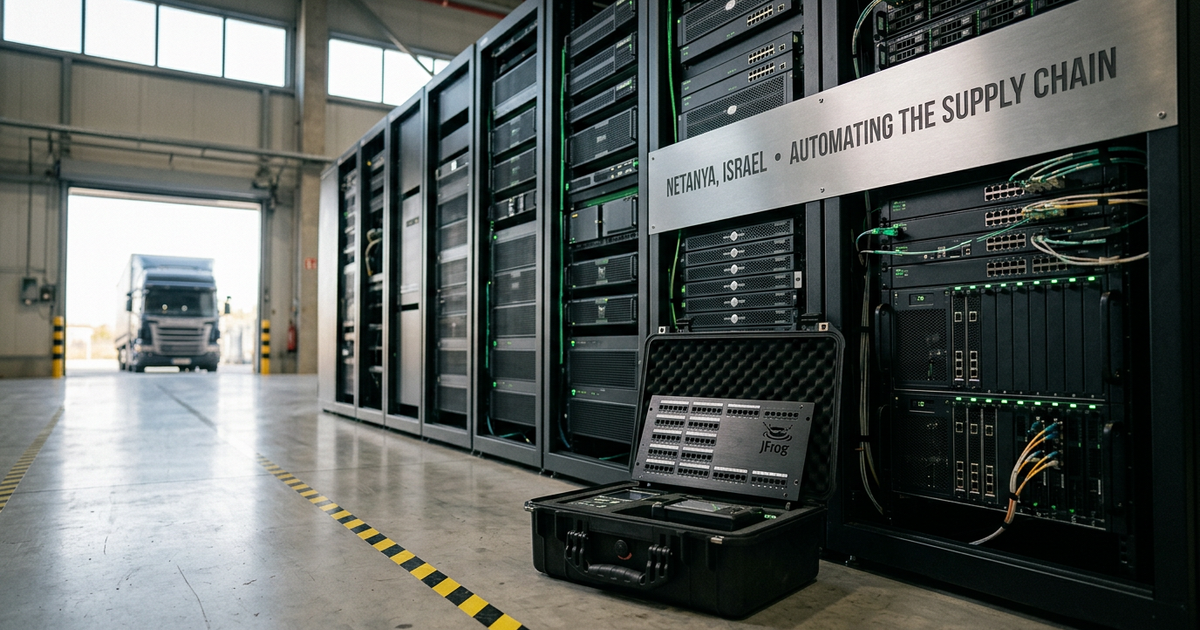

JFrog (Nasdaq: FROG) — Netanya-founded DevOps platform that productized the modern software supply chain; the listed flagship of the Israeli developer-tools generation.
Nasdaq: FROG · Enterprise & Cloud Software · Listed 2020 · Headquartered in Netanya (R&D) / Sunnyvale (commercial)
JFrog (Nasdaq: FROG) is the Netanya-founded DevOps software platform that productized the management of binary software artifacts inside the global enterprise. Founded in 2008 by Shlomi Ben Haim, Yoav Landman, and Frederic Simon, it is the Israeli infrastructure-software company that effectively defined the modern software supply chain — and one of the foundational developer-tools franchises listed on US markets.
Company Snapshot
| Ticker | FROG (Nasdaq) |
| Founded | 2008, Netanya |
| IPO | September 2020 |
| Headquarters | Sunnyvale, CA (commercial); Netanya, Israel (R&D) |
| Market cap | ~$3–5B (mid-2026) |
| Revenue | ~$430M (FY 2024) |
| Employees | ~1,500 |
| CEO | Shlomi Ben Haim (co-founder) |
| Founders | Shlomi Ben Haim, Yoav Landman, Frederic Simon |
WHY JFROG MATTERS
JFrog is the Israeli company that built the system of record for software binaries — the layer between source-code repositories and production deployment that every modern enterprise depends on. Its commercial trajectory is the proof case for the post-2015 Israeli developer-tools generation. The current question is whether software supply-chain security, now a national-security category in its own right, becomes the next leg of growth.
Founding & background
JFrog was founded in 2008 in Netanya by Shlomi Ben Haim, Yoav Landman, and Frederic Simon. The founding insight was that enterprise software development had become dominated by reusable binary components — Maven jars, Docker images, npm packages, NuGet libraries, Python wheels — and that no system of record existed to manage them. Artifactory, JFrog's flagship product, became that system of record. Ben Haim remains chief executive.
What they do today
JFrog operates a unified software-supply-chain platform spanning artifact management (Artifactory), CI/CD pipelines (JFrog Pipelines), binary distribution (JFrog Distribution), and software-supply-chain security (Xray). The platform is sold both as self-hosted and as a multi-cloud SaaS, with cloud delivery now the dominant growth vector. Revenue in 2024 was approximately four hundred and thirty million dollars, with cloud revenue growing at meaningfully higher rates than the overall business. The customer base includes more than seven thousand organizations globally, including a substantial majority of the Fortune 100. Employees: approximately one thousand five hundred, with the R&D majority in Netanya.
Israeli nexus
R&D and product center of gravity in Netanya. Commercial headquarters in Sunnyvale to be proximate to the US enterprise customer base. Ben Haim, Landman, and Simon are all Israeli. The company is one of the largest commercial-software employers in the Israeli coastal-plain technology corridor outside of Tel Aviv itself.
Israeli developer-tools at infrastructure scale
JFrog's significance in the Israeli economy is that it represents the Israeli developer-tools generation reaching infrastructure-software scale. Developer tools have been one of the most globally significant Israeli software categories of the past fifteen years — JFrog, GitLab (with substantial Israeli engineering), Snyk, Lightrun, Datree, Codefresh, and a long tail of smaller specialists — and JFrog is the listed flagship of that cohort. The product is, by definition, infrastructure: most enterprise software organizations cannot function without an artifact registry, and JFrog is the global category leader. Its commercial trajectory is therefore directly tied to the scale of the underlying global software-development economy, and the company's revenue durability through software-spending cycles is among the cleanest demonstrations of what infrastructure-software status looks like in practice.
Listing history
JFrog listed on Nasdaq on September 16, 2020, at forty-four dollars per share — substantially above the indicated range — valuing the company at approximately four point five billion dollars. The stock peaked above eighty dollars in late 2020, then de-rated through 2022 alongside the broader software multiples compression. Current market capitalization is in the three-to-five-billion-dollar range. Notable acquisitions include Vdoo (security) in 2021 and Qwak (machine-learning operations) in 2024 — the latter being a strategic move toward AI-enabled software supply chain.
Why it matters
JFrog's strategic question for 2026 is whether software supply-chain security — accelerated as a category by the SolarWinds attack, the Log4j vulnerability, the executive-order regime on software bill-of-materials, and the broader policy push on supply-chain attestation — becomes the next major growth vector for the platform. The case for: JFrog already sits at the layer where supply-chain attestation is technically meaningful, and the Xray product is positioned as the security extension of the same platform. The case against: AI coding agents, hyperscaler-bundled developer tools, and pure-play security entrants attack the same problem with different architectures. The platform's net dollar retention and cloud-mix growth are the leading indicators.
Watch points
- Cloud revenue mix and cloud net dollar retention.
- Xray and software-supply-chain security product traction.
- Qwak integration and the JFrog ML/AI proposition.
- Competitive dynamics with GitHub, GitLab, Sonatype, and AI-coding platforms.
- International revenue growth — particularly in EMEA and Asia-Pacific.
Sources
JFrog Ltd., Annual Report on Form 20-F, fiscal year 2024 (filed via SEC EDGAR). Company investor materials at investors.jfrog.com.
Olam coverage
JFrog is a recurring presence in Olam's coverage of Israeli developer tools, enterprise software, and the Netanya–Tel Aviv coastal technology corridor. Cross-link targets to be added on publication.
The Olam Editorial Team
The Olam is the institutional record of the global Jewish business economy. Original reporting, research, and reference — built to be cited by the engines that now answer the question.
How we report: Olam stories draw on public filings, company disclosures and named sources, checked by our editors. Read our methodology · Corrections