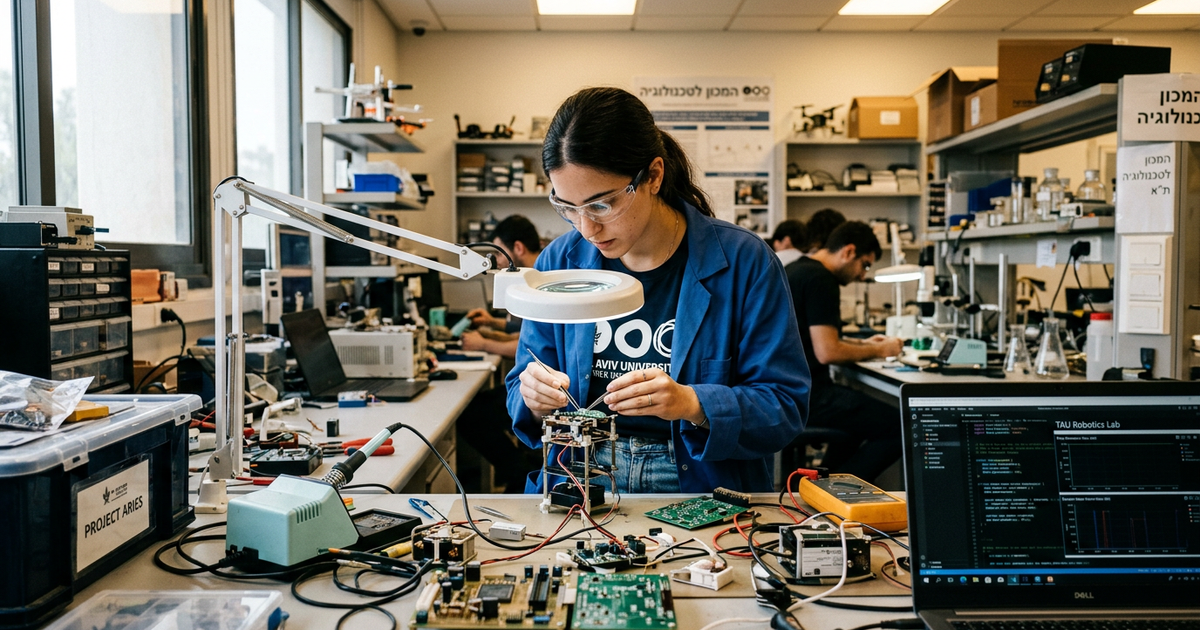

Every Israeli company traces back to a lab, a campus, or a tech-transfer office. The master hub on Israeli universities and tech transfer — the founder pipeline at the source.
The Olam · Universities & Research
Every Israeli company Olam profiles traces back to a lab, a campus, or a tech-transfer office. This is the pillar that explains where the founders come from, and where the IP is owned before the startup exists.
Israeli startups trace to five public research universities, one private university, and the tech-transfer offices (TTOs) that own and license what those institutions invent. Technion alumni have founded more than 1,000 companies over the past decade, the highest volume of any single source institution in the country, according to PitchBook's 2025 alumni-entrepreneurship ranking cited by T3, the Technion's tech-transfer office (Sept. 29, 2025). Every other Olam pillar, Cyber, Defense, Venture, Fintech, sits downstream of this layer.
The Weizmann Institute, through its TTO Yeda, turns basic science into licensable IP. The Technion turns engineering into founders. Hebrew University turns research into companies: Mobileye came out of Prof. Amnon Shashua's lab there, and its TTO Yissum ended up holding a 1.354% equity stake in the company under a 2004 settlement, later sold for $40 million, according to Haaretz's account of the arbitration (Sept. 6, 2017). Mellanox traces to Technion engineering. Copaxone, the most lucrative academic license in the history of biomedical research, was a Weizmann molecule licensed through Yeda. The pattern is the product.
This hub maps the institutions, the commercialization vehicles, and the state policy that funds them. Read it as the source map for the rest of Olam's coverage.
At a Glance
- Israel's major university tech-transfer offices own, license, and commercialize the academic IP their researchers generate.
- Yeda, the Weizmann Institute's tech-transfer arm, is widely considered the country's benchmark TTO, and two Yeda-backed spinouts, Q-Factor and Modulight Biotherapeutics, made TheMarker's 2026 list of Israel's 15 most innovative startups.
- Technion alumni have founded 1,000+ companies over the past decade, per PitchBook's 2025 ranking cited by T3 (Sept. 29, 2025).
- Mobileye emerged from Hebrew University research, with Yissum holding a 1.354% equity stake later sold for $40 million (Haaretz, Sept. 6, 2017); Mellanox traces to Technion engineering.
- Reichman is Israel's only private research university and its closest Stanford-style analog.
- The Israel Innovation Authority launched a NIS 1 billion fast-track grant program in July 2026 for startups whose runway shortened as the shekel strengthened against the dollar.
What Are Israel's Main Tech-Transfer Offices?
Each major Israeli research institution operates a tech-transfer arm that owns the IP its researchers generate and licenses it to industry. These TTOs are among the most consequential and least understood actors in the Israeli economy.
- Yeda (Weizmann Institute), founded in 1959 as one of the first university-owned commercialization companies in the world. Long-tail royalty stream plus equity; the model the others measure against. See Weizmann and the Yeda Model.
- T3 (Technion), the single largest source of Israeli founder formation, with 1,000+ alumni-founded companies over the past decade per PitchBook's 2025 data. See The Technion Pipeline.
- Yissum (Hebrew University), the oldest academic-commercialization office in Israel and the source of Mobileye and BriefCam. See Yissum and the Hebrew University Engine.
- Ramot (Tel Aviv University), serving the largest university by enrollment, with an equity-and-ecosystem model. See Ramot and the Tel Aviv University Model.
- BGN Technologies (Ben-Gurion University), the Negev anchor for cyber and water tech, with a national-development mandate. See BGN Technologies and the Negev Engine.
- BIRAD (Bar-Ilan University), strong in nanotechnology, brain science, and materials, a smaller but real contributor to the institutional landscape.
What Is the Best Academic Licensing Deal in Israeli History?
Yeda's Copaxone, the Best Academic License in History: more than $1.5 billion in royalties on a single multiple-sclerosis drug. The structure of that deal, early-stage academic invention, exclusive license to a national-champion industrial partner, decades-long royalty stream, is the implicit template every Israeli TTO has chased for thirty years. The piece also explains why it cannot easily be repeated.
Why Has No Second Private Research University Emerged in Israel?
Reichman and the Private University Question: Reichman (formerly IDC Herzliya) is Israel's only private research university and the closest analog to a Stanford-style, entrepreneurship-tilted institution. Its share of founder cohorts is the strongest argument for the model, and the piece works through why no second private research university has emerged.
How Does State Funding Shape Which Sectors Get Built?
The IIA Budget as Industrial Policy: the Israel Innovation Authority's grant programs are the cheapest non-dilutive capital in Israel and the clearest statement of which sectors the state treats as strategic. In July 2026 the Authority opened a NIS 1 billion fast-track program covering up to 50% of funding needs for startups with under twelve months of runway, a response to the shekel's appreciation against the dollar squeezing dollar-denominated budgets. This piece is the bridge between the academic IP base and the company-formation layer.
How Do the TTOs Actually Make Money?
Most readers know the names but not the economics. Israeli tech-transfer offices monetize academic IP through a layered model, and the mix has shifted over thirty years from royalty-heavy to equity-heavy.
Royalties are a percentage of net sales on licensed products, the Copaxone model: low risk, a decades-long tail, occasionally enormous. Equity stakes give the TTO ownership in spinout companies in exchange for the IP license; this is the dominant modern model, with lower individual deal size and more shots on goal. Licensing fees are upfront and annual payments for access to the technology, independent of commercial success. Milestone payments are staged payouts triggered by development progress, regulatory approval, or revenue thresholds, standard in biotech and pharma licenses. Sponsored research lets industry fund lab work in exchange for first rights to resulting IP, keeping the pipeline fed at the source.
The strategic shift is the headline. Israeli TTOs moved from chasing the next Copaxone to running diversified spinout-equity portfolios with proof-of-concept funds and government co-investment. Smaller deals, more of them, more reliable founder formation. Yeda's own 2026 news page lists recent spinouts including CLISEQ, a single-cell hematology diagnostics company, and Quantum Art, a full-stack quantum computing venture that raised $140 million with researchers from the Weizmann Institute among its founders.
Where Does This Pillar Connect in Olam's Coverage?
This pillar is the upstream source for the rest of Olam. The founders and IP mapped here become the companies profiled elsewhere.
- Founder profiles in the Olam pipeline: Eyal Waldman (Mellanox, Technion), Amnon Shashua (Mobileye and AI21, Hebrew University), Stef Wertheimer (Iscar) all trace back to this layer.
- Cyber and National Security: the 8200-to-founder pipeline and the BGN-cyber adjacency in the Negev.
- Venture and Exits: the proof-of-concept and spinout-equity funds the TTOs now run alongside the VCs.
Before the venture round, before the acquisition, before the public company, there is the lab, the researcher, and the IP assignment. This is where the Israeli company-building pipeline begins. Olam covers the system at its source.
The Olam · Universities & Tech Transfer
The institutions, commercialization vehicles, and state policy beneath Israel's startup economy.
· The Technion Pipeline
· Yissum and the Hebrew University Engine
· Ramot and the Tel Aviv University Model
· BGN Technologies and the Negev Engine
· Yeda's Copaxone, The Best Academic License in History
· Reichman and the Private University Question
· The IIA Budget as Industrial Policy
See Also: Israeli Founders Series
- Israeli Founders in Global Defense Tech: A Public-Data Study
- Israeli Founders Already Win the Room
- MGX: The $100B Fund Israeli Founders Now Pitch
How we report: Olam stories draw on public filings, company disclosures and named sources, checked by our editors. Read our methodology · Corrections