The Israeli Luxury Hospitality Market: Operators, Properties, and the UHNW Pipeline
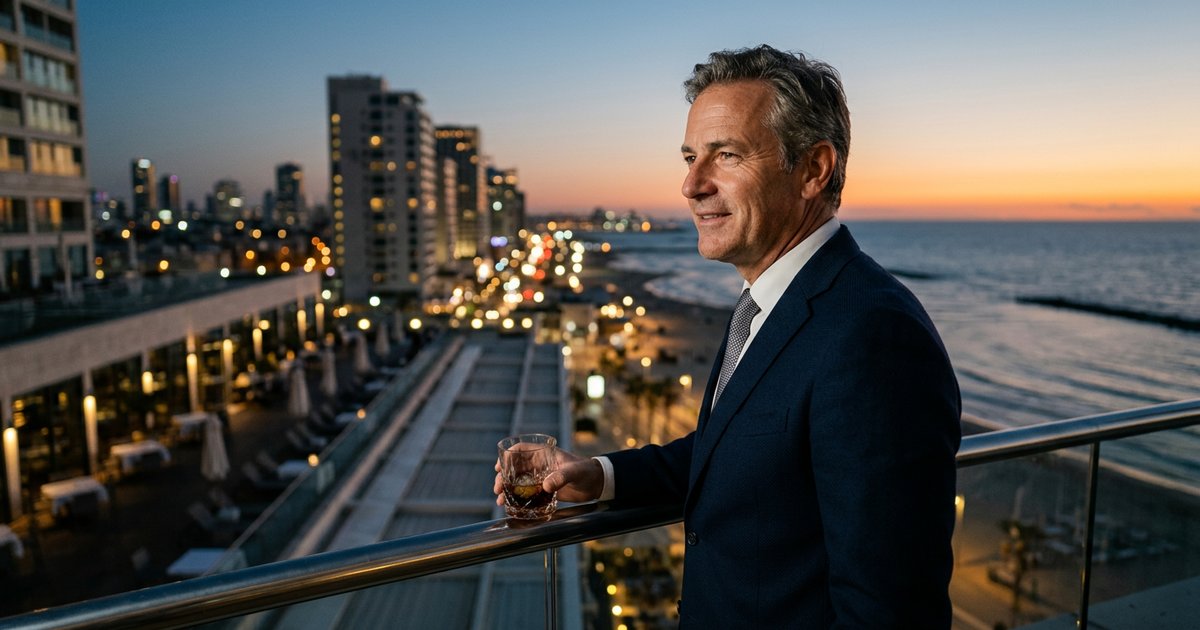
The Israeli ultra-luxury hospitality market spans three principal geographies — Tel Aviv beachfront, Old Jaffa heritage, and southern desert resort — anchored by Kempinski, the Setai brand, Six Senses Shaharut, and the Norman. The operator architecture, demand layers, and 2023-2026 cycle.
Quick Answer
The Israeli ultra-luxury hospitality market has expanded substantially since the mid-2010s, anchored by the entry of Kempinski (2022), the consolidation of the Setai brand (Tel Aviv and Sea of Galilee), the emergence of Six Senses in the desert segment (2021), and the established positions of the Norman (2014), the Mamilla in Jerusalem, the Ritz-Carlton Herzliya, and the Isrotel Exclusive Royal Beach Tel Aviv. The market structure operates across three principal geographies — Tel Aviv beachfront, Old Jaffa and adjacent restored-heritage locations, and the southern desert resort segment — with supplementary positions in Jerusalem, Herzliya Pituach, and Caesarea.
Key Facts
- The David Kempinski Tel Aviv opened April 2022; the Setai Tel Aviv operates in Old Jaffa; the Setai Sea of Galilee operates in adjacent geography under the same brand architecture.
- Six Senses Shaharut, opened 2021, anchors the desert ultra-luxury segment; Six Senses Tel Aviv pipeline discussions are at pre-development stage.
- The Norman, opened 2014, holds the longest-tenured ultra-luxury position in Tel Aviv proper.
- The Mamilla Hotel in Jerusalem (opened 2009) operates the established Jerusalem ultra-luxury position adjacent to the Old City.
- The Ritz-Carlton Herzliya, opened 2014, anchors the Herzliya Pituach ultra-luxury market.
The three principal geographies
The Israeli ultra-luxury hospitality market operates across three distinct geographic positions, each with its own market characteristics.
Tel Aviv beachfront. The David Kempinski (Hayarkon Street), the Isrotel Exclusive Royal Beach Tel Aviv, the Hilton Tel Aviv (in transition between brand positions), and the broader high-end Tel Aviv beachfront layer. This geography combines proximity to the city's commercial and dining core with direct Mediterranean access — the structurally most differentiated Tel Aviv hospitality position.
Old Jaffa and restored-heritage Tel Aviv. The Setai Tel Aviv, the Norman, the W Tel Aviv (in Jaffa, opened 2021), and the broader category of ultra-luxury hospitality in restored historic structures across Tel Aviv-Jaffa. This geography combines architectural distinctiveness with a quieter operational profile than the beachfront properties.
Southern desert resort. Six Senses Shaharut anchors this geography. The desert-resort segment operates with a different market structure — longer average stays, more pronounced seasonality, higher dependence on transient ultra-luxury demand and adjacency to the Eilat luxury market — and is structurally distinct from the metropolitan Tel Aviv segments.
Supplementary positions operate in Jerusalem (anchored by the Mamilla, with the King David retaining a heritage ultra-luxury position), Herzliya Pituach (Ritz-Carlton), and Caesarea (with multiple boutique ultra-luxury properties operating across the residential resort).
The operator architecture
The Israeli ultra-luxury hospitality market operates through several institutional structures.
International luxury brands. Kempinski, Six Senses, the Setai brand, Hyatt (the Norman), Marriott (the W Tel Aviv, the Ritz-Carlton Herzliya), and IHG (multiple properties at varying segments) operate Israeli properties under their global brand architecture.
Israeli ultra-luxury operators. Isrotel operates the Royal Beach Tel Aviv and adjacent ultra-luxury properties under its own brand architecture; Dan Hotels operates the King David Jerusalem at the heritage ultra-luxury position; Atlas Hotels operates a network of boutique-positioned properties; and several specialized Israeli ultra-luxury operators run individual properties.
Mixed-brand and developer-operator structures. Several properties operate under combined brand-management agreements between international hospitality brands and Israeli development sponsors, with the management agreement covering the operational architecture and the development sponsor retaining property ownership.
The operator architecture has implications for the market's institutional structure: international-brand-managed properties tend to standardize service architecture to global brand expectations; Israeli-operator-managed properties retain more local market knowledge but lack the international brand recognition that the cross-border UHNW buyer values.
The demand structure
Three principal demand layers populate the Israeli ultra-luxury hospitality market.
Cross-border UHNW transient demand. Family-office principals, US and European UHNW travelers, business travelers at the senior-executive layer, and the broader category of inbound ultra-luxury demand. This layer is the most exposed to regional security conditions and to the broader Israeli travel-and-tourism cycle, with substantial volatility across the 2023-2026 window.
Domestic Israeli UHNW demand. Israeli ultra-luxury consumers using domestic hospitality for short stays, anniversary occasions, business entertainment, and adjacent purposes. The domestic anchor demand has held more consistently across recent cycles than the international layer.
Cross-border family-office migration demand. The expanding population of family-office principals partially or fully resident in Israel, using ultra-luxury hospitality during the period before completed primary-residence transition, during partial-occupancy intervals, and for adjacent purposes. This layer has materially expanded since 2022 and is structurally durable across regional cycles in ways the transient-tourist layer is not.
The three layers have different cyclical sensitivities and different operational implications, and the mix across them is a meaningful determinant of individual property economics.
The 2023-2026 cycle
The period since October 2023 has tested the Israeli ultra-luxury hospitality market in specific ways. International transient demand contracted substantially through the acute phase of the regional security environment; the cross-border family-office migration demand expanded; the domestic Israeli demand held with some compression. Different operators with different mix exposures have experienced the cycle differently — operators with high transient-tourist exposure experienced more pronounced contraction than operators with deeper domestic and family-office migration exposure.
The cycle's resolution and the trajectory of the Israeli ultra-luxury hospitality market through 2027-2028 will depend on the broader normalization of regional travel and the durability of the family-office migration architecture.
Why It Matters
The Israeli ultra-luxury hospitality market is the institutional anchor of cross-border UHNW engagement with Israel. The market's three principal geographies and three principal demand layers create a structurally differentiated picture that aggregate reporting obscures. Mapping the architecture clarifies which operators, properties, and demand layers anchor the market's resilience.
Israeli Luxury Hospitality Market — FAQ
What are the main ultra-luxury hotels in Israel?
The Israeli ultra-luxury hospitality market is anchored by The David Kempinski Tel Aviv (opened 2022), The Setai Tel Aviv (Old Jaffa), The Setai Sea of Galilee, Six Senses Shaharut (Arava desert, 2021), The Norman Tel Aviv (2014), The Mamilla Hotel Jerusalem (2009), The David Citadel Jerusalem, Ritz-Carlton Herzliya (2014), W Tel Aviv (Jaffa, 2021), Isrotel Exclusive Royal Beach Tel Aviv, and the King David Jerusalem at the heritage tier.
When did the David Kempinski Tel Aviv open?
The David Kempinski Tel Aviv opened in April 2022 on Hayarkon Street along the Tel Aviv Mediterranean beachfront. It is the highest-profile Tel Aviv beachfront ultra-luxury opening of the past decade.
What are the three main geographies of Israeli luxury hospitality?
Three principal geographies: (1) Tel Aviv beachfront — David Kempinski, Isrotel Exclusive Royal Beach, Hilton Tel Aviv; (2) Old Jaffa and restored-heritage Tel Aviv — The Setai, The Norman, the W Tel Aviv; and (3) southern desert resort — Six Senses Shaharut. Supplementary positions operate in Jerusalem, Herzliya Pituach, and Caesarea.
What is the Ritz-Carlton Herzliya?
The Ritz-Carlton Herzliya, opened in 2014, anchors the Herzliya Pituach ultra-luxury market. Operated by Marriott under the Ritz-Carlton brand.
What is the W Tel Aviv?
The W Tel Aviv is a Marriott-operated ultra-luxury hotel in Old Jaffa, opened in 2021. It sits within the restored-heritage Tel Aviv-Jaffa luxury geography alongside The Setai and The Norman.
What is the Setai Sea of Galilee?
The Setai Sea of Galilee operates under the same Setai brand architecture as the Setai Tel Aviv, positioned in the northern Galilee region as part of the brand’s Israeli portfolio expansion.
Who are the main operators in Israeli luxury hospitality?
International brand operators include Kempinski, Six Senses (IHG), the Setai brand, Hyatt (the Norman), Marriott (W Tel Aviv, Ritz-Carlton Herzliya), and IHG. Israeli operators include Isrotel (Royal Beach Tel Aviv, Exclusive Collection), Dan Hotels (King David Jerusalem), Atlas Hotels, and Alrov (Mamilla, David Citadel).
What is the demand structure of Israeli luxury hospitality?
Three principal demand layers: (1) cross-border UHNW transient demand (the most exposed to regional security cycle); (2) domestic Israeli UHNW demand (the most consistent through cycles); and (3) cross-border family-office migration demand (the structurally expanding layer since 2022, durable across regional cycles).
Is Six Senses opening a second property in Israel?
Six Senses Tel Aviv pipeline discussions are at the pre-development stage as of 2026. No public announcement of a confirmed second Israeli property has been made.
How has Israeli luxury hospitality performed since October 7, 2023?
The cycle has tested the market unevenly. International transient demand contracted substantially through the acute phase. Cross-border family-office migration demand expanded. Domestic Israeli demand held with some compression. Operators with high transient-tourist exposure experienced more pronounced contraction than operators with deeper domestic and family-office migration exposure.
Where is the Mamilla Hotel Jerusalem located?
The Mamilla Hotel sits adjacent to the Old City of Jerusalem, integrated with the Alrov-developed Mamilla Mall complex. Opened in 2009, it operates the established Jerusalem ultra-luxury position with direct access to Jaffa Gate.
Read Next in The Olam
- The Israeli Boutique Hotel Class — How a country with five luxury hotels in 2005 ended up with forty
- Who Owns the Israeli Hotel Sector — The institutional ownership map
- Six Senses Shaharut — The first international ultra-luxury flag
- Tourism Inside Israel: The Recovery Math — The post-October 7 recovery numbers
Sources: Israeli hotel-industry press; international hospitality-brand corporate disclosures; Times of Israel; The Jerusalem Post; Globes; Israeli Hotels Association. Data current as of Q2 2026.