
How a country with five luxury hotels in 2005 ended up with forty of them — and built a serious boutique-luxury layer largely on its own.
Part of: Who Owns the Israeli Hotel Sector
Updated June 29, 2026.
How a country with five luxury hotels in 2005 ended up with forty of them, and built a serious boutique-luxury layer largely on its own.
There are roughly forty hotels in Israel today positioned in the boutique-luxury category. Two decades ago, there were five. The class was built quickly, deliberately, and largely by Israeli operators, with a handful of international flag plantings that confirmed the country had arrived as a serious hospitality market.
The shift is structural. Israel was historically a destination for big mainstream hotels: King David, Hilton Tel Aviv, the Dan brand, Isrotel’s Eilat resorts. The boutique class arrived after the country crossed into high-income territory, tech wealth anchored at home, and a generation of Israeli developers concluded the local market could support thirty-room hotels priced at $700 to $1,500 a night.
It worked. The class survived the pandemic. It is now absorbing the post-October 7 dislocation. And it is the layer of Israeli hospitality the outside world increasingly recognizes.
BY THE NUMBERS
Israeli boutique-luxury hotels (2026): ~40
Israeli boutique-luxury hotels (2005): ~5
Top-tier ADR range: $700–$1,500+ per night
Key markets: Tel Aviv–Jaffa · Jerusalem · Galilee · Negev
Largest boutique-luxury operators:
Alrov Properties (Akirov) · Isrotel Exclusive Collection (Lubinski) · Brown Hotels (Avigad) · Atlas Boutique Hotels (Damari) · The Norman (Lourie)
First international ultra-luxury flag: Six Senses Shaharut (2021)
Standard reference property: The Norman, Tel Aviv (2014)
A field map.
The Norman Tel Aviv: The Project That Set the Israeli Boutique Bar
The Norman, Tel Aviv is the right place to start, most operators in the current class will privately admit it set the standard.
Two restored 1920s buildings in the Nachalat Binyamin area, brought together as a single fifty-key hotel by the Lourie family. Opened in 2014. From the day it opened, The Norman was the answer to a question Tel Aviv had been unable to answer for decades: was there a hotel in this city that could host a senior international visitor, a head of state, a Hollywood principal, a Fortune 50 CEO, and have them leave saying this was as good as anything in Paris or London?
The answer was yes. And once the answer was yes, the market understood the ceiling had moved.
The Norman is not a tower. It is a low-rise, restored, carefully imperfect building, with rooms individually designed and a rooftop pool that became one of the most-copied images in Israeli hospitality marketing.
The Norman has since expanded with The Norman Residences and additional projects in development. The principals belong in the same conversation as Alfred Akirov, Leon Avigad, and the Lewis family at Isrotel. It is not the biggest hotel in Israel, it is the one that proved a category could exist, and the one international press still uses as the reference point when writing about Israeli hospitality.
Standards held. Year after year.
Tel Aviv–Jaffa: The Center of Gravity for Israeli Boutique Hotels
Around The Norman, a Tel Aviv–Jaffa cluster has filled in.
The Jaffa, A Luxury Collection Hotel: RFR Holdings’ restoration of the former French Hospital. John Pawson interior. Opened in 2018. The garden is one of the few hotel gardens in central Israel that feels like a garden rather than a smoking patio. The bar, built inside the deconsecrated chapel, is one of the more architecturally serious public rooms in the country.
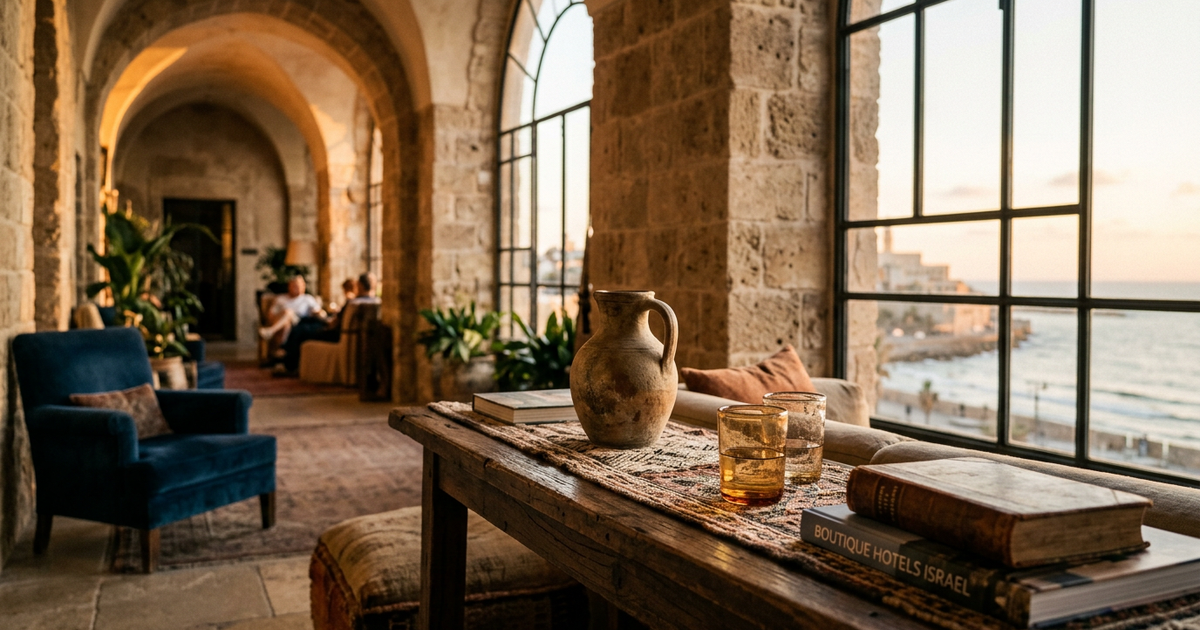
The Setai Tel Aviv: Jaffa’s restored Ottoman-era complex, operated within the Fattal portfolio under license from the Setai brand owner. Arches, stone, courtyard. The room product leans into the historic architecture instead of fighting it. It is the property most often booked by visiting fashion, entertainment, and tech principals who want Jaffa rather than the Tel Aviv beachfront.
The Drisco, Tel Aviv: Mendel House. Templer-era American Colony building, 1866. Forty-two keys. The smallest of the central cluster, and arguably the most discreet. Used by Israeli families and senior business visitors who specifically do not want to be at The Norman.
Hotel Montefiore: small, central, one of the original Tel Aviv boutiques. Still works. The restaurant is still on the short list of best hotel kitchens in the country.
Jerusalem: Alrov, Akirov, and the Stone City
Jerusalem boutique hospitality is dominated by two operators: Alfred Akirov’s Alrov Properties and the group behind the Waldorf Astoria Jerusalem.
The Mamilla Hotel: Alrov. Adjacent to the Alrov-developed Mamilla Mall. Designed by Moshe Safdie with interiors by Piero Lissoni. 194 keys, technically larger than the standard boutique definition, but positioned and operated as one. The rooftop bar is one of the highest-grossing single hotel bars in the country.
The David Citadel: Alrov’s older Jerusalem flagship. Adam Tihany interiors. Bigger than boutique on paper, but pricing and clientele put it in the same conversation. One of the default modern Jerusalem hotels for visiting heads of state, senior US political delegations, and Fortune 100 boards.
The Waldorf Astoria Jerusalem: the restored Palace Hotel building from 1929, brought back as a Hilton-managed Waldorf flagship developed by Reichmann International. Opened 2014. The lobby is one of the most-photographed hotel interiors in the Middle East.
The Orient, Jerusalem: Isrotel Exclusive Collection. German Colony. Two historic buildings combined with a modern wing into a single property. The Orient was Isrotel’s signal that it could play in the Jerusalem upscale market alongside the entrenched Alrov properties, and it does.
The American Colony Hotel: separate category. Historic 19th-century pasha’s villa in East Jerusalem. Leading Hotels of the World member. Used by senior journalists, diplomats, and visiting heads of state for over a century. Not boutique-by-design, boutique by lineage.
The Galilee: Israel's Country-House Boutique Tradition
The northern boutique scene is older than the Tel Aviv one. It was built around the Galilee’s natural-spa, organic-farm, and kibbutz-country tradition.
Mizpe Hayamim: above the Sea of Galilee, near Rosh Pinna. The view does most of the work. Originally founded in 1967, rebuilt as a wellness hotel, today operated within Isrotel Exclusive Collection. Organic farm on-site, in-house dairy, kitchen garden. What the hotel sells is air and quiet. It has a serious following among Tel Aviv professionals who do not want to fly to take three days off.
Cramim Resort: Isrotel Exclusive, Judean Hills. Wine-country resort modeled on Napa lodge logic. Spa-anchored, vineyard-anchored, low-key.
Pastoral Kfar Blum: Upper Galilee kibbutz hotel. Country-house in feel. The kind of property where the same Israeli families have been spending the same week every summer for three decades.
Vered HaGalil: Anglo-built, horse-ranch DNA, historic.
The northern scene is the slowest-moving of the three regions. Operators add capacity carefully. Properties tend to be small, repeat-visit driven, and dependent on Israeli domestic demand more than international. That, more than anything else, is what protected them through the past two years.
Pereh: The Israeli Wilderness Boutique Property
Pereh sits in its own category.
The name, פרא, meaning wild, is the brief. Pereh is a small mountain resort in the Galilee, built on the site of a former military observation post. The hotel opened in the early 2020s. Roughly forty keys. Adults-only. The room product is design-forward in a way the Israeli boutique market had not produced at this remove from the cities, concrete, glass, exposed timber, hidden lighting, architecture that reads as a private compound rather than a hotel.
The setting is the headline. Pereh is genuinely remote, a winding mountain drive from anywhere, and the property uses the remoteness as the product. The infinity pool faces wilderness. The bar is a destination in itself for guests who arrive expecting a room and stay all night. The kitchen is serious. The wine list is selective. The service operates closer to a private estate than a hotel.
The price point is among the highest in Israeli hospitality. The bookings still close. There are weekends where Pereh is the hardest single hotel room to book in the country.
Pereh’s significance to the boutique class is not the room count. It is the proof that an Israeli operator could build an internationally competitive design hotel in a non-urban setting and command Aman-tier pricing. Six Senses Shaharut, which opened a year later in the Arava, validated the thesis at international brand scale. Pereh validated it at independent-operator scale, and arguably opened the door.
The right reference is not the Israeli market. The right reference is Aman, Singita, the better Como properties, the small Belmond houses. Pereh competes on that shelf. It is arguably the most internationally competitive independent small hotel project built in Israel to date.
The Negev: Six Senses Shaharut and Beresheet Anchor Israeli Desert Luxury
Two properties anchor the south.
Six Senses Shaharut: opened in 2021. The first international ultra-luxury flag in Israel. Sixty villas spread across the cliffs above the Arava, near Kibbutz Shaharut. Built and operated under the Six Senses brand, the IHG-owned wellness-luxury house. Room rates routinely exceed $1,500 a night. The property is a statement: a global luxury operator looked at Israel and decided this was a market where the brand belonged.
Beresheet by Isrotel: Mitzpe Ramon, on the rim of the Ramon Crater. Opened 2011. Isrotel Exclusive Collection. The original Israeli desert luxury property, the one Six Senses Shaharut effectively built on top of structurally. Beresheet proved domestic demand existed for $700-a-night desert resort product. Six Senses scaled the thesis to $1,500.
Between them, the Negev now has two of the most architecturally distinct desert resorts in the wider Mediterranean and Middle East. Neither would have been built without the other.
The Operators Behind Israel’s Boutique Hotel Boom
Five operators control most of the class.
Alrov Properties: Alfred Akirov. The Mamilla Hotel, the David Citadel, the Mamilla Mall, plus international hotel projects: Café Royal London, the Conservatorium Amsterdam. The closest thing Israel has to a domestic Aman or Mandarin Oriental at operator scale.
Isrotel Exclusive Collection: David Lewis and the Lubinski family. The upscale sub-brand of Isrotel: Beresheet, The Orient Jerusalem, Cramim, Mizpe Hayamim, Carmim. Isrotel built the broader Israeli hotel industry through Eilat. Exclusive Collection is the move up the curve.
Brown Hotels: Leon Avigad. The volume operator in the class. Brown TLV, Brown Beach House, The Lighthouse, Poli House, Brown Mamilla Jerusalem, plus an international portfolio across Greece, Cyprus, Croatia, and Germany. Sharper price point, urban-cool aesthetic, design-led without trophy positioning, at scale. The closest thing Israel has to a domestic Soho House in operating logic: a chain that built brand equity by getting the room product right before getting the room count up. The domestic boutique chain that exported.
The Norman: Lourie family. Smallest portfolio at the top of the positioning curve. The Norman Tel Aviv is the flagship and remains the standard reference.
The Setai Tel Aviv, The Jaffa Luxury Collection, and Six Senses Shaharut: operated under international brand contracts but with Israeli ownership and economics behind them. The third pattern in the class: international brand on the door, Israeli capital underneath.
Behind these, Atlas Boutique Hotels, Sigal Damari and team, runs the largest portfolio of design-led mid-market boutiques: Bezalel Jerusalem, Shalom Tel Aviv, the rest of the urban Atlas grid. Atlas is the mid-market spine. Not in the same room-rate category as Alrov or The Norman, but in the same conversation about boutique aesthetics. The class would be much thinner without it.
What Comes Next for Israeli Boutique Hotels
Post-October 7 cost the class a brutal eighteen months. The properties that held up best had the strongest domestic demand: Pereh, Mizpe Hayamim, Brown’s Tel Aviv portfolio, the Galilee. The ones that took the hardest hit were the trophy international-flagged Jerusalem hotels.
The recovery is now underway. International luxury arrivals are pacing back toward 2019 baseline through 2026. The class itself was never the question, Israelis built it for Israelis first, and that bet was correct. International demand is the multiplier, and it is returning.
Three structural points for the next decade.
One: the international flags will keep arriving. Six Senses opened the door. Aman, Rosewood, Como, Belmond, and Soho House have all been quietly evaluating Israel for years. The Tel Aviv beachfront has limited buildable site count. The Galilee, the Negev, and Jerusalem do not.
Two: the Israeli operators will keep exporting. Brown is already in Greece, Cyprus, Croatia, and Germany. Alrov runs Café Royal in London and the Conservatorium in Amsterdam. The Norman has international ambitions. The boutique class is no longer a domestic story.
Three: the room-rate ceiling continues to move. Pereh and Six Senses Shaharut proved $1,500-a-night Israel works. The next class of openings will be priced accordingly.
Israel built a boutique hotel layer in twenty years. It is one of the densest, most architecturally serious, and most domestically grounded in the Mediterranean. The world is starting to notice. The class is just getting started.
The Israeli Boutique Hotel Class: FAQ
What is the Israeli boutique hotel class?
The Israeli boutique hotel class is a layer of roughly 40 high-end design-led hotels positioned at $700–$1,500+ per night across Tel Aviv–Jaffa, Jerusalem, the Galilee, and the Negev. It was built almost entirely between 2005 and 2025 by Israeli operators, with a handful of international flag plantings confirming the country as a serious global hospitality market.
How many boutique luxury hotels does Israel have?
Israel has approximately 40 boutique-luxury hotels as of 2026, compared with roughly five in 2005.
What is the best boutique hotel in Israel?
The Norman in Tel Aviv is the most consistent reference point for international press and luxury bookers. Other top-of-class properties include Six Senses Shaharut (Arava desert), Pereh (Galilee mountain), The Jaffa, The Setai Tel Aviv, The Mamilla Hotel (Alrov, Jerusalem), and The David Citadel (Alrov, Jerusalem).
What is The Norman Tel Aviv?
The Norman is a fifty-key boutique luxury hotel in Tel Aviv’s Nachalat Binyamin area, opened in 2014 by the Lourie family. Two restored 1920s buildings joined as a single property.
What is Pereh hotel?
Pereh is a roughly forty-key adults-only design hotel in the Galilee mountains, built on a former military observation post and opened in the early 2020s. Among the most internationally competitive independent boutique hotel projects ever built in Israel.
Who is The Norman owned by?
The Norman is owned and operated by the Lourie family. The group remains private and family-controlled.
What are the major Israeli boutique hotel operators?
Five operators control most of the class: Alrov Properties (Akirov), Isrotel Exclusive Collection (Lubinski), Brown Hotels (Avigad), The Norman (Lourie), and Atlas Boutique Hotels (Damari).
What is the most expensive hotel in Israel?
Six Senses Shaharut routinely exceeds $1,500 per night and sits at the top of Israel’s ADR curve, alongside Pereh.
When did Israel get its first international ultra-luxury hotel?
Israel’s first international ultra-luxury hotel flag was Six Senses Shaharut, which opened in 2021 in the Arava desert.
Which international hotel brands are coming to Israel?
Aman, Rosewood, Como, Belmond, and Soho House have all been evaluating the Israeli market. None has publicly confirmed entry as of 2026.
How did the Israeli boutique hotel class perform after October 7, 2023?
The boutique class took an eighteen-month blow. Properties with strong domestic Israeli demand held up best. The trophy international-flagged Jerusalem hotels took the hardest hit. By 2026, international luxury arrivals are pacing back toward 2019 baseline.
↗ Index: this is the boutique pillar in the Israeli Hotels cluster. Capstone: Who Owns the Israeli Hotel Sector. Operator profiles: Fattal · Isrotel · Dan · Alrov · Brown · Norman.