
Israel-Japan: $3.4B trade, $2.9B in Japanese VC (record). SoftBank, Sony, Honda, Toyota, Denso in Israeli tech. Pax Silica semiconductor alignment. Automotive intelligence corridor. Structurally underweight.
ISRAEL & JEWISH BUSINESS CORRIDORS · OLAM.BUSINESS
Japanese investors put $2.9 billion into Israeli startups — a record — in the same year SoftBank co-led $400 million into an Israeli cybersecurity firm and Google closed its $32 billion acquisition of Wiz. Bilateral trade sits at $3.4 billion. Sony bought an Israeli semiconductor company. Honda scouts Israeli vehicle intelligence. Toyota, Denso, and Mitsubishi run Israeli R&D partnerships. The corridor is quiet, commercially dense, and structurally different from every other Israeli trade relationship: Japan brings manufacturing scale, materials science, and automotive platforms. Israel brings the software, the algorithms, and the cybersecurity. Neither has what the other needs — which is exactly why it works.
$2.9 Billion in Japanese VC: The Investment Layer
Japanese investments in Israeli startups reached a record $2.9 billion — the highest annual figure in the bilateral relationship. SoftBank is the anchor. Masayoshi Son's Vision Fund has been the single largest Japanese investor in Israeli technology, with positions across cybersecurity, AI, and enterprise software. SoftBank co-led a $400 million round in an Israeli cybersecurity company, invested $25 million in OurCrowd (Israel's most active venture platform), and held a significant position in Wiz before its $32 billion acquisition by Google — completed in March 2026.
Beyond SoftBank, the Japanese corporate venture ecosystem in Israel includes KDDI (which signed a strategic deal with Israeli networking company DriveNets), NEC, Fujitsu, Mitsubishi Electric, and Mitsui. Toyota's venture arm has invested in Israeli automotive technology. Honda's Silicon Valley Lab scouts Israeli vehicle intelligence startups. Denso runs Israeli R&D partnerships focused on ADAS and sensor fusion.
Sony, Altair, and the Semiconductor Bridge
Sony acquired Israel-based Altair Semiconductor for $212 million — a deal that connected Japan's electronics manufacturing scale to Israel's chip design capability. The acquisition placed Israeli semiconductor IP inside Sony's IoT and connectivity architecture.
The semiconductor bridge runs both directions. Japan exports $1.24 billion in electrical and electronic equipment to Israel (2025), including diodes, transistors, and integrated circuits. Israel exports $220 million in electronics to Japan, concentrated in optical instruments and radar components. Israel joined the Pax Silica Initiative alongside Japan — the US-led partnership securing the global chip supply chain — locking both countries into the same strategic semiconductor architecture.
Automotive Intelligence: Where Japan Needs Israel
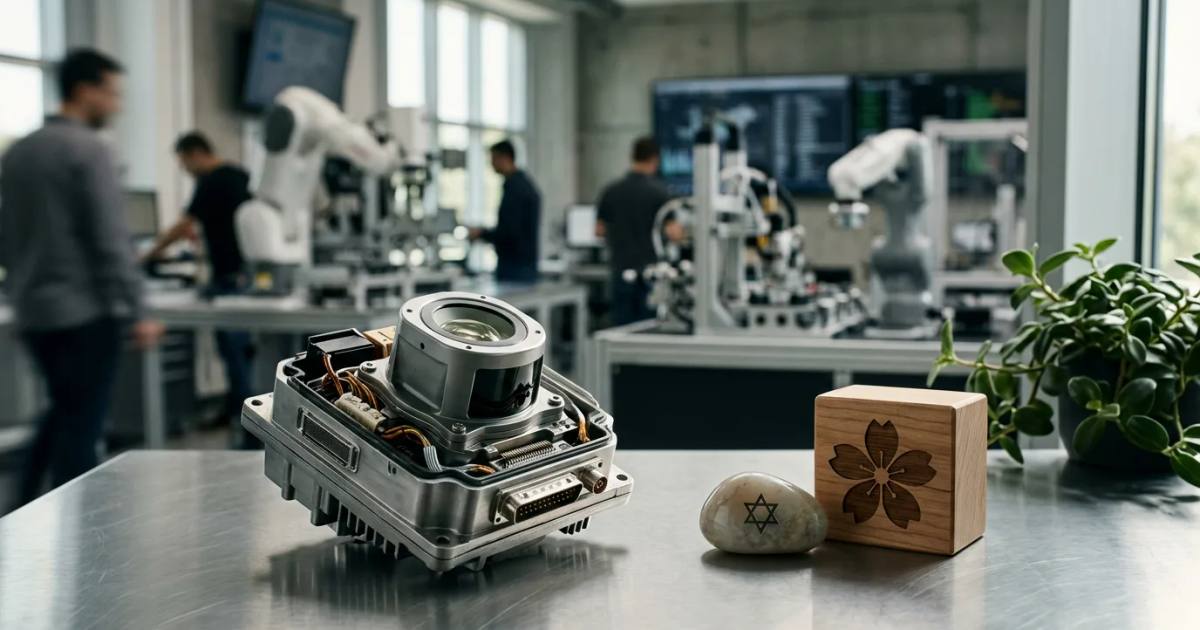
Japan's automotive industry — the largest in the world by export value — is undergoing a forced transition from mechanical engineering to software-defined vehicles. The companies that built reliable engines for fifty years now need ADAS, computer vision, cybersecurity, and AI inference at the edge. Israel has it.
Check Point, CyberArk, and the broader Israeli cyber ecosystem provide automotive cybersecurity — protecting connected vehicles from intrusion. Mobileye (Intel subsidiary, Jerusalem-based) is the global leader in ADAS computer vision, with technology deployed in vehicles from BMW, Volkswagen, Ford, and multiple Japanese OEMs. Israeli startups in LiDAR, radar signal processing, and V2X communications feed into Japanese tier-one supply chains through Denso, Aisin, and other component manufacturers.
The fit is structural: Japan designs and manufactures the vehicle. Israel writes the software that makes it autonomous, connected, and secure.
The R&D Framework
The Israel-Japan Joint Committee on Cooperation in Science and Technology has met ten times. Joint R&D programs span robotics, AI, materials science, life sciences, and agricultural technology. The Israel Innovation Authority and Japan's Ministry of Economy, Trade and Industry (METI) co-fund bilateral research projects with a focus on commercializable outcomes.
Japanese pharmaceutical companies — including Takeda, Astellas, and Daiichi Sankyo — run Israeli R&D partnerships and license Israeli drug candidates. Israel's life sciences corridor to Japan is smaller than its corridor to the US or Europe but growing, driven by Japan's aging population and its need for med-tech innovation it cannot generate domestically at the pace required.
$3.4 Billion and the Missing Scale
Bilateral trade between Israel and Japan reached approximately $3.4 billion — meaningful but small relative to both economies' weight. Japan is the world's fourth-largest economy. Israel's technology sector is globally competitive. The trade relationship should be multiples of its current size.
The limiting factor is not technology fit — it is commercial structure. Japanese procurement cycles are long. Decision-making is consensus-driven. Israeli startups, built for speed and direct sales, struggle with the patience required to penetrate Japanese enterprise accounts. The companies that succeed — Mobileye, Check Point, CyberArk — do so over years, not quarters.
The $2.9 billion in Japanese VC, the Pax Silica semiconductor alignment, and the automotive intelligence demand all point in the same direction: a corridor that is structurally underweight and commercially overdue. Japan needs Israeli software. Israel needs Japanese manufacturing and distribution. The infrastructure exists. The volume doesn't — yet.
Olam coverage
Wiz · Check Point · CyberArk · Defense Prime Index · $14.8B Export Year · Israel–South Korea · Israel–Singapore
The Olam Editorial Team | Israel & Jewish Business Corridors
How we report: Olam stories draw on public filings, company disclosures and named sources, checked by our editors. Read our methodology · Corrections