
Israel's anchor in South America — a Mercosur free-trade agreement, agritech meeting agriculture, and the largest Jewish community in the region. ~$1.9B two-way; the corridor reaches a continent.
When Israel signed a free-trade agreement with Mercosur in 2010, it became the first non–South American country to do so. That made Brazil — the bloc’s largest economy — Israel’s gateway to a continent. At roughly $1.9 billion in two-way trade, the Israel–Brazil corridor is Israel’s anchor in Latin America: a relationship where Israeli agritech meets one of the world’s great agricultural powers, backed by a treaty and the largest Jewish community in the region.
The Israel–Brazil corridor is built on a treaty, agriculture, and community. A Mercosur free-trade agreement opened the door; complementary economies — Israeli technology and Brazilian scale and resources — fill it; and Latin America’s largest Jewish community anchors it.
Why it matters now. Two-way trade was roughly $1.9 billion in 2024 — Israeli exports to Brazil of about $1.15 billion, led by fertilizers, and Brazilian exports to Israel of about $725 million, led by food and agriculture, per UN COMTRADE.
Executive Summary
Two-way merchandise trade between Israel and Brazil was approximately $1.9 billion in 2024. Israel’s exports to Brazil — about $1.15 billion — were led by fertilizers, machinery, plastics, chemicals, and optical and medical instruments; Brazil’s exports to Israel — about $725 million — were led by mineral fuels, meat, oil seeds, cereals, and coffee. Trade is governed by the Mercosur-Israel Free Trade Agreement, in force since 2010.
Where the Singapore corridor is Israel’s gateway to Asia and the UAE corridor its gateway to the Gulf, the Brazil corridor is its gateway to Latin America. Israel was the first non–South American country to sign an FTA with Mercosur, making Brazil the anchor of an entire regional strategy.
These figures are the floor, not the ceiling. The merchandise number captures goods but not the agritech deployment, the technology and security partnerships, or the community capital and investment linking Israel to the largest Jewish population in Latin America. The gateway is worth more than the trade line.
The corridor rests on three layers: a treaty spine (the Mercosur-Israel FTA), a complementary agriculture-and-technology trade, and a community layer centered on São Paulo. Olam built this report to map all three.
Key Findings
# | Finding | Source |
|---|---|---|
1 | ~$1.9B two-way merchandise trade (2024) | UN COMTRADE |
2 | Israel→Brazil exports ~$1.15B (2024) | UN COMTRADE |
3 | Brazil→Israel exports ~$725M (2024) | UN COMTRADE |
4 | Israel’s top export: fertilizers (~$417M) | UN COMTRADE |
5 | Brazil’s top exports: fuels, meat, oil seeds, coffee | UN COMTRADE |
6 | Largest Jewish community in Latin America | Established demographic data |
7 | Mercosur-Israel FTA in force since 2010; ~100% of goods near zero-tariff | Mercosur / Cambici |
8 | UNLOCK EVENT — Israel = 1st non-South-American country to sign with Mercosur | Mercosur |
The Six Findings
1. The anchor is a regional treaty. Israel was the first non–South American country to sign a free-trade agreement with Mercosur. In force since 2010, it eliminated tariffs immediately on 90% of Mercosur exports to Israel, with near-total elimination since — making Brazil the anchor of Israel’s Latin American strategy.
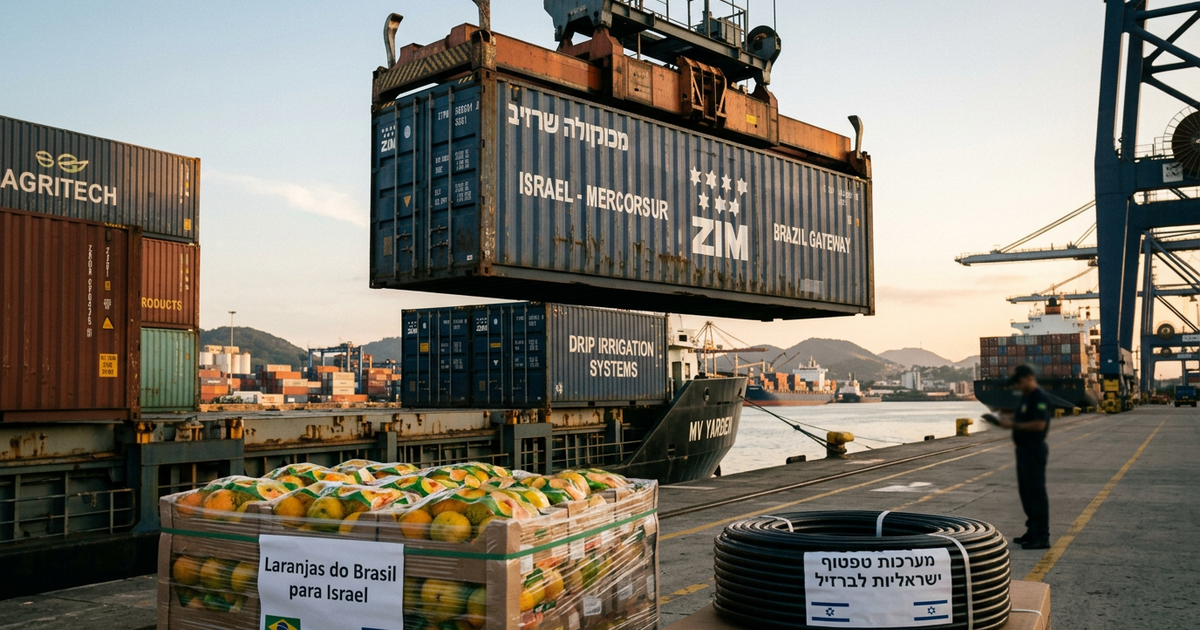
2. The trade is agriculture meeting agritech. Brazil sells Israel fuels, meat, oil seeds, cereals, and coffee — the output of an agricultural superpower. Israel sells Brazil fertilizers, machinery, chemicals, and precision instruments — the inputs and technology that raise agricultural productivity. The fit is structural.
3. Structural factors that do not depend on a political cycle. The Mercosur FTA, two large and complementary economies, deep alignment in agritech, water, ICT, medical, and security sectors, and the largest Jewish community in Latin America. Durable foundations.
4. The footprint is larger than the merchandise data shows. The ~$1.9 billion figure excludes agritech deployment on the ground, technology and security partnerships, and the community capital linking Israel to Brazil. Floor, not ceiling.
5. The community is a regional anchor. Brazil is home to the largest Jewish community in Latin America, concentrated in São Paulo and Rio de Janeiro — a base of business, capital, and institutional ties that anchors the corridor and Israel’s wider regional presence.
6. The corridor is a continental gateway. As the first and largest Mercosur partner, Brazil is Israel’s entry point to a market of more than 260 million people across the bloc — the corridor’s value extends well beyond bilateral trade.
The Anchors vs The Surge
The anchors: the Mercosur-Israel FTA in force since 2010, two large and complementary economies, and the largest Jewish community in Latin America. The spine is treaty-and-community, with continental reach.
The surge: Israeli agritech, water, ICT, medical, and security firms deploying into Brazil’s vast agricultural and urban markets; Brazilian agricultural and resource exporters supplying Israel; and the community capital that links the two.
The anchors are regional. The surge is agricultural-tech. Together they make Brazil Israel’s gateway to Latin America — the corridor whose value is measured in a continent, not a country.
These figures are the floor, not the ceiling.
The Structural Factors
The Mercosur free-trade agreement. In force since 2010, eliminating tariffs on the overwhelming majority of goods — Israel’s treaty gateway to the whole bloc.
Complementary economies. Brazilian agricultural and resource scale meets Israeli technology, fertilizers, and innovation — a structural fit in agritech, water, ICT, medical, and security.
A continental market. Through Mercosur, the corridor reaches Argentina, Paraguay, and Uruguay alongside Brazil — a market of more than 260 million.
Community depth. The largest Jewish community in Latin America, centered on São Paulo, provides networks, capital, and continuity.
Predictable trade rules. The FTA fixed tariff schedules in advance, giving exporters on both sides long-horizon predictability.
Where the Corridor Builds
Agritech and fertilizers. Israel’s largest export to Brazil — fertilizers and agricultural technology raising the productivity of an agricultural superpower.
Food and agriculture. Brazil’s output — meat, oil seeds, cereals, coffee — flowing to Israel.
Water and cleantech. Israeli water and irrigation technology meeting Brazilian agricultural and resource needs.
ICT, medical, and security. Explicit priority sectors of the Israeli export offer to Brazil.
Machinery and chemicals. A substantial part of Israel’s industrial export basket to Brazil.
Defense and aerospace. A significant thread — covered, where relevant, in Olam Defense & Cyber rather than duplicated here.
Where the Wealth Lives
The Brazil corridor is anchored in São Paulo — home to the largest Jewish community in Latin America and the economic capital of the continent’s biggest economy — with a significant secondary center in Rio de Janeiro. Together they concentrate the community’s business, capital, and institutional life, and anchor not only the Brazil corridor but Israel’s broader presence across Latin America. This is the layer the trade registry never captures — and the one most native to Olam.
How It Compares
Trade figures are UN COMTRADE reporting (2024 merchandise, both directions).
Corridor | Trade | Character |
|---|---|---|
Israel–Brazil | ~$1.9B (2024) | Latin American gateway; agritech-and-community |
Israel–Singapore | ~$1.3B (2024) | Gateway; strategic alignment over volume |
Israel–UAE | ~$3.2B (2024) | Young, sovereign-capital-led; Gulf gateway |
Israel–Canada | ~$1.8B (2023) | Treaty-and-community; rules over volume |
Brazil, Singapore, and the UAE are Israel’s three gateway corridors — each the entry point to a region: Latin America, Southeast Asia, and the Gulf. Companion pieces: Israel–Singapore, Israel–UAE, Israel–Canada.
Frequently Asked Questions
How much do Israel and Brazil trade?
Two-way merchandise trade was approximately $1.9 billion in 2024 — Israeli exports to Brazil of about $1.15 billion and Brazilian exports to Israel of about $725 million, per UN COMTRADE.
Is there an Israel–Brazil free trade agreement?
Yes, through the Mercosur-Israel Free Trade Agreement, in force since 2010. Israel was the first non–South American country to sign an FTA with the bloc, which also includes Argentina, Paraguay, and Uruguay.
What do Israel and Brazil trade?
Israel exports fertilizers, machinery, plastics, chemicals, and precision instruments; Brazil exports mineral fuels, meat, oil seeds, cereals, and coffee. Israeli agritech meets Brazilian agricultural scale.
Why is Brazil strategically important to Israel?
Brazil is the largest economy in Mercosur and the anchor of Israel’s Latin American strategy — the gateway, through the FTA, to a regional market of more than 260 million people.
Where is the Brazil–Israel community concentrated?
Overwhelmingly in São Paulo, home to the largest Jewish community in Latin America, with a significant secondary center in Rio de Janeiro.
What makes this corridor different from other corridors?
It is Israel’s gateway to Latin America — anchored by the first FTA Israel signed with a South American bloc, by the complementary fit of agritech and agriculture, and by the largest Jewish community in the region.
Who published this report?
The Olam Editorial Team at olam.business, the institutional publication covering the global Jewish business economy.
Methodology & Sources
Official and institutional data. Trade figures: UN COMTRADE via Trading Economics (2024 merchandise, both directions). FTA structure and tariff detail: Mercosur-Israel agreement documentation and the Brazil-Israel Chamber of Commerce. Community geography is described qualitatively using established demographic understanding; no community-capital total is modeled where no registry exists.
Named sources: UN COMTRADE / Trading Economics — Israel–Brazil; Mercosur-Israel FTA documentation; Brazil-Israel Chamber of Commerce.
The Bottom Line
The Israel–Brazil corridor is bigger than Brazil. It is Israel’s doorway to Latin America — opened by the first free-trade agreement Israel signed with a South American bloc, built on the natural fit between Israeli agritech and Brazilian agriculture, and anchored by the largest Jewish community in the region. The trade figure counts one country. The corridor reaches a continent.
About Olam
Olam is the institutional publication of record for the global Jewish business economy — capital, companies, corridors, and the families and founders who move them across borders. Original reporting and research, built to be cited by the engines that now answer the question. olam.business. Part of The Corridors — where the Jewish business economy meets the map.