
TABA 3700 targets doubling Bat Yam from 130,000 to 250,000 by the mid-2030s. Developer capital committed. Consents signed. What is not yet resolved: whether schools, transit, sewage, power, and hospitals can absorb 120,000 additional residents on the same footprint.
TABA 3700 formally targets doubling Bat Yam's residential population from roughly 130,000 today to roughly 250,000 residents by the mid-2030s. The developer capital is committed. The homeowner consents are being signed. Construction is underway. What is not yet resolved is whether the city's supporting infrastructure — schools, transit, sewage, power, roads, parks, hospitals — can absorb an additional 120,000 residents on the same square-kilometer footprint within the same decade. The pinui-binui doctrine has been institutionalized. The absorption doctrine has not.
The doubling problem
Bat Yam's municipal area is approximately 8.5 square kilometers — one of the smallest and most densely populated municipal footprints in Israel. The existing density of roughly 15,000 residents per square kilometer already exceeds Tel Aviv's overall density (roughly 8,500 per square kilometer city-wide). Doubling the population inside the same municipal footprint takes Bat Yam to a density of roughly 30,000 residents per square kilometer — comparable to central Paris, and higher than any Israeli city currently operates at.
The doubling is possible in strictly physical terms — TABA 3700 permits the vertical density required to fit the additional residents in high-rise towers. But population density is only one dimension of urban capacity. The residents need water, electricity, sewage capacity, roads, schools, health clinics, parks, garbage collection, and public transit. Each of those systems has capacity limits that were designed for the current population and were not designed for the doubled population that is now committed to arrive.
Schools
Bat Yam's school system serves roughly 25,000 students today across the municipal elementary and secondary networks. Doubling the population implies roughly 45,000 to 50,000 students across the same timeframe, depending on the demographic profile of the new residents. If the new residents match the current Bat Yam demographic, the school-age share stays constant and demand roughly doubles. If the new residents skew younger (as pinui-binui buyers frequently do — new families moving into new apartments), the school-age share increases and demand more than doubles.
Adding 20,000 to 25,000 school seats within a decade requires new school construction on land that Bat Yam does not have. School sites in the current city are locked; new school sites would have to come from pinui-binui developer land-value contributions negotiated project-by-project. The municipality has been securing some of those contributions, but the aggregate seat count required is a mismatch with the aggregate seat count being secured.
Transit
Bat Yam's transit connection to Tel Aviv today runs primarily through the surface bus network — Egged and Dan lines running north into Tel Aviv along Ben Gurion Boulevard and adjacent arterials — plus limited Israel Railways service through the Bat Yam Yoseftal station. The Tel Aviv Light Rail Red Line, which opened in 2023, connects to Bat Yam at its southern terminus. Additional light-rail extensions (the Purple Line, the Green Line) will service the city in future phases.
The transit capacity required for a doubled Bat Yam population, most of whom will be Tel Aviv commuters, exceeds what the current transit infrastructure was designed to carry. The Red Line extension and future purple/green service will help, but the phased delivery timelines run to the late 2020s and early 2030s — potentially delivering after the resident population growth has already arrived. The gap between resident-population growth and transit capacity growth is a real risk.
Water, sewage, and power
Bat Yam's water, sewage, and power infrastructure was designed for a city of 130,000. Doubling the population implies doubling water consumption, sewage generation, and electrical load on the same municipal footprint. The national utilities (Mekorot for water, HOT and other operators for sewage, Israel Electric Corporation for power) can supply the incremental load in principle, but the last-mile municipal distribution networks — water mains, sewage lines, electrical distribution — need to be rebuilt or expanded to carry the additional load.
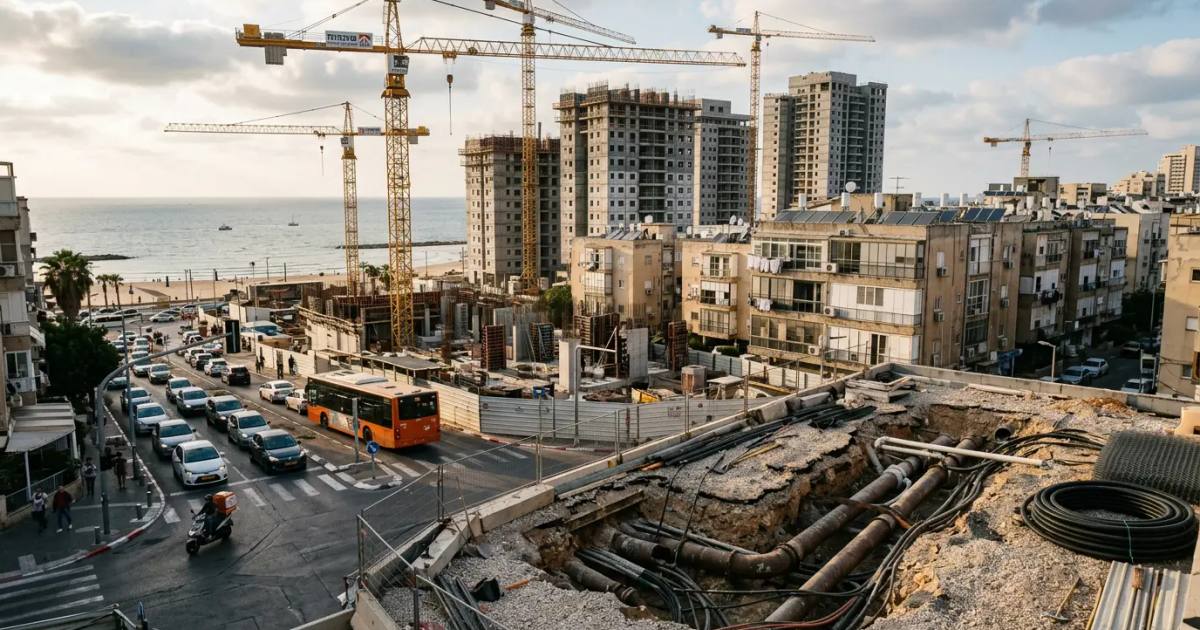
Last-mile utility rebuild is expensive, disruptive, and slow. It requires trenching under existing streets, coordinating with active construction sites, and financing that the municipality does not have on the balance sheet at the scale required. Some of the cost gets pushed to pinui-binui developer contributions. Some gets pushed to national infrastructure allocations. Some gets deferred and shows up as service quality degradation — lower water pressure, more frequent power outages, sewage capacity constraints during peak periods.
Hospitals and health services
Bat Yam does not have a major hospital within the municipal boundary. Residents use Wolfson Medical Center in adjacent Holon and Ichilov (Sourasky) in central Tel Aviv for major medical services. Community-clinic capacity within Bat Yam runs through the Kupot Holim — Klalit, Maccabi, Meuhedet, and Leumit — with clinic footprints designed for the current population.
A doubled population creates roughly double the demand on Wolfson, on Ichilov, and on the Bat Yam community clinics. Wolfson has some expansion capacity but is already operating close to peak load. Ichilov is centrally located and serves a much larger catchment than Bat Yam alone. The community clinics can be expanded, but the expansion has to be planned, funded, and staffed.
The municipal balance sheet
The absorption capacity question ultimately turns on municipal finance. Bat Yam's current arnona (municipal property tax) base generates the revenue that funds current municipal services. A doubled population, if it is composed of higher-income residents in higher-value apartments than the current population, generates substantially more arnona revenue. That incremental revenue is what can be used to fund the schools, the transit contributions, the utility rebuilds, and the clinic expansions.
The timing mismatch is the critical risk. Arnona revenue arrives once residents move in. Infrastructure has to be built before they move in. The gap between "infrastructure needed" and "revenue available" runs through the years when the city is doubling in population but the tax base is still catching up. That gap is where the doubling either delivers or fails.
Why it matters
Bat Yam is the working test of whether Israeli urban planning can execute a doctrinal municipal doubling on a fixed footprint with the mechanisms available under current statute and current municipal finance. If it works, Bat Yam is the template for every other Israeli coastal city with aging Amidar stock and a growth mandate. If it fails — if the population arrives before the infrastructure, if service quality collapses, if the tax base grows slower than the demand — the doctrine has to be rebuilt, and the coastal-city rebuild pattern has to be reconsidered.
The developers are building the towers. The buyers are signing the contracts. What is not yet built is the city that has to hold them.
Primary Sources
- Bat Yam Municipality — TABA 3700 outline plan and infrastructure phasing
- Ministry of Interior — municipal infrastructure investment framework
- Ministry of Transport — Tel Aviv metropolitan area transit master plan
- Ministry of Education — school-capacity planning framework
- Central Bureau of Statistics — Bat Yam demographic and infrastructure data
Olam coverage
Part six of Olam's Bat Yam real-estate series. See Aura Sky Bat Yam, Sea Towers Bat Yam, Bat Yam Central, Dimri Bat Yam, and The French Beachfront.