
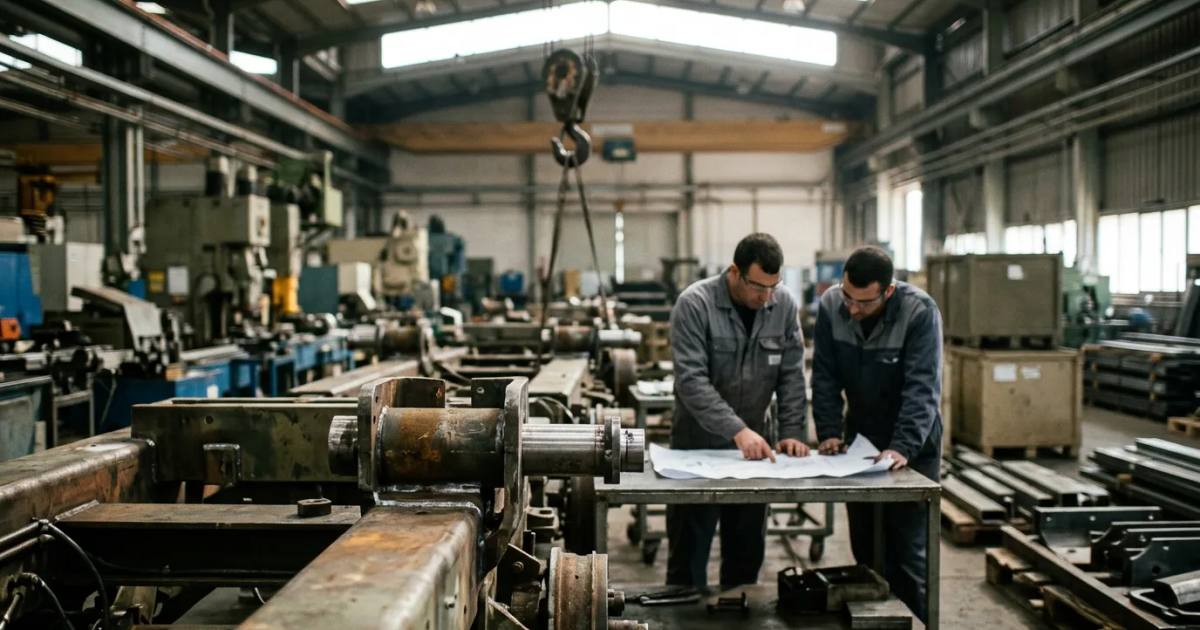

The 2018 acquisition of state-owned Israel Military Industries by Elbit Systems for NIS 1.8 billion collapsed Israel's fragmented land-warfare industrial base into a single publicly listed prime — the structural precondition for the European rearmament contracts that followed.
The privatization Israel postponed for 28 years, and how it built the arsenal Europe now buys from.
The 2018 acquisition of state-owned Israel Military Industries by Elbit Systems (NASDAQ / TASE: ESLT) for NIS 1.8 billion collapsed the country's fragmented land-warfare industrial base into a single publicly listed prime. Seven years on, the merged division — Elbit Land — is the structural expression of a policy decision Israel made once and cannot easily reverse. It is also the vehicle for every European rearmament contract Elbit has signed since 2022.
The story of that acquisition is the story of how a state-owned munitions house that armed the Haganah in the 1930s became the engine of a $30 billion order book eighty years later — and why the four-way structure of Israeli defense collapsed into three.
The company that armed the Haganah
Israel Military Industries began in 1933 as Ta'as — the clandestine munitions arm of the Haganah, producing small-arms ammunition inside a bakery in Tel Aviv. It was the industrial base of a state that did not yet exist. On May 15, 1948, it was folded into the newly declared Israeli government as the country's first defense manufacturer.
For seven decades it made the ammunition, tank shells, small arms, and Uzi submachine guns that armed the IDF. The Merkava tank's 120mm rounds came from IMI. The Negev light machine gun came from IMI. The Galil rifle came from IMI. The Iron Fist active protection system, later exported to the US Army and the Dutch military, came from IMI's Advanced Defense Systems division.
It was also, for most of its history, financially broken. The state absorbed the losses because the alternative — an Israeli army dependent on imported ammunition — was strategically unacceptable.
The privatization the state postponed for two decades
IMI was corporatized in 1990 and put on the privatization track. It stayed there for 28 years. Successive governments — Rabin, Netanyahu I, Barak, Sharon, Olmert, Netanyahu II, Netanyahu III — all proposed selling it. None finished the job. The company carried:
- Structural annual losses
- An unfunded pension liability inherited from the state
- Environmental cleanup obligations at the Ramat HaSharon site — a valuable Tel Aviv-adjacent parcel the state also wanted to redevelop
- A workforce protected by the Histadrut, with employment guarantees that survived multiple sale attempts
Every sale attempt broke on one or more of those constraints. The 2013 attempt collapsed on pension terms. Earlier attempts collapsed on Histadrut opposition. IMI became a case study in why state-owned industrial assets in strategic sectors are difficult to privatize even when successive governments explicitly want to do it.
By 2013, IMI Systems Ltd. was formally established as the operating entity, with the state moving the profitable Advanced Defense Systems division — Iron Fist, Trophy variants, precision munitions — into a separate government company called Tomer, ring-fenced from the sale. What was left, IMI Systems, was still one of the country's largest defense employers: 3,000 workers, roughly NIS 2 billion in annual revenue, and a book of business the state could not walk away from.
In November 2018, after a competitive process against Rafael and a consortium led by FIMI Opportunity Funds, Elbit Systems closed the acquisition for NIS 1.8 billion — approximately $495 million at the time — plus an earn-out. The deal was covered by Reuters at close and included the Ramat HaSharon relocation to the Negev, which the state co-funded through the Ministry of Defense. That co-funding — pension buyouts, environmental remediation, plant relocation — was the price the state paid to close a 28-year privatization.
Why the state let a public company buy it
Three reasons, in the order they mattered to the Ministry of Defense.
First — ammunition security. The 2014 Gaza war exposed Israeli munitions stockpile fragility. IMI's tank shell, mortar, and artillery-round production lines were the only domestic source. A privatized IMI, capitalized and modernized by a listed acquirer, was judged more reliable than a state entity that had missed capex cycles for a decade. The October 7 replenishment cycle vindicated that judgment. Domestic ammunition capacity was the constraint that could not be imported around.
Second — export scale. IMI's product lines — small arms, ammunition, active protection — needed a global sales channel. Elbit had one. IMI, as a government company, could not sell into most of the markets Elbit already served under existing bilateral defense agreements. The moment the acquisition closed, entire product lines that had been export-restricted became export-active. That is the origin of every PULS deal in Europe today.
Third — industrial consolidation. The state wanted three primes, not four. Rafael would remain the missile and air-defense house. Israel Aerospace Industries would remain the aerospace, drone, and Arrow-3 house. Elbit would absorb IMI and become the land-warfare house. The map of Israeli defense would be, in one sentence, cleaner than it had been since 1948.
What Elbit Land actually contains
The acquired IMI assets were folded into Elbit Systems Land Division — Elbit Land — which today accounts for roughly a third of Elbit's consolidated revenue. The division consolidates:
Ammunition and munitions. Small-arms ammunition, tank shells (105mm, 120mm), mortar rounds, artillery shells including the M338 155mm precision round, and the ATMOS 2000 self-propelled howitzer. Every category of round the IDF fires domestically comes off an Elbit line.
Precision fires. The PULS multiple launch rocket system, exported to the Netherlands, Denmark, Germany, Spain, and Serbia in a run of contracts worth well over €2 billion between 2022 and 2025 alone. PULS is the export vehicle Elbit built around the IMI rocket family. The German army selection was announced in September 2023, followed by the Bundeswehr's decision to make PULS the foundation of its Future Long-Range Indirect Fire System in 2025 — a Lockheed/Rheinmetall loss on German soil.
Active protection and armor. The Iron Fist active protection system, selected by the US Army in 2020 for the Bradley Fighting Vehicle upgrade. Iron Fist is the direct commercial descendant of the Trophy-adjacent IMI programs. Together with Rafael's Trophy, Israeli active protection is now the NATO reference standard for main battle tank and IFV survivability.
Small arms. The X95 Tavor, the Negev, the Galil ACE — the IDF standard-issue platforms, all now consolidated inside a single publicly listed company. Manufactured through subsidiary IWI (Israel Weapon Industries), which was originally spun out of IMI in 2005.
The consolidation completed Israel's three-prime map
Before 2018, Israeli defense industry sat in an awkward four-way structure: Elbit (public, privately controlled by the Federmann family through Federmann Enterprises), IAI (state-owned), Rafael (state-owned), and IMI (state-owned, pending sale). After 2018, it sat in a clean three-way map that has held since:
Elbit Systems. Public (NASDAQ: ESLT / TASE: ESLT), controlled by the Federmann family. Land warfare, C4I, electro-optics, unmanned systems. FY 2025 revenue: $7.94 billion. Backlog above $30 billion in Q1 2026.
Israel Aerospace Industries. State-owned; Q2 2026 IPO targeted for 25–30% TASE float. Aerospace, missile defense (Arrow), drones, satellites. FY 2025 revenue: $7.3 billion (up 21%). Backlog ~$29B end-2025.
Rafael Advanced Defense Systems. State-owned; Q2 2026 IPO also targeted. Air defense (Iron Dome co-manufacture with IAI), missiles (Spike), active protection (Trophy). FY 2025 sales $6.8B.
The four-way map was untenable. The three-way map is the operating structure of the Israeli defense industrial base in the AI-warfare and precision-fires era.
What the deal did to Elbit
The IMI acquisition roughly doubled Elbit's Israel-domestic land-warfare footprint overnight. Elbit inherited approximately 3,000 IMI employees, four production sites, and a customer relationship with the IDF that the state had been curating since 1948. It also inherited the pension liability, the environmental obligations at Ramat HaSharon, and the Histadrut labor agreements — all of which Elbit accepted as the cost of category consolidation.
Seven years on, Elbit's land division has become the vehicle for the largest European rearmament contracts of the post-2022 period. The German army selected PULS in 2023 and again in 2025. The UK selected Elbit's mortar systems. Poland, Denmark, Spain, and the Netherlands have all placed multi-hundred-million-euro orders into the division that did not exist in this form before the IMI merger. The SIPRI Arms Transfers Database tracks the wider flow.
The financial vindication is now beyond dispute. The NIS 1.8 billion Elbit paid in 2018 has been earned back many times over in PULS export revenue alone. The strategic vindication is even larger: the IMI acquisition is what made Elbit the tier-one land-warfare prime it is today.
Why it matters for the record
Israel privatized IMI once. There is no version of policy in which the state buys it back. The category is closed. Elbit is the only publicly listed Israeli land-warfare prime, and every future export contract for Israeli ammunition, precision fires, active protection, or small arms flows through a single company controlled by a single family.
That is a piece of institutional design with a long tail. It is also the case study every defense-industrial-policy analyst in Europe is now studying. The German munitions consolidation, the French munitions capacity buildup, the Polish defense-industry reform — all of them are looking at Israel's 2018 IMI-Elbit deal as the reference precedent for how you take a fragmented state-owned munitions base and turn it into an export-active listed prime.
The 2018 deal is the moment Israel's defense industrial base moved from four institutions to three, from state-heavy to state-and-market, and from fragmented to consolidated. It is the structural precondition for every European ammunition and precision-fires contract Elbit has signed since 2022.
What to watch
- The IAI and Rafael partial IPOs. If they clear in 2026, the three-prime map becomes three publicly listed primes — a second privatization of an even larger scale than 2018.
- Tomer's future. The ring-fenced government precision-munitions company remains state-owned. Its fate — sale, merger, IPO — is the next open institutional question in Israeli defense.
- Ramat HaSharon redevelopment. The former IMI site is a valuable Tel Aviv-adjacent parcel. Watch what the state does with it.
- The IWI export franchise. IWI small arms — Tavor, Negev, Galil ACE — are the underreported export engine inside Elbit Land. Latin American and African procurement is the growth vector.
- The next European consolidation deal. Whoever executes the "Israeli IMI playbook" first — Germany, France, Poland — wins the second-mover advantage in Europe's own munitions consolidation.
Primary Sources
- NASDAQ — ESLT listing
- Tel Aviv Stock Exchange — ESLT listing
- Reuters — Elbit acquires IMI for NIS 1.8 billion (Nov 2018)
- Reuters — Germany selects Elbit PULS system (Sep 2023)
- Israeli Ministry of Defense
- SIPRI Arms Transfers Database
Olam coverage
See the CEO profile of Bezalel Machlis, and the Olam entity profiles of Israel Aerospace Industries and Rafael Advanced Defense Systems.