
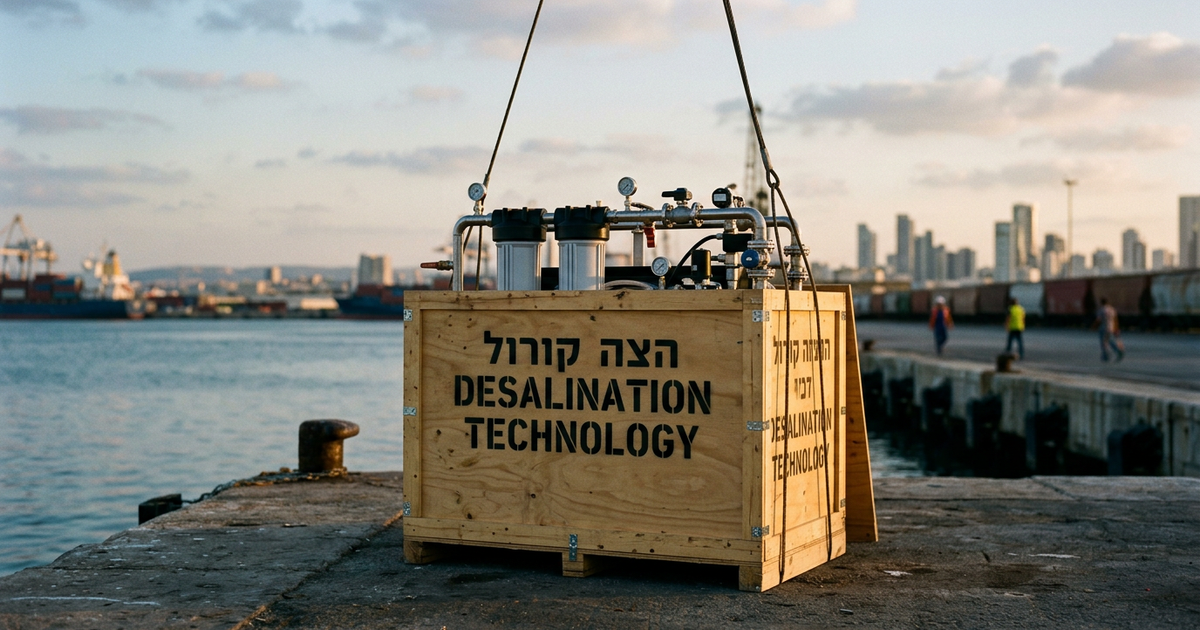

The world is discovering it has Israel's old problem. Israel already has the answer packaged, financed and ready to ship.
Desalination supplies a large share of Israel's municipal water — the Sorek plant alone covers roughly a fifth of it — and that capability is now one of the country's most strategic, least-tracked exports. Israel exports software, defense systems and agricultural technology, and the world watches all three. It also exports the complete operating model for manufacturing fresh water at scale: a national problem turned into a national product line, and badly under-covered as an economic story.
The macro backdrop is unambiguous. Water demand is rising while supply grows less reliable, and the global desalination market is expanding fast — by one widely cited estimate, the equivalent of several large Sorek-scale plants comes online worldwide every year. Hundreds of millions of people already depend on desalinated water, and that figure is climbing. Whoever can build and operate these plants reliably owns a structurally growing infrastructure market.
Carlsbad as the proof point
The case study sits in Southern California. The Carlsbad plant, designed and operated by IDE Technologies, marked its tenth year of operation in 2026, reliably supplying roughly 400,000 residents regardless of drought or weather. It was an uphill decade of permitting, litigation and public skepticism — and precisely because of that, it became the reference project that proved large-scale desalination could work in the United States. Israel did not just sell a plant; it exported the political and financial template for getting one built.
The financing model travels too
Israel pioneered build-operate-transfer and public-private structures for its own plants, aligning private builders with public water authorities over multi-decade horizons. That financial architecture is as exportable as the membranes. For capital, the appeal is the shape of the cash flows: sovereign- or municipal-grade demand, long-dated contracts, and recurring operations-and-maintenance revenue that outlasts the construction phase. It is infrastructure with a climate tailwind and a built-in customer of last resort.
Water as diplomacy
There is a geopolitical dividend layered on top. Water has become one of Israel's most effective regional bridges — embedded in the Abraham Accords and in cooperation with Bahrain, Morocco, Azerbaijan and Jordan, the last of which receives Israeli water and is tied into cross-border water-for-energy discussions. Few exports double as both revenue and soft power. Desalination and reuse expertise do exactly that, which is why they tend to open doors that conventional trade cannot.
The honest constraint
The thesis has a real limit, and it is worth flagging plainly: desalination is energy-intensive, and brine disposal carries genuine environmental cost. A bigger global desalination market means a bigger energy and waste problem to solve alongside it — which is exactly where the next wave of Israeli technology, from brine minimization to lower-energy membranes, is aimed. The export is not just the plant. It is the entire problem-and-solution package, constraints included — and that completeness is what makes it hard for competitors to copy.
Part of Olam's Climate & Resource Tech coverage. See the pillar: Israel Solved Water. Now It Sells the Answer..