
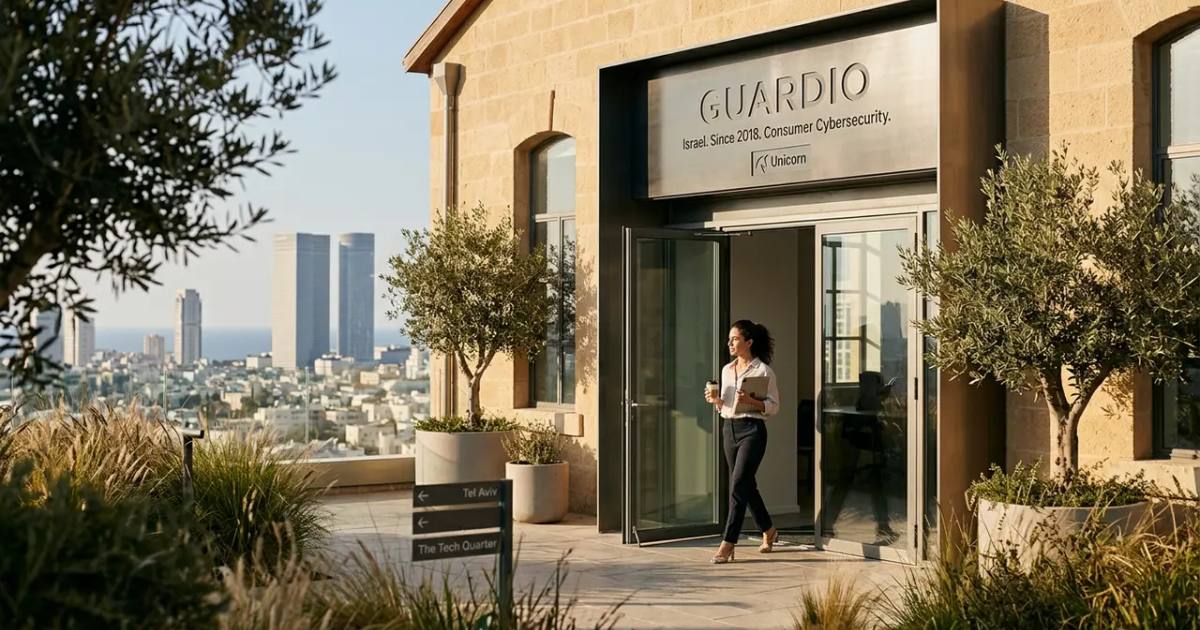

Guardio, an Israeli consumer cybersecurity company founded in 2018, reached a 1.1 billion dollar valuation in September 2026 after Wiz CEO Assaf Rappaport joined its funding round and the company crossed 150 million dollars in annual recurring revenue.
Guardio is an Israeli consumer cybersecurity company that reached a 1.1 billion dollar valuation in September 2026, becoming one of the few Israeli-founded security unicorns built around individual users rather than enterprises. Founded in 2018 by Amos Peled, Daniel Sirota, and Michael Vainshtein, Guardio protects browsing, email, texting, and device activity from scams, phishing, malicious websites, and identity theft, and had crossed 150 million dollars in annual recurring revenue and one million paying customers by the time of its latest raise.
What does Guardio do?
Guardio builds browser extensions and mobile applications that scan a user's online activity for scams, phishing attempts, malicious websites, and identity theft risk. The product spans browsing, email, and text messaging, positioning Guardio as a single security layer across the channels where individual consumers, rather than corporate networks, are most commonly targeted.
Guardio CEO and co-founder Amos Peled has described the company's core thesis as a response to how fraud economics have changed. Attackers who once needed technical skill and infrastructure can now rent AI tools that write, voice, and dial scams for a small fee, according to Peled. Guardio's pitch is that consumer security has to be rebuilt around the individual person rather than the device, since traditional antivirus software built for an earlier decade cannot recognize scams that look and sound convincingly human.
Who founded Guardio and when?
Amos Peled, Daniel Sirota, and Michael Vainshtein founded Guardio in 2018. The company operated on a bootstrapped basis in its early years, a decision Peled has said gave the founding team room to build the underlying product and business model before taking on outside capital or pressure to scale spending prematurely.
Guardio raised its first institutional round, a Series A, in 2021, led by Tiger Global. The company then held off on further fundraising for roughly four years while it built out its revenue base, a gap that is unusually long for a venture-backed Israeli technology company at Guardio's eventual growth rate.
How has Guardio's funding and valuation progressed?
Guardio's funding history compresses a long bootstrapped period followed by two fast rounds inside a single year. The company raised nothing between its 2021 Series A and November 2025, then closed two rounds within roughly ten months of each other as its revenue growth accelerated.
- 2018 — Guardio founded by Amos Peled, Daniel Sirota, and Michael Vainshtein.
- 2021 — Series A led by Tiger Global.
- November 2025 — 80 million dollar Series B led by ION Crossover Partners, with Vintage Investment Partners, Union Tech Ventures, and Emerge Ventures participating. The round followed three consecutive years of more than 100 percent annual revenue growth.
- September 2026 — 40 million dollars raised at a 1.1 billion dollar valuation, with Wiz co-founder and CEO Assaf Rappaport joining as an investor alongside the existing Series B backers. Total funding to date: 167 million dollars.
At the time of the September 2026 round, Guardio reported more than 150 million dollars in annual recurring revenue, one million paying customers, and four consecutive years of triple-digit revenue growth. ION Crossover Partners, the lead investor across both the Series B and the 2026 round, has previously backed pre-IPO Israeli companies including Monday.com, Fiverr, and Taboola.
Why did Assaf Rappaport invest in Guardio?
Assaf Rappaport co-founded and leads Wiz, the Tel Aviv cloud security company that Google acquired for a publicly reported 32 billion dollars, the largest Israeli technology exit on record. The Olam's coverage of the Wiz founders after the Google acquisition tracks how Rappaport and his co-founders, Ami Luttwak, Yinon Costica, and Roy Reznik, have deployed their time and capital since the deal closed in March 2026, including early-stage investing in Israeli security companies.
Rappaport has said Guardio's approach depends on understanding user context in depth, a capability he described as increasingly important as AI-generated fraud grows more personalized and harder to distinguish from legitimate communication. Guardio has also formed a product partnership with Lovable, the Swedish-founded vibe-coding platform, aimed at identifying AI-generated web abuse at the point a scam site or fraudulent page is created rather than after it reaches a victim.
Where does Guardio fit in the Israeli cybersecurity landscape?
Guardio occupies a category that is largely absent from the enterprise-dominated upper tiers of Israeli cybersecurity. The Olam's Israeli Cyber 50 ranking for Q1 2026 maps the sector across four tiers led by Wiz (acquired by Google for 32 billion dollars), Check Point Software, CyberArk (acquired by Palo Alto Networks for 25 billion dollars), and SentinelOne, none of which sell directly to individual consumers. Guardio's 1.1 billion dollar valuation would place it in the range of that ranking's mid-cap tier, but its consumer focus sits outside the enterprise, cloud, and identity-security categories that structure the existing list.
The Olam's guide to Israeli cybersecurity in 2026 notes that the sector's cumulative valuation has been estimated at more than 200 billion dollars, with Israeli cybersecurity companies raising 4.4 billion dollars across 130 funding rounds in 2025 according to YL Ventures. That capital has concentrated overwhelmingly in enterprise categories: cloud security, identity and access management, and the AI-security cohort that emerged between 2023 and 2025, several of whose members were acquired within fifteen months of founding. Guardio's growth from an 80 million dollar Series B to a 1.1 billion dollar valuation in roughly ten months suggests investor interest in consumer-facing security is starting to follow a similar acceleration curve, driven by the same AI-enabled fraud economics reshaping the enterprise side of the market.
What is Guardio's competitive position?
Guardio competes less directly with the Unit 8200-descended enterprise security operators that dominate Israeli cyber exits and more with legacy consumer antivirus brands built for an earlier threat model centered on malware rather than social engineering and AI-generated scams. The company's claim to differentiation rests on treating the individual user, not the device, as the unit of protection, an approach that requires understanding behavioral context across browsing, email, and messaging rather than scanning files for known malicious signatures.
The involvement of Assaf Rappaport, whose enterprise security background at Wiz and previously at Adallom (acquired by Microsoft in 2015) sits on the opposite end of the market from Guardio's consumer focus, signals that some of the same capital and operator expertise built inside Israel's enterprise cyber pipeline is now flowing into the consumer segment as AI reshapes fraud at both ends of the market.
How we report: Olam stories draw on public filings, company disclosures and named sources, checked by our editors. Read our methodology · Corrections