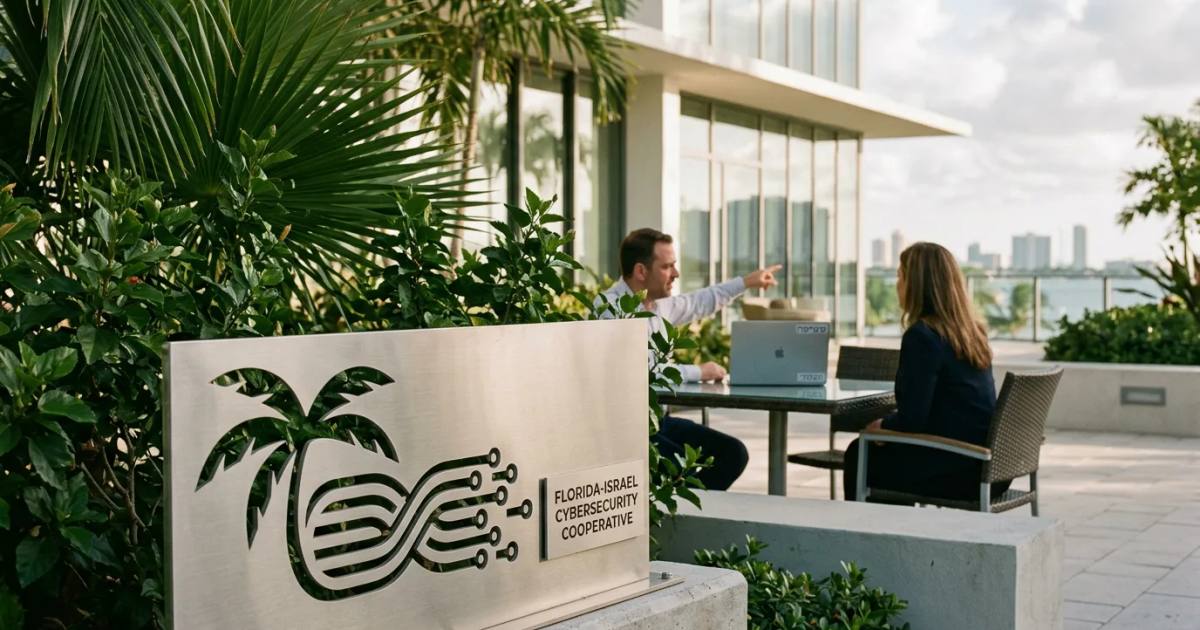

14 Israeli firms made the Rising in Cyber 2026 list. FIBA and the Tampa-MacDill defense pipeline are steering that funding toward Florida addresses.
Fourteen Israeli cybersecurity companies made the Rising in Cyber 2026 list compiled by Notable Capital and Morgan Stanley, and Israeli founders account for nearly half of the 30 startups named, according to a May 2026 Israel Defense report. Increasingly, when these companies open a U.S. office, they choose Florida.
Which 14 Israeli Companies Made the Rising in Cyber 2026 List?
The Rising in Cyber 2026 list ranks the 30 most promising private cybersecurity startups based on a survey of roughly 150 CISOs and senior security executives, conducted by venture firm Notable Capital with Morgan Stanley, according to Israel Defense's May 2026 report. The 14 Israeli companies named are Cyera (data security), Orca Security (cloud-native application protection), Island (enterprise browser), Torq (security automation), Grip Security (SaaS security), Noma Security, Oligo Security, Token Security, Beacon Security, Clover Security, Descope, Echo Security, Terra Security, and Tonic AI.
A fifteenth company, Runlayer, was founded by an Israeli entrepreneur, which Israel Defense counts as bringing Israeli representation to roughly half the list. Notable Capital's managing partner Oren Yunger described the selections as technologies "already trusted and deployed by leading enterprises," per the same report.
Why Are Israeli Cybersecurity Companies Choosing Florida?
Israeli cybersecurity companies expanding into the U.S. increasingly route through Tampa and Miami because of a specific pipeline: the Florida-Israel Business Accelerator (FIBA), which has supported more than 100 Israeli companies entering the U.S. market since 2017. FIBA is based in Tampa, and Tampa's structural advantage is military rather than commercial.
MacDill Air Force Base hosts both U.S. Central Command (CENTCOM), established there in 1983, and U.S. Special Operations Command (SOCOM), activated in 1987, per MacDill's own fact sheet. For an Israeli defense-technology or cybersecurity company chasing Pentagon contracts, proximity to both commands shortens the sales cycle. The resulting pattern, documented in Olam's county-by-county map of the corridor: Miami handles capital and enterprise sales, and Tampa handles defense procurement and manufacturing.
How Big Is the Cybersecurity Market Driving This Migration?
The global cybersecurity market will grow from $153 billion in 2025 to $255 billion by 2029, according to IDC data cited in Israel Defense's Rising in Cyber 2026 coverage. Cybersecurity M&A reinforced that growth in 2025: total disclosed deal value exceeded $84 billion across more than 420 transactions, including Google's $32 billion acquisition of Wiz and Palo Alto Networks' $25 billion purchase of CyberArk, according to SecurityWeek's year-end M&A tracker.
The same Israel Defense report identifies the sector's biggest gap: 71% of surveyed CISOs said they already run AI agents in production, while only 11% described their tools for securing those agents as mature. Around 20% of CISOs named control over AI-driven identities as their top near-term concern, which is the category several of the 14 listed Israeli companies, including Token Security and Oligo Security, are built to address.
Which Israeli Cybersecurity Company Actually Opened a Florida Office?
Cybecs, an Israeli cybersecurity company, announced in September 2023 that it was establishing its regional U.S. headquarters in downtown Tampa, with plans to create 150 jobs over three years in software development, sales, and IT roles, according to a Tampa Bay Economic Development Council announcement. Cybecs CEO Asaf Levy said the company chose Tampa for its Eastern time zone position and its technology talent pool, per the same release. Cybecs joined a Tampa cybersecurity cluster that already included Ridgeline International, Rapid7, and OPSWAT, the Tampa Bay EDC noted.
What Does the Florida-Israel Cybersecurity Infrastructure Look Like?
Five elements make up the pipeline that moves Israeli cybersecurity companies into Florida: FIBA as the Tampa-based soft-landing accelerator; Israel Tech Week Miami, which drew more than 2,000 attendees; the Tampa-MacDill defense-procurement channel; nonstop El Al service between Tel Aviv and South Florida, detailed in Olam's reporting on the Miami route; and Florida's zero state income tax. Together they sit inside the wider $7.3 billion Florida-Israel corridor that Olam tracks across cybersecurity, real estate, and defense technology.
Cybersecurity is one slice of a corridor covered in Olam's Israeli Cybersecurity Companies & Exits section. The pattern holds across sectors: Israeli founders build the technology, and Florida increasingly supplies the U.S. address, the capital access, and, in Tampa's case, the defense customer.
This article is part of Olam's Florida-Israel coverage, ongoing reporting on the capital, companies, and community building the corridor.