
The Polish-born Holocaust survivor whose three towers redefined Tel Aviv — and whose name still anchors one of Israel's largest property empires.
THE BUILDERS | OLAM.BUSINESS
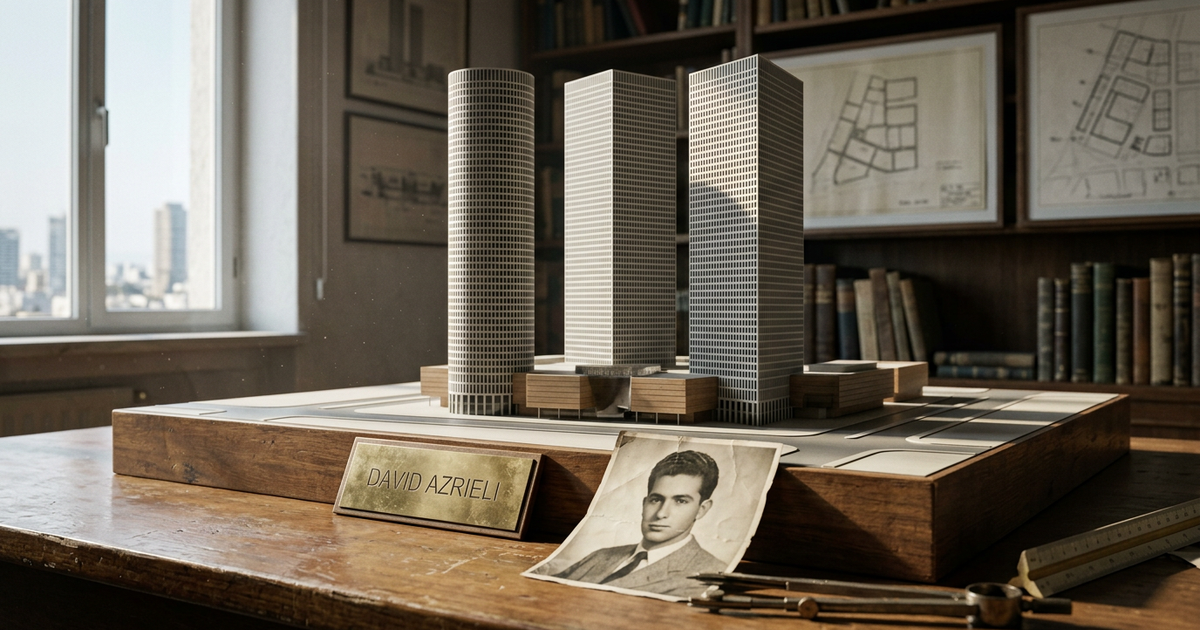
Three shapes define the Tel Aviv skyline: a circle, a triangle, and a square.
The man behind them was a Polish-born Holocaust survivor who fled east during the war, fought in Israel's War of Independence, made his fortune building shopping centers in Canada, and returned decades later to reshape the center of Tel Aviv.
David Azrieli was never simply another real estate developer. He built systems that outlived him — malls, offices, infrastructure, and institutions that still shape daily life in Israel.
When he took the group public in 2010, it was the largest IPO in Israeli history. When he died in 2014, his daughter Danna inherited the chairmanship. The company kept compounding. The towers kept rising. The name kept appearing on the side of new buildings in every major Israeli city.
Snapshot
- Born: 1922, Maków Mazowiecki, Poland (died 2014, Israel)
- Primary business: Real estate
- Main company: Azrieli Group (TASE: AZRG)
- Sector: Malls, office towers, data centers, senior living
- Based in: Tel Aviv and Montreal
- Known for: Azrieli Center towers, Israel's largest mall portfolio, Azrieli Foundation
The Business Story
Born Dawid Azrylewicz in 1922, in a small Polish town northeast of Warsaw, he fled the Nazi invasion in 1939 and survived the war moving across the Soviet Union and Central Asia. He reached Mandate Palestine in 1942, joined the Haganah, and fought in the 1948 War of Independence. He studied architecture at the Technion in Haifa but left before completing his degree.
In 1954 he emigrated to Montreal, where he started in development with nothing and built Canpro Investments into one of Quebec's most active shopping-center operators. He spent three decades building Canadian retail real estate. By the late 1970s and 1980s, he was wealthy by any measure — and he turned back to Israel.
The Azrieli Center, conceived in the 1990s and opened in stages beginning in 1999, was the project that put his name on the country. Three connected towers in central Tel Aviv — round, triangular, square — anchored a shopping mall and reshaped the city's central business district. The complex remains, twenty-five years on, one of the most photographed corners of Israel.
In 2010, Azrieli took the group public. The offering raised approximately 2.5 billion shekels — the largest IPO in Tel Aviv Stock Exchange history at the time. He served as chairman until his death in July 2014. His daughter Danna Azrieli, long involved in the business, became chair. Eyal Henkin runs the company as chief executive.
Why He Matters in Israel
Israelis know the Azrieli name without trying. The malls are where suburban consumer life happens. The office towers house some of the country's largest tenants. The Azrieli Center remains one of the defining images of Tel Aviv's skyline — and one of the most recognizable commercial landmarks in Israel.
The deeper significance is generational. David Azrieli was a Holocaust survivor who became one of the country's most successful builders, and who spent the second half of his life giving away a substantial portion of his fortune through the Azrieli Foundation — funding Holocaust survivor memoirs, neurodevelopment research, architecture education, and university scholarships in Israel and Canada. The foundation today holds assets in the high hundreds of millions of dollars and operates as one of the largest private philanthropies tied to Israel.
What the Company Does Today
The Azrieli Group is now Israel's largest commercial landlord. It owns and operates more than two dozen malls under the Azrieli brand, an office portfolio approaching one million square meters concentrated in Tel Aviv, Herzliya, Holon, Haifa, Be'er Sheva, and Jerusalem, and a growing data-center business that includes Compass Datacenters in North America and a controlling stake in Norway-based Green Mountain. Its senior-living arm operates under the Palace brand.
Strategically, the group has moved aggressively into digital infrastructure, betting that the same long-duration, hard-asset thesis that built the mall and office business will now build the data-center business.
Key Holdings
- Azrieli Center, Tel Aviv (three towers plus Sarona Tower)
- More than 25 Azrieli-branded malls across Israel
- Holon Towers, Azrieli Town, and other major office complexes
- Compass Datacenters (acquired 2021)
- Green Mountain (Norway-based data center operator)
- Palace senior-living facilities
- Significant Israeli land bank and development pipeline
- Azrieli Foundation (Israel and Canada)
Legacy and Influence
The group's market capitalization places it among the most valuable real estate companies in Israel. Family control runs through Canit Hashalom Investments. The foundation continues to publish the Azrieli Series of Holocaust Survivor Memoirs — more than one hundred volumes to date — and funds neurodevelopment fellowships at institutions including Weizmann, the Hebrew University, McGill, and Harvard.
Why He Matters Now
Azrieli's relevance in 2026 goes beyond real estate. The group sits at the intersection of several defining sectors of the Israeli economy: commercial office space, retail, senior living, and increasingly digital infrastructure through data centers. As Israel's economy becomes more technology-driven and land-constrained, Azrieli's portfolio increasingly looks less like a traditional property company and more like national infrastructure.
The towers are still there. The malls are still full. The name is on the building.
More from The Builders
- Noam Lanir: Empire Online to Livermore
- Rami Levy: Israel's Grocery King
- Yitzchak Mirilashvili: Watergen, VK, Channel 14
מי הוא דוד עזריאלי? הבונה ששמו על קו הרקיע של תל אביב
ניצול שואה יליד פולין ששלושת מגדליו עיצבו מחדש את תל אביב — ושמו עדיין מחזיק את אחת מאימפריות הנדל"ן הגדולות בישראל.
שלוש צורות הגדירו את קו הרקיע של תל אביב: עיגול, משולש וריבוע. דוד עזריאלי, שהקים אותן, היה פליט פולני שניצל מהמלחמה בבריחה מזרחה אל ברית המועצות, לחם במלחמת העצמאות, עשה את הונו בבניית קניונים בקוויבק וחזר לישראל בגיל שישים פלוס כדי לבנות את היצירה המסחרית המכוננת של המדינה.
עזריאלי לא היה עוד יזם נדל"ן. הוא בנה מערכות שהמשיכו לפעול אחריו — קניונים, משרדים, תשתיות ומוסדות שמעצבים עד היום את החיים היומיומיים בישראל.
כשהנפיק את הקבוצה ב-2010, זו הייתה ההנפקה הגדולה ביותר בתולדות הבורסה הישראלית. כשנפטר ב-2014, בתו דנה ירשה את תפקיד היו"ר. החברה המשיכה להתעצם. המגדלים המשיכו לעלות. השם המשיך להופיע על דפנות בניינים חדשים בכל עיר מרכזית בארץ.