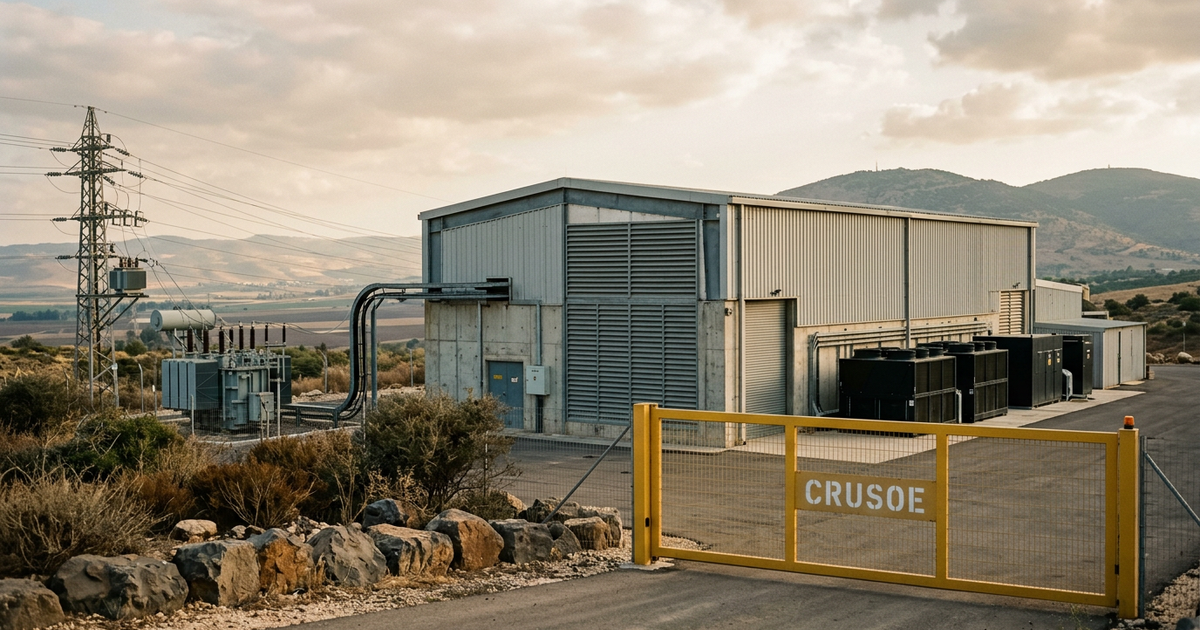

Crusoe's Afula data-center deal upgrades Israel's positioning as a regional AI compute hub, as grid economics and land in the northern technology corridor start competing with European geographies.
Crusoe, the U.S. AI-infrastructure operator, has closed a large data-center deal in Afula — a move that materially upgrades Israel's positioning as a regional AI compute hub. The deal lands as Israeli grid economics, land availability, and a maturing northern technology corridor anchored by Haifa start competing seriously with European data-center geographies for AI training and inference workloads.
Crusoe is one of the new generation of vertically integrated AI-compute operators, building dedicated data centers oriented around large-scale GPU deployment rather than retrofitting general-purpose colocation. Founded in 2018, the company has raised more than $1 billion in equity and debt to build out compute capacity that targets the specific thermal, power-density, and rack-design demands of frontier AI workloads. Its Afula footprint now adds capacity in northern Israel and signals that Israeli infrastructure has cleared the institutional threshold for serious AI deployment — a threshold that previously routed Israeli compute demand to Frankfurt, Amsterdam, and London.
Afula's appeal is geographic and economic. The city sits in the Jezreel Valley, with access to the Israel Electric Corporation's northern grid backbone and significantly cheaper industrial-zoned land than the Tel Aviv metropolitan belt. It is also within a 45-minute drive of the Haifa technology corridor — the home of Intel, IBM, and Mobileye — which gives the facility a meaningful talent radius. The deal follows Nvidia's separate expansion of laboratory footprint in Rishon LeZion, mapping a clear thickening of Israel's AI-infrastructure stack from R&D labs in the south to training-scale compute in the north.
Why It Matters
Israel's AI economy has historically been algorithm-heavy and compute-light. The country produces a disproportionate share of the world's AI researchers and start-up founders — by some industry estimates between 8% and 12% of global AI engineering talent traces through Israel — but it has not until now hosted the infrastructure to train large models domestically. A Crusoe-scale facility in Afula moves the country into the small set of geographies that can host serious AI training and inference workloads inside national borders. For sovereign-tech use cases, defense-AI applications, regulated-data workloads, and the growing class of Israeli AI start-ups that need lower-latency compute, that is a structural shift.
It also matters commercially. Israeli AI start-ups have been routing compute spend offshore — predominantly to AWS, Microsoft Azure, and Google Cloud regions outside Israel — which has meant a steady outflow of capital that Israeli financial-services players watching the sector have flagged for years. Domestic AI-infrastructure capacity reverses that flow. The Afula facility is one data point; the trend it sits inside is broader.
The Strategic Picture
Three forces are converging. First, the cost of moving AI training data across borders is becoming a real constraint for Israeli companies handling sensitive data, particularly in defense, healthcare, and financial services. Second, the European AI Act and emerging U.S. export controls on AI compute have raised the value of geographically diversified compute footprints. Third, Israeli grid and land economics in secondary cities like Afula, Beersheva, and Ashkelon now compete favorably with their European counterparts on a per-megawatt basis.
Crusoe's move into Afula reads less as an isolated property deal and more as a marker that the global AI-infrastructure map is being redrawn — and Israel is now on it. Watch for follow-on announcements from the major U.S. and Asian hyperscalers in the next 12 to 18 months. The infrastructure thesis aligns with the broader build-and-own move visible across Israeli infrastructure builders moving up the value chain from contracting into long-duration asset ownership.
What to Watch
Three indicators will tell you whether the Afula deal is a one-off or a category opening. First: power-purchase agreements with the Israel Electric Corporation or independent power producers — large-scale AI data centers require dedicated power infrastructure that takes 18 to 36 months to build. Second: announcements from competing operators (CoreWeave, Lambda, Together AI) on Israeli geographies. Third: Israeli government posture on AI-infrastructure incentives — the Innovation Authority and Ministry of Economy have signaled interest in compute as a strategic asset class. Crusoe's footprint also creates downstream optionality for the Israeli deep-tech sector, where quantum-computing and other compute-intensive workloads will eventually want domestic capacity.
FAQ
Who is Crusoe?
A U.S.-based AI-infrastructure operator, founded in 2018, building vertically integrated data centers purpose-built for large-scale AI training and inference workloads. The company has raised over $1 billion in combined equity and debt financing.
Why Afula?
Land availability, lower-cost industrial-zoned parcels, access to the Israel Electric Corporation's northern grid backbone, and proximity to the Haifa technology corridor — Intel, IBM, Mobileye are all within a 45-minute radius.
What's the broader Israeli AI infrastructure context?
The deal sits alongside Nvidia's Rishon LeZion expansion, signaling material thickening of Israel's AI-infrastructure base. Both moves point to Israel becoming a credible non-U.S., non-European AI compute geography.
Has the deal value been disclosed?
Specific transaction terms have not been publicly disclosed at time of reporting. Hebrew-language coverage describes it as a large deal but stops short of a headline number.
What does this mean for Israeli AI start-ups?
Domestic compute capacity reduces latency and currency exposure on AI training spend, and removes a meaningful regulatory drag for any Israeli company handling defense, healthcare, or financial-services data.
Published 15 June 2026 · Olam Hebrew Desk