Quantum Art Extends Series A to $140 Million — Weizmann Spinout Builds Israel's 1,000-Qubit Trapped-Ion Quantum Computer
Quantum Art, the Israeli quantum-computing company spun out of the Weizmann Institute of Science, has extended its Series A to $140 million. Bedford Ridge Capital led. Perspective — the 1,000-qubit trapped-ion system — is the target.
Quantum Art, the Ness Ziona–based Israeli quantum computing company spun out of the Weizmann Institute of Science, has extended its Series A financing to $140 million, adding $40 million to the $100 million round it announced in December 2025. Bedford Ridge Capital led the extension, joined by new investors Hudson Bay Capital, Poalim Equity, LIP Ventures, Wolverine Global Ventures, and IDA Ventures. The capital funds Perspective — Quantum Art's 1,000-qubit multi-core trapped-ion system — and pushes the company toward commercial-scale quantum computing.
What Quantum Art Is
Quantum Art is an Israeli quantum computing company founded in 2022 and headquartered in Ness Ziona, Israel. The company is a spin-off from Prof. Roee Ozeri's research group at the Weizmann Institute of Science and builds full-stack trapped-ion quantum computers — quantum systems that use individual ions held in place by lasers as the qubit substrate.
The founding team is Dr. Tal David (CEO), Dr. Amit Ben-Kish (CTO), and Prof. Roee Ozeri (Chief Scientific Officer). All three came out of the Weizmann trapped-ion program. Quantum Art's technical bet is a reconfigurable, multi-core trapped-ion architecture with multi-qubit gates that compress complex operations into a single step. The company claims the architecture delivers up to 100× more gates per second and up to a 50-fold footprint reduction compared to competing roadmaps.
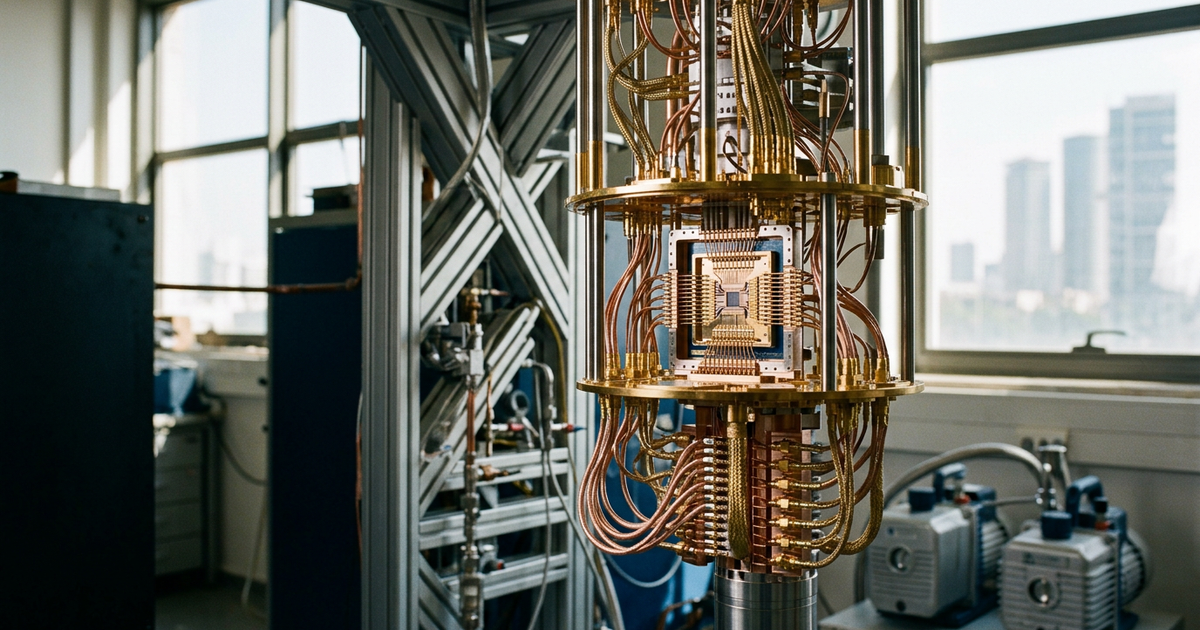
Quantum Art's flagship product is Perspective, a 1,000-qubit multi-core quantum computer designed to reach commercial quantum advantage. In parallel, the company is prototyping a third-generation 2D architecture aimed at scaling toward millions of qubits. In 2025, Quantum Art demonstrated a stabilized, fully controlled 200-ion chain — one of the longest linear ion chains ever achieved in an industry-grade quantum system.
The $140 Million Round
The Series A extension brings the round to $140 million total. The original $100 million Series A closed in December 2025, led by Bedford Ridge Capital, with Battery Ventures, Destra Investments, Lumir Growth Partners, Disruptive AI, Harel Insurance, Karen W. Davidson, GTV, Yasmin Lukatz, Corner Capital, and Qbeat Ventures. Seed-round backers Amiti Ventures (seed lead), StageOne Ventures, Vertex Ventures Israel, Entrée Capital, and the Weizmann Institute of Science continued in the round.
The April 2026 extension of $40 million was led by Bedford Ridge Capital, joined by new investors Hudson Bay Capital, Poalim Equity, LIP Ventures, Wolverine Global Ventures, and IDA Ventures. Total company funding now sits above $160 million.
Series A extensions at this scale in quantum hardware are not routine. They signal one of two things — existing-investor conviction in the technical roadmap, or accelerated commercial traction that warrants additional runway. In Quantum Art's case, the return of Bedford Ridge Capital as extension lead points to the first.
Israel's Quantum Stack
Quantum Art sits inside a small but technically deep Israeli quantum sector. In 2025 alone, five Israeli quantum companies — Quantum Art, Quantum Machines, Classiq, QuamCore, and Qedma — raised close to $500 million combined, covering nearly every layer of the quantum stack from hardware to control systems to error-correction software.
Quantum Machines builds quantum-control systems out of Tel Aviv. Classiq, founded in 2020 by Nir Minerbi, Amir Naveh, and Dr. Yehuda Naveh, builds quantum-algorithm software and counts NVIDIA, Microsoft, AWS, BMW, Comcast, Rolls-Royce, Citi, Toshiba, and SoftBank among partners and customers. QuamCore, led by Alon Cohen, is building toward a million-qubit superconducting architecture. Qedma, built out of the Technion, develops error-mitigation software and is backed by IBM.
Quantum Art occupies the trapped-ion hardware position in the stack. It competes globally with superconducting-qubit systems (IBM, Google, Rigetti), neutral-atom systems (QuEra, Atom Computing, Pasqal), and photonic systems (PsiQuantum, Xanadu) — the principal architectural bets in the early quantum market.
The research substrate behind all of these companies runs through the Weizmann Institute of Science, the Hebrew University of Jerusalem, and the Technion. The Israel Innovation Authority's national quantum-computing program, launched in 2018 and expanded in 2022 and 2024, has funded much of the underlying research.
Why the Round Matters
Quantum computing is one of the few deep-tech categories where Israeli companies have built credible global positioning early in the technology cycle. A $140 million Series A — at extension stage, not a fresh round — tells you the existing capital base has conviction in Quantum Art's roadmap. That is the signal that matters more than the headline number. In quantum hardware, the existing-investor signal carries more information than new-investor entry, because the technical-progress information asymmetry favors insiders.
It also matters as a capital-allocation marker. Israeli deep-tech has remained accessible to global venture capital through the war period, and at a scale that supports multi-year hardware timelines. For the broader Israeli capital map, that is a signal worth tracking alongside the parallel repricing in Israeli financial services and the AI-infrastructure capital being deployed in Afula. Quantum Art also competes for the same narrow pool of senior hardware engineers that Nvidia and Intel are bidding up in Israel's chip corridor.
What to Watch
Three indicators. First, technical milestones from Quantum Art over the next twelve months — qubit count, gate fidelity, error-correction progress on the Perspective system — which will determine whether the existing-investor conviction is validated. Second, parallel financing activity at Quantum Machines, Classiq, QuamCore, and Qedma, which would confirm sector-wide capital availability for Israeli quantum. Third, Israeli quantum M&A. U.S. and European quantum-hardware sectors have begun to consolidate. Israeli companies will be acquisition targets if commercial traction accelerates.
Frequently Asked Questions About Quantum Art
What is Quantum Art?
Quantum Art is an Israeli quantum computing company that builds full-stack trapped-ion quantum computers. It is a spin-off from Prof. Roee Ozeri's research group at the Weizmann Institute of Science.
Who founded Quantum Art?
Quantum Art was founded by Dr. Tal David (CEO), Dr. Amit Ben-Kish (CTO), and Prof. Roee Ozeri (Chief Scientific Officer) in 2022, as a spin-off from the Weizmann Institute of Science.
Where is Quantum Art headquartered?
Quantum Art is headquartered in Ness Ziona, Israel.
When was Quantum Art founded?
Quantum Art was founded in 2022.
How much has Quantum Art raised?
Quantum Art's Series A totals $140 million after an April 2026 extension of $40 million on top of the December 2025 initial close of $100 million. Total company funding is above $160 million including the 2022 seed round.
Who led Quantum Art's Series A?
Bedford Ridge Capital led both the original $100 million Series A in December 2025 and the $40 million extension in April 2026. The extension added Hudson Bay Capital, Poalim Equity, LIP Ventures, Wolverine Global Ventures, and IDA Ventures as new investors.
What is Perspective, Quantum Art's flagship product?
Perspective is Quantum Art's 1,000-qubit multi-core trapped-ion quantum computer, designed to reach commercial quantum advantage.
What technology does Quantum Art use?
Quantum Art uses trapped-ion quantum computing — individual ions held in place and controlled by lasers as qubits — with a reconfigurable multi-core architecture, multi-qubit gates, and dense 2D arrays for scaling.
Who are Quantum Art's competitors?
Globally, Quantum Art competes with IonQ (trapped-ion), IBM, Google, and Rigetti (superconducting), QuEra, Atom Computing, and Pasqal (neutral-atom), and PsiQuantum and Xanadu (photonic). Inside Israel, Quantum Machines, Classiq, QuamCore, and Qedma occupy adjacent layers of the stack.