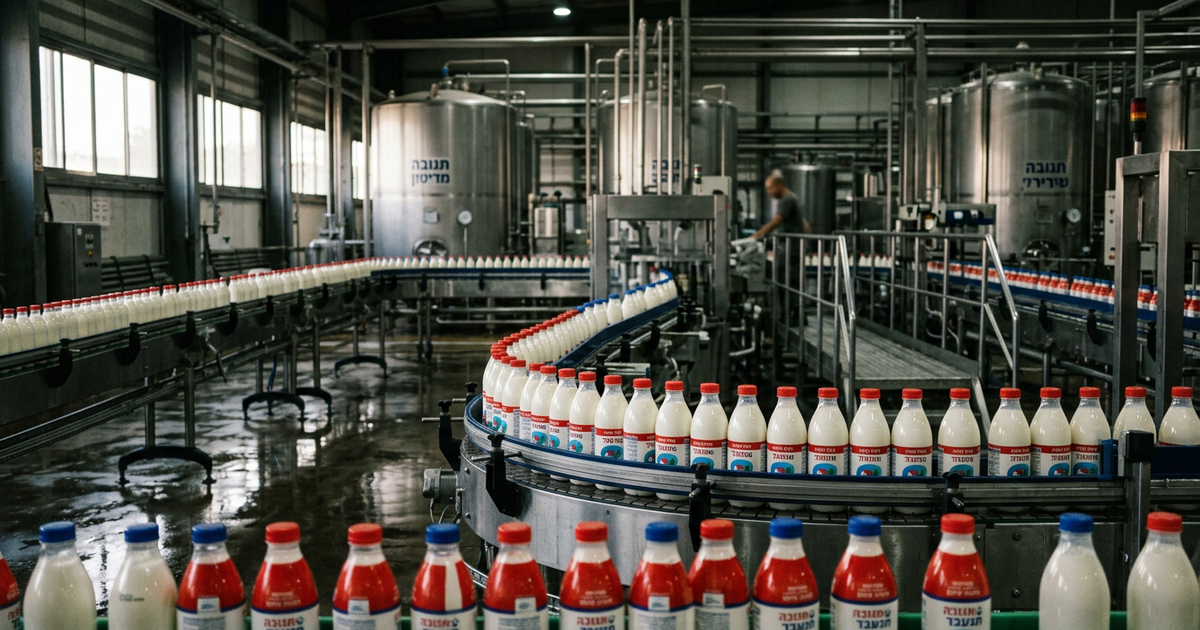

A Chinese state-linked conglomerate has controlled Tnuva, Israel's dominant dairy processor, for over a decade. Its ownership structure has not been publicly examined.
A Chinese state-linked conglomerate has controlled Tnuva, Israel's dominant dairy processor, for over a decade. Post–October 7, post-decoupling, that ownership structure has not been publicly examined. It should be.
Israelis drink some of the most expensive milk in the developed world. One company processes roughly 70% of it. A Chinese state-linked conglomerate has owned that company since 2015. And English-language business media has never seriously covered any of it.
The company is Tnuva. The owner is Bright Food — the Shanghai-headquartered state-adjacent food giant that acquired its controlling stake from Apax Partners in a deal valuing Tnuva at roughly $2.5 billion. Eleven years later, the company that touches more Israeli refrigerators than any other brand sits inside a Chinese portfolio.
The Bright Food Question
Bright Food is not a private company in any meaningful Western sense. It is majority-owned by the Shanghai Municipal Government. Its board and senior leadership rotate through Chinese Communist Party channels. Its acquisition strategy — Weetabix in the UK, Manassen in Australia, Tnuva in Israel — has been characterized by analysts as part of Beijing's broader food-security posture.
None of that was secret in 2015. What has changed is the frame. The Abraham Accords. October 7. The U.S.–China decoupling. CFIUS-style scrutiny of Chinese ownership across allied economies. Australia forced a review of Chinese dairy acquisitions. The UK tightened foreign-investment rules around food infrastructure. Israel has not opened the file.
The strategic question is simple: should the country's dominant processor of a staple food category — one whose supply chain runs through kibbutz refets, moshav cooperatives, and government-set quotas — sit inside a portfolio managed from Shanghai? The answer may be yes. The conversation has not happened.
The Cartel
Tnuva, Strauss, and Tara move as three points of a triangle. The Israel Competition Authority has opened, closed, and reopened dairy-pricing investigations for more than a decade. Nothing structural has shifted.
Cottage cheese — the product that toppled a finance minister during the 2011 social-justice protests — costs more today than it did then. The margin sits somewhere between the farm gate and the supermarket shelf. Nobody in English has mapped where.
Israeli consumers pay 40 to 80 percent more for basic dairy than European equivalents. That premium is not explained by climate, by scale, or by input costs. It is explained by structure — a closed system of quotas, tariffs, and processor concentration that has survived every reform attempt since Stanley Fischer's tenure at the Bank of Israel.
The Import Wall
Every finance minister from Yair Lapid to Bezalel Smotrich has promised to open dairy imports. Every one has lost to the same coalition: moshav farmers, kibbutz refets, and Tnuva's distribution muscle.
The politics of that fight is a Jerusalem story hiding in plain sight. Which agriculture minister flipped. Which Knesset member's district depends on quota income. Which reform got gutted in committee at 2 a.m. The dairy lobby is the most effective single-industry lobby in the country. It has never lost a full-scale confrontation.
The Refet Economy
For dozens of privatized kibbutzim, the dairy barn — the refet — remains the single largest revenue line. Milk-quota cuts are political violence in kibbutz country. Any government that touches the quota system loses the periphery.
That is why nobody touches the refet. The refet vote is small in absolute terms but decisive in coalition math. The Labor-adjacent kibbutz movement and the Religious Zionist moshav bloc agree on almost nothing. They agree on this.
The Gulf Play
Tnuva and Tara are quietly building halal-certified export lines into the UAE and Saudi markets. Israeli dairy processing technology, kosher-halal overlap, Gulf demand for premium dairy protein. Real deals are moving.
The strategic contradiction is worth naming out loud: Israel's dairy exports to the Gulf are, in part, routed through a Chinese-owned processor. No English-language outlet has written that sentence.
The Rami Levy Front
Rami Levy — the discount grocer — has spent a decade trying to crack dairy pricing. Private-label milk. Direct-import hard cheese. Running battles with the Ministry of Agriculture over import licenses.
Where Rami Levy has won, prices dropped. Where Rami Levy has been blocked, prices held. The map of his wins and losses is the map of who actually controls the Israeli shelf.
The Precision-Fermentation War
Remilk and Imagindairy — two Israeli startups building dairy proteins without cows — have raised hundreds of millions on the promise of displacing the incumbent processors.
The dairy lobby is quietly working the regulatory path against them. Approval delays. Labeling fights. Standards-of-identity battles. Classic incumbent disruption playbook.
The sentence nobody has written: the incumbents are Chinese-owned. The disruptors are Israeli-founded. The regulator is Israeli. The buyer is global. That is the story.
What This Adds Up To
Israeli dairy is not a consumer story. It is a national-security story, a foreign-ownership story, a competition-policy story, and a food-technology story — braided together and unexamined in English.
The cartel is old. The Chinese ownership is a decade in. The reform politics are frozen. The disruptors are funded. Something in that stack is going to break in the next twenty-four months. When it does, the coverage will begin. The reporting should start now.
How we report: Olam stories draw on public filings, company disclosures and named sources, checked by our editors. Read our methodology · Corrections