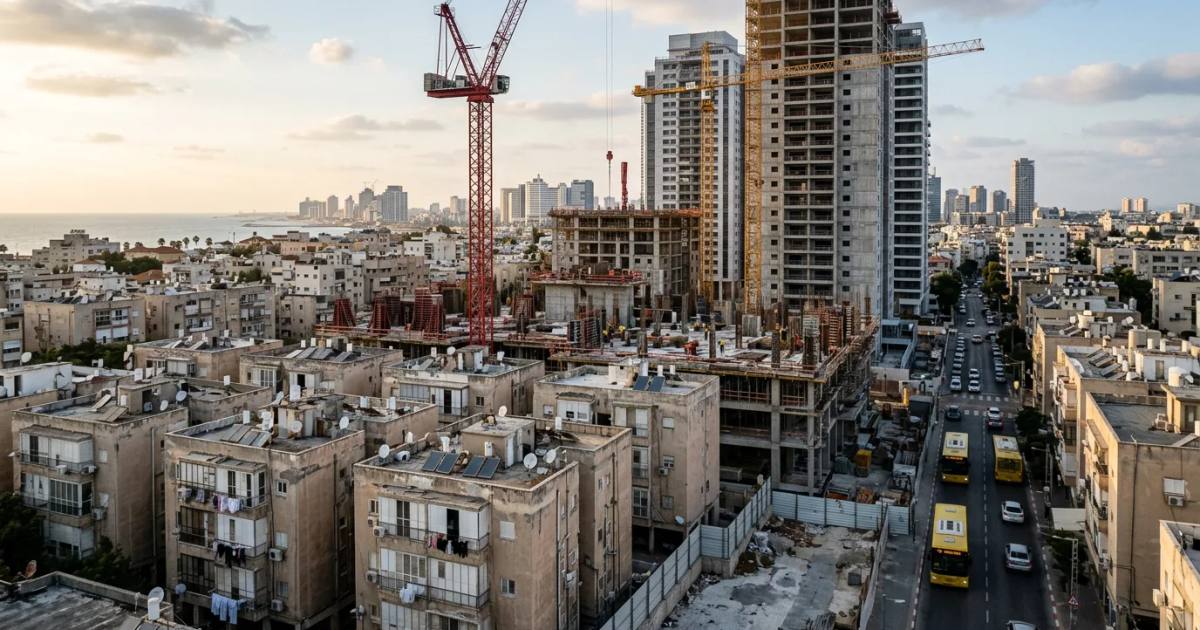

Bat Yam leads Israeli cities in pinui-binui approvals per capita. The Rambam Complex exemplifies this urban renewal density, driven by Amidar stock and its Tel Aviv border location.
The Rambam Complex pinui-binui in central Bat Yam — a multi-parcel evacuation-and-rebuild project that replaces six aging apartment blocks with a cluster of new high-rise residential towers — is one of the largest single urban-renewal projects approved anywhere in Israel. It sits at the geographic and structural center of a citywide transformation: Bat Yam has more pinui-binui approvals per capita than any Israeli city, more units in the pipeline than most, and a municipal doctrine that treats the entire built environment as replaceable. The Rambam Complex is the model. Bat Yam is running that model across the city at once.
The pinui-binui numbers
Bat Yam's approved and in-progress pinui-binui pipeline totals thousands of units across dozens of distinct project sites — a per-capita concentration that outpaces every other Israeli city of comparable size. Tel Aviv has more absolute units in urban renewal because Tel Aviv is larger, but Tel Aviv's pipeline is more dispersed across a wider set of neighborhoods and a broader mix of project types. Bat Yam's pipeline is denser, more concentrated in residential-only pinui-binui, and more heavily weighted toward large multi-parcel projects like Rambam.
The concentration is not accidental. Four structural factors drive it, and all four apply to Bat Yam more strongly than to any comparable Israeli city.
Factor one: the Amidar housing stock
Roughly 60 percent of Bat Yam's residential building stock was constructed between the mid-1950s and the mid-1970s, most of it under the Amidar public-housing program that built standardized four-story walk-ups across dozens of small parcels throughout the city center. That stock is now at end of life. The buildings lack elevators, structured parking, and modern seismic engineering. The plots are small enough that individual TAMA 38 retrofits often fail on economics, which pushes owners toward multi-parcel pinui-binui projects that pool land value across neighboring blocks.
The end-of-life Amidar stock is the physical feedstock. Without it, there is no pinui-binui volume. Bat Yam has more of it, more concentrated, than any comparable city.
Factor two: the Tel Aviv border
Bat Yam's northern municipal boundary runs directly against south Tel Aviv-Yafo. The Jaffa neighborhoods sit across the city line. That geographic reality means Bat Yam land values track Tel Aviv values with only a modest discount — a discount that has narrowed steadily as Tel Aviv prices have climbed. A new apartment on Bat Yam's Ben Gurion Boulevard prices within a narrow range of a comparable apartment in south Tel Aviv, and the beachfront strip prices even closer. That price convergence is what makes pinui-binui economics work in Bat Yam: developers can compensate original owners with new apartments and still sell the incremental units at Tel Aviv-adjacent prices.
Interior Israeli cities without a Tel Aviv-metro border cannot generate the same pinui-binui margin, no matter how aged their housing stock is.
Factor three: the TABA 3700 masterplan
Bat Yam's TABA 3700 outline plan is one of the most aggressive municipal densification frameworks in Israel. The masterplan formally targets doubling the city's residential population to roughly 250,000 residents by the mid-2030s, allows building heights that would have been impossible to approve a decade earlier, and specifically channels new development into pinui-binui rather than greenfield expansion. The Bat Yam municipality has almost no undeveloped land — the city is fully built out within its boundaries — so densification is the only growth path available, and pinui-binui is the mechanism the masterplan chose.
The masterplan matters because it removes the single largest source of delay in Israeli residential development: the fight over whether new construction should be allowed at all. In Bat Yam, that fight is over. The fight is now about specific project execution, which is a fight developers can plan around.
Factor four: the developer specialization
Bat Yam has attracted a concentrated pool of pinui-binui specialist developers — Aura Investments, Ashtrom, Y.H. Dimri, Elad, Rotem Shani, and a longer tail of mid-tier operators — who have built local acquisition, legal, and construction machinery specifically for Bat Yam-scale projects. The specialization is self-reinforcing: developers who close reliably in Bat Yam attract more owner consent, more municipal cooperation, and more presale interest, which lowers their execution cost and enables them to close more deals. New entrants face a steeper learning curve than incumbents.
That developer concentration is why Bat Yam's pipeline runs at industrial scale while pinui-binui in other Israeli cities often stalls at the individual-project level. Bat Yam is the city where the pinui-binui doctrine has been institutionalized.
The Rambam Complex as archetype
The Rambam Complex captures all four factors in a single project. The site consists of multiple adjacent Amidar-era apartment blocks in central Bat Yam, aggregated into a single pinui-binui development that replaces the existing low-rise stock with a cluster of significantly taller residential towers. The scale allows the developer to pool land value across parcels, negotiate compensation with owners as a bloc rather than one-by-one, and deliver a mixed-use ground plane with retail and public space that a single-parcel project could not economically justify.
Rambam is not the only such complex in Bat Yam. The Aliyat HaNoar and Ramat Yosef neighborhoods host similar-scale projects. The Ben Gurion Boulevard corridor is a linear version of the same pattern. Bat Yam is running the Rambam architecture in parallel across at least a dozen distinct sites — which is the reason the pipeline totals what it totals.
What Bat Yam becomes
The 2035 Bat Yam that TABA 3700 targets is a fundamentally different city from the one that exists today. Roughly double the residential population. A skyline defined by dozens of new high-rise towers along the beachfront, the Ben Gurion axis, and the interior neighborhoods. A demographic mix shifted toward younger, higher-income Tel Aviv commuters. Municipal tax revenue several multiples of the current base. Infrastructure — schools, transit, sewage, power — expanded to match.
Whether the city delivers on that trajectory depends on execution across dozens of individual projects. But the doctrinal question is already settled. Bat Yam has committed to becoming the city TABA 3700 imagines. The developers have committed the capital. The homeowners have signed the consent forms. What remains is construction, and construction is now underway across most of the city at once.
Why it matters
Bat Yam is the working laboratory for pinui-binui at municipal scale. If the doctrine works — if a city of 130,000 can be rebuilt into a city of 250,000 within a single decade using coordinated urban-renewal replacement rather than greenfield expansion — Bat Yam is the proof. Every other Israeli coastal city with aging Amidar stock and a Tel Aviv-metro adjacency is watching. So is every planner in the developed world dealing with end-of-life postwar housing on high-value urban land.
The Rambam Complex is one project. The doctrine is city-wide. The precedent is national.
Primary Sources
- Bat Yam Municipality — TABA 3700 outline plan and pinui-binui project registry
- Israel Land Authority — national pinui-binui pipeline data
- Ministry of Construction and Housing — urban renewal statistics by municipality
- Central Bureau of Statistics — Bat Yam demographic and housing data
- Amidar Ltd. — public housing stock history and disposal registry
Olam coverage
Part three of Olam's Bat Yam real-estate series. See also Aura Sky Bat Yam (Aura Investments) and Sea Towers Bat Yam (Ashtrom coastal complex) for the developer-level views underneath the citywide numbers.