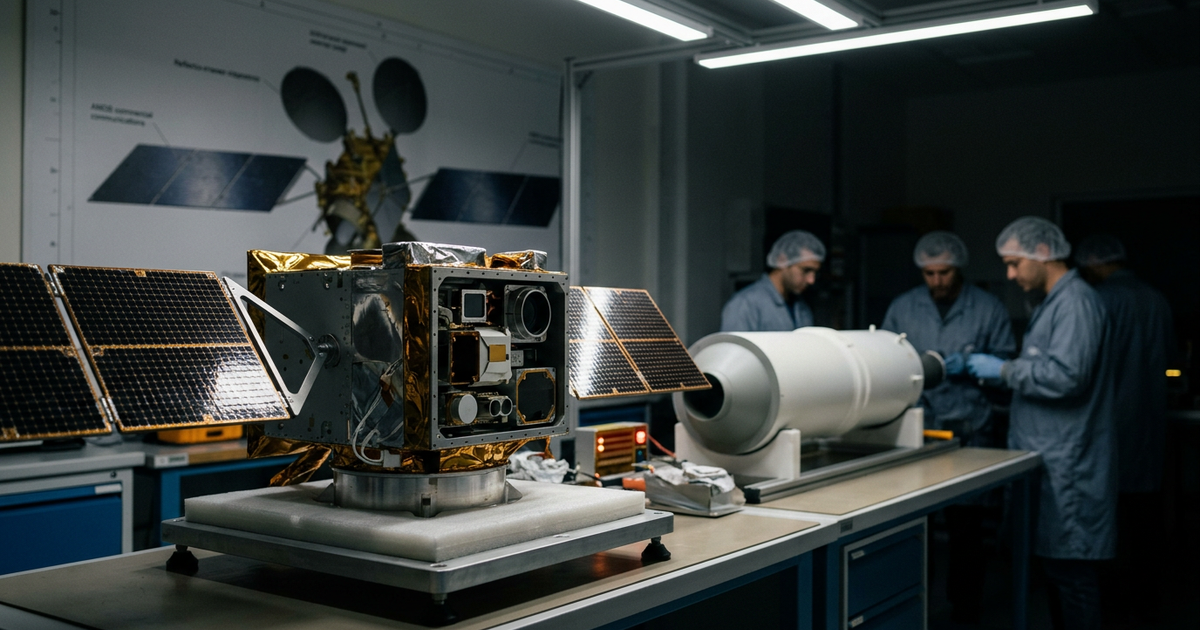

Ofek reconnaissance satellites. Shavit launch vehicle. AMOS commercial communications. ImageSat's EROS constellation. The Israel Space Agency. Israel runs a small but capable indigenous space program \u2014 one of roughly a dozen nations with launch, reconnaissance, and communications capability concurrently.
Ofek reconnaissance satellites. Shavit launch vehicle. AMOS commercial communications. ImageSat's EROS constellation. Israel's small but indigenous space-launch, reconnaissance, and communications program — one of the least-visible major components of the country's defense industrial base.
Edited on Jun 24, 2026.
Israel is one of the smallest countries publicly reported to have indigenous space-launch capability, indigenous reconnaissance-satellite capability, AND indigenous communications-satellite capability — concurrently. The Israeli space sector sits inside Israel Aerospace Industries (IAI), Spacecom, ImageSat International, and the Israel Space Agency (ISA), with a startup cohort developing underneath.
Israeli space program — at a glance
- Reconnaissance program — Ofek (Horizon) series, operated by IAI for the Israeli Ministry of Defense.
- Launch vehicle — Shavit, operated by IAI. One of the only operational launch vehicles globally that launches retrograde (westward), due to Israel's geographic position.
- Launch site — Palmachim Airbase.
- Most recent Ofek launches — Ofek-16 (July 2020); Ofek-13, SAR-equipped (March 2023); subsequent platforms reported.
- Commercial reconnaissance — ImageSat International (ISI), operating the EROS-A, EROS-B, and EROS-C constellation. EROS-C provides sub-meter optical imaging.
- Communications operator — Spacecom Satellite Communications (TASE-listed), operating the AMOS fleet.
- Latest communications satellite — AMOS-17, launched 2019 on a SpaceX Falcon 9 — anchored Spacecom's recovery after the 2016 AMOS-6 SpaceX pad incident.
- Civilian agency — Israel Space Agency (ISA), within the Ministry of Innovation, Science and Technology.
- Primary manufacturer — IAI Space Division.
- Indigenous capability club — Roughly a dozen nations worldwide hold the full launch-plus-reconnaissance-plus-comms trio.
The Reconnaissance Line: Ofek
Ofek (Horizon) is Israel's military reconnaissance-satellite program, operated by Israel Aerospace Industries for the Israeli Ministry of Defense. The program encompasses both optical and synthetic-aperture-radar (SAR) reconnaissance satellites, with multiple generations launched into low Earth orbit on the Israeli Shavit launch vehicle.
Ofek-16 was launched in July 2020. Ofek-13, a SAR-equipped variant, was launched in March 2023. Subsequent platforms in the family have been publicly reported. Imaging-resolution disclosures are limited; what is on the public record is that the program places Israel inside a small group of nations operating indigenous high-resolution reconnaissance satellites.
Shavit — Israel's space-launch vehicle, operated by IAI — is one of the only operational launch vehicles globally that launches retrograde (westward), a function of Israel's geography. Eastward launches over Arab states are not politically viable, so Shavit pays a fuel and payload penalty in exchange for sovereign launch independence. The launches operate from Palmachim Airbase.
The Commercial Reconnaissance Line
ImageSat International (ISI) operates the EROS commercial reconnaissance constellation. EROS-A, EROS-B, and the more recent EROS-C generation are operational, with EROS-C providing sub-meter optical imaging. ISI sells imagery globally to government and commercial customers and operates as the civilian-commercial twin of the Ofek program — same engineering base, different customer.
The Communications Line: AMOS
AMOS (Spacecom) — Spacecom Satellite Communications operates the AMOS communications-satellite fleet. AMOS-17, the company's most recent operational platform, was launched in 2019 on a SpaceX Falcon 9 — anchoring Spacecom's recovery after the 2016 AMOS-6 SpaceX pad incident.
Spacecom's commercial position spans broadcast distribution, government communications, and broadband connectivity across Africa, Europe, the Middle East, and adjacent footprints. The company is publicly listed on the Tel Aviv Stock Exchange.
The Institutional Layer
Israel Space Agency (ISA) operates within the Israeli Ministry of Innovation, Science and Technology. ISA's annual budget is substantially smaller than comparable Western space agencies — but the leverage through IAI, Rafael, Elbit, and the academic research base produces capability significantly disproportionate to the budget.
IAI Space Division is Israel's prime spacecraft manufacturer. The division produces reconnaissance satellites (Ofek family), communications satellites (AMOS), and adjacent platforms. IAI Space has publicly reported partnerships with multiple international operators for satellite manufacturing and launch services.
The Startup Cohort
Below the primes, an Israeli space-startup cohort has emerged:
- NSLComm — Compact high-throughput satellite communications.
- Hello Space — Geospatial analytics and satellite operations.
- SpacePharma — Microgravity research platforms.
Adjacent companies operate in launch services, satellite communications, in-orbit servicing, and space-based ISR adjacent categories.
Why the Sector Matters
One — independent ISR is strategically irreplaceable. The Ofek program lets Israel orient its intelligence cycle without dependence on allied imagery-release timelines. That capability has been central to multiple major Israeli military operations of the past two decades, including pre-conflict targeting and battle-damage assessment functions.
Two — the commercial position is durable. Spacecom's AMOS fleet and ISI's EROS constellation produce ongoing commercial revenue and maintain the manufacturing-and-launch capability that the defense program also depends on. The civilian-commercial-defense integration is structurally similar to the cyber industrial base.
Three — the export market is growing. Israeli space technology is integrated into multiple allied national programs through component, sensor, and software supply chains. The export footprint is smaller than the cyber or air-defense footprints — but it is real and growing.
Israel runs a small but capable independent space program. That capability is one of the most important quiet pillars of the broader defense industrial base.
Frequently Asked Questions
What is the Ofek satellite program?
Ofek (Hebrew for "horizon") is Israel's military reconnaissance-satellite program, operated by Israel Aerospace Industries for the Israeli Ministry of Defense. The program includes both optical and synthetic-aperture-radar (SAR) reconnaissance platforms launched on the Israeli Shavit launch vehicle. Ofek-16 launched July 2020; Ofek-13 (SAR) launched March 2023.
What is the Shavit launch vehicle?
Shavit is Israel's indigenous space-launch vehicle, operated by IAI from Palmachim Airbase. It is one of the only operational launch vehicles in the world that launches retrograde (westward), because eastward launches over Arab states are not politically viable for Israel. The retrograde trajectory imposes a fuel and payload penalty in exchange for sovereign launch independence.
What is AMOS?
AMOS is the communications-satellite fleet operated by Spacecom Satellite Communications, a TASE-listed Israeli company. The most recent operational platform, AMOS-17, launched in 2019 on a SpaceX Falcon 9. The fleet serves broadcast distribution, government communications, and broadband connectivity across Africa, Europe, the Middle East, and adjacent regions.
What is ImageSat International?
ImageSat International (ISI) operates the EROS commercial reconnaissance-satellite constellation — EROS-A, EROS-B, and the more recent EROS-C generation, which provides sub-meter optical imaging. ISI sells imagery globally to government and commercial customers.
Is Israel one of the few nations with indigenous space capability?
Yes. Israel is one of roughly a dozen nations worldwide with all three capabilities concurrently: indigenous space-launch (Shavit), indigenous reconnaissance satellites (Ofek), and indigenous communications satellites (AMOS). It is one of the smallest by population and economy to operate the full trio.
Who operates Israel's civilian space agency?
The Israel Space Agency (ISA), within the Ministry of Innovation, Science and Technology. ISA's budget is small relative to NASA, ESA, JAXA, or comparable Western space agencies, but the leverage through IAI, Rafael, Elbit, and the academic research base produces capability disproportionate to the budget.
Sources and further reading
- Israel Aerospace Industries — public materials on Ofek, Shavit, and AMOS.
- Spacecom Satellite Communications — TASE filings and operational disclosures.
- ImageSat International — EROS constellation documentation.
- Israel Space Agency — Ministry of Innovation, Science and Technology.
Related Olam coverage
- Israel's $14.8B Pivot Home: The Sovereignty Doctrine
- Europe Just Became Israel's Biggest Defense Customer
- Arrow 3, David's Sling, Iron Beam: Israel's Multi-Layer Shield
- Iron Dome: Israel's Air-Defense Stack
- Israeli Drones Now Rule Two Continents of Combat
- The Invisible War: Israel's Electronic Warfare Industrial Base
- The Defense Startup Wave
- After Line5: The Second Wave
- The MAFAT 10% Allocation
How we report: Olam stories draw on public filings, company disclosures and named sources, checked by our editors. Read our methodology · Corrections