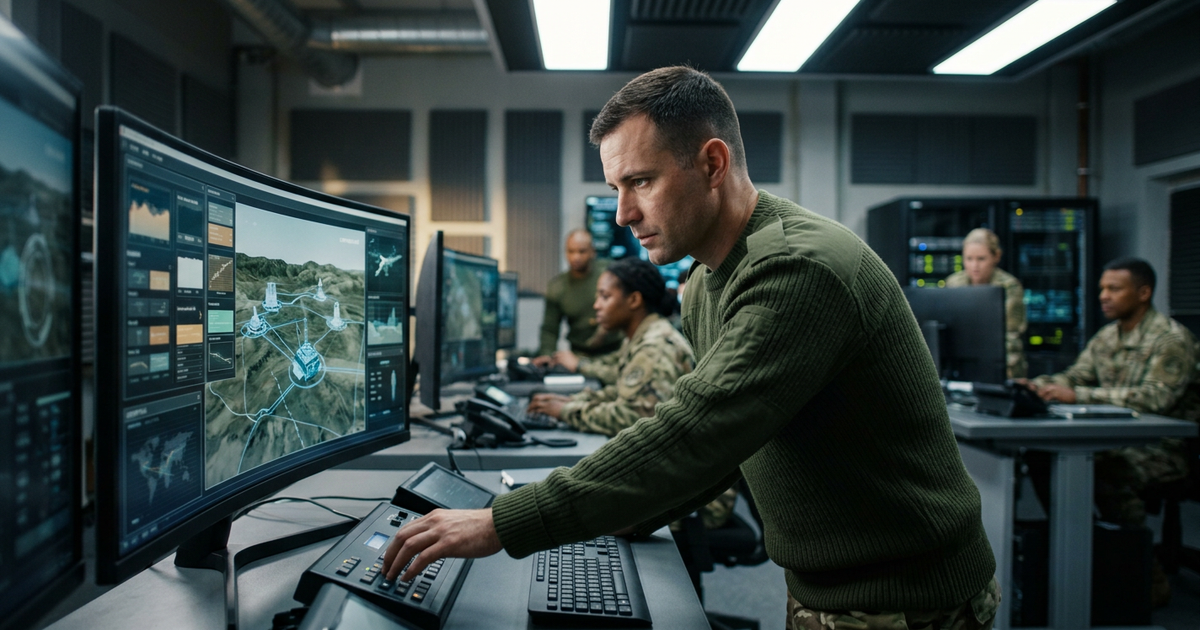

Israeli defense AI benefits from continuous combat validation and a globally competitive civilian AI base. This unique intersection drives its operational integration and export trajectory.
Israeli defense AI sits at a structural intersection no other industrial base occupies: a continuously operational combat environment that generates training data and validation cycles US and European development programs cannot match, paired with a civilian AI industrial base (Mobileye, Lightricks, AI21, multiple Unit 8200-graduate companies) that operates at globally competitive scale. The combination produces an AI-defense capability development pipeline that is structurally faster than parallel allied development programs.
The Unit 8200 pipeline
The structural foundation of Israeli AI-defense capability is the Unit 8200 (intelligence corps signal intelligence) and Unit 81 (intelligence corps technology unit) graduate pipeline. Multiple Israeli AI companies were founded by Unit 8200 graduates — including Mobileye (autonomous driving), Lightricks (consumer AI), AI21 Labs (language models), Wiz (cloud security), and adjacent companies that operate at global scale.
The pipeline feeds in both directions. Unit graduates start commercial AI companies that operate globally. The same graduates often return to defense industry through reserve duty obligations and through formal industrial engagement. The result is a continuous knowledge transfer between commercial AI and defense AI that no other industrial base maintains at this depth.
The operational AI integration
Multiple Israeli defense industrial counterparties have publicly described AI integration across operational capability categories. IAI has integrated AI-driven target identification and mission planning across multiple unmanned aerial platforms. Rafael's BNET-X battle management system uses AI for sensor fusion across the multi-layered missile defense architecture. Elbit has integrated AI across electronic warfare systems and battle management. Smart Shooter — a smaller industrial counterparty — has built AI-driven targeting systems for small arms and adjacent platforms with substantial Israeli, US, and international military adoption.
The structural pattern is operational AI integration deployed and iterated in continuous combat use, rather than R&D-cycle AI development tested in simulated environments. The validation depth that produces is the structural advantage Israeli defense AI carries against parallel allied programs.
The target identification controversy
The 2023-2026 period has produced substantial international debate over IDF use of AI-driven target identification systems — specifically the systems known publicly as "Lavender" and "The Gospel" (Habsora). The systems were widely reported in international press across 2024-2025. The IDF has acknowledged use of AI-driven target identification systems while disputing some characterizations of how the systems operate.
The debate is ongoing and is one of the most-watched policy and ethics questions in the global AI-and-defense conversation. The Olam covers the policy and procurement architecture; the broader ethical debate sits adjacent to but outside the institutional intelligence layer the property is built to provide.
The autonomous-systems intersection
AI-enabled autonomy in unmanned aerial systems — the next-generation portfolio across IAI, Elbit, UVision, BlueBird, Aeronautics, and adjacent industrial counterparties — is the most-funded category of Israeli defense AI development. Capabilities include autonomous target identification, swarm operation, autonomous mission planning, and adjacent autonomy layers. The Israeli industrial base operates at the operationally deployed end of this capability development trajectory, several iteration cycles ahead of comparable European programs.
The civilian-defense crossover
Multiple Israeli civilian AI companies have publicly engaged with the defense industrial market — directly through dual-use contracts, indirectly through Unit 8200 reserve duty and adjacent informal engagement. AI21 Labs has published research relevant to defense-oriented language model applications. Mobileye's autonomous-vehicle capabilities have adjacent applications in unmanned ground systems. Cybersecurity-AI companies including Wiz, Sentra, and adjacent firms operate in dual civilian-and-defense markets.
The dual-use civilian-defense AI pattern is structurally important. It is one of the few industrial environments globally where civilian AI scale-up funding directly cross-subsidizes defense AI capability development.
The export trajectory
AI-enabled defense systems are not separately broken out in SIBAT's 2024 export categories — they cut across the unmanned, radar/EW, command-and-control, and adjacent categories. Industry reporting suggests that AI-enabled systems are one of the highest-growth components of the European demand surge that pushed Europe to 54% of 2024 Israeli defense contracts.
The structural question for 2026-2027 is whether US export-control architecture will tighten around AI-enabled defense systems — and whether that would constrain the Israeli AI-defense export trajectory or reroute it through ITAR-free configurations that Israeli industry has historically built when US authorization timelines lengthen.
Read Next in The Olam
- The Israeli Cyber-Defense Industrial Base — Detail on the Unit 8200 graduate pipeline
- The Israel-US Defense Corridor — Context on US export-control architecture for AI-enabled systems
Sources
IAI, Rafael, Elbit Systems, Smart Shooter corporate disclosures; Israeli Ministry of Defense statements; The Jerusalem Post; The Times of Israel; Breaking Defense; +972 Magazine reporting on AI target identification; Globes; published research on Israeli AI-defense industrial integration. Data current as of Q2 2026.
How we report: Olam stories draw on public filings, company disclosures and named sources, checked by our editors. Read our methodology · Corrections