The Israel-US Defense Corridor
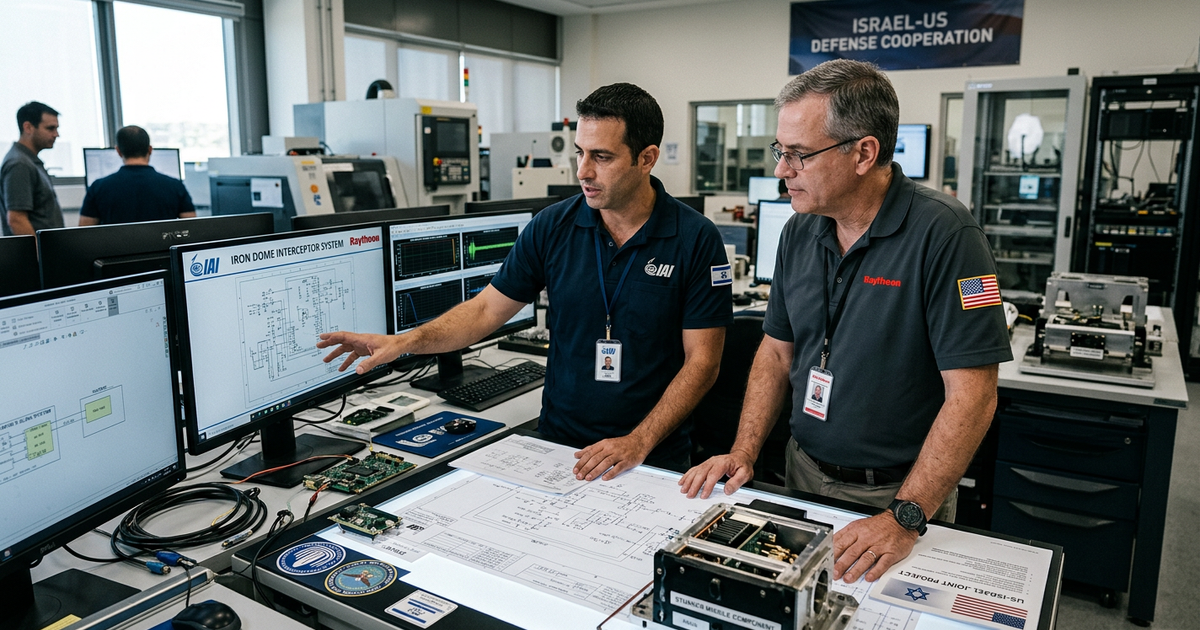
The deepest bilateral defense relationship in the world operates across five layers — FMF, joint development programs, US adoption of Israeli systems, the export-control regime, and the post-October 7 supplementals. Inside the architecture and the asymmetry.
The Israel-US defense corridor is the deepest, most institutionally complex bilateral defense relationship in the world — measured by annual transfer value, by joint program count, by industrial integration, and by regulatory coordination depth. Israeli industry exports $14.795 billion globally; US Foreign Military Financing (FMF) to Israel runs at $3.3 billion annually under the 2016 MOU; and dozens of joint development programs sit between the two industrial bases.
The bilateral corridor operates across five distinct layers — and each layer carries a different transaction architecture, a different regulatory framework, and a different political profile.
Layer 1 — Foreign Military Financing (FMF)
The principal annual US transfer to Israel runs at $3.3 billion under the 2016 ten-year Memorandum of Understanding signed by the Obama administration, replacing the previous $3.1 billion annual baseline. The current MOU runs through 2028. Of the annual $3.3 billion, the structural provision allowing Israel to spend 26.3% of the FMF on Israeli industrial procurement (Off-Shore Procurement, OSP) — a unique provision in US foreign military assistance — was phased out under the 2016 MOU, with the OSP allocation winding down to zero by Fiscal Year 2028. The wind-down has substantively reshaped Israeli industrial budget planning and is part of why the 2026 long-term force buildup plan emphasizes domestic industrial capacity.
Layer 2 — Joint development programs
The most consequential joint programs are the Arrow missile defense series (IAI / US Missile Defense Agency), the David's Sling system (Rafael / Raytheon), and the original Iron Dome co-funding architecture (Rafael / US Department of Defense). Each program carries a co-funding mechanism, a co-development governance structure, and a US procurement option. The Arrow-3 system has been sold to Germany under a $3.5 billion deal — the largest single export transaction in Israeli history — with US authorization a precondition.
Layer 3 — US adoption of Israeli systems
The most-cited recent example is the Trophy active protection system (Rafael), adopted by the US Army across Abrams and Bradley armored brigade combat teams. The Elbit Systems of America subsidiary anchors a substantial US Department of Defense procurement footprint across multiple capability categories. The Iron Dome system itself was purchased by the US Army (two batteries) — a rare reverse-direction transaction from Israeli industry into US procurement.
Layer 4 — The US regulatory architecture
The Israel-US defense corridor operates within the most regulatory-dense bilateral architecture in global defense trade. The Bureau of Industry and Security (BIS) administers EAR over dual-use technology. The Directorate of Defense Trade Controls (DDTC) administers ITAR over defense articles. The de minimis threshold framework determines which Israeli systems containing US-origin technology fall under US re-export jurisdiction. The Foreign Direct Product Rule extends US jurisdiction over Israeli systems produced using US-origin technology or software. Israeli manufacturers maintain dual product configurations as standard practice — one US-integrated, one designed to be ITAR-free or EAR-light.
Layer 5 — The wartime supplementals
The post-October 7 environment has produced US emergency supplemental allocations to Israel above the standard FMF baseline. The April 2024 supplemental authorized $14.3 billion in additional Israeli security assistance, including replenishment of Iron Dome interceptor stocks and Arrow stocks depleted by 2023-2025 operational use. The supplementals are episodic rather than baseline-shifting — they reset Israeli stockpiles after intensive operational use but do not change the long-run FMF structure.
What's changed in 2024-2026
Three structural shifts. First, US authorization timelines on certain Israeli third-party exports have selectively lengthened — not formally restricted, but operationally slower. Second, the Arrow-3 sale to Germany has set a precedent for large European procurement of US-Israeli joint systems with US authorization. Third, the European demand surge has produced direct US-Israeli industrial cooperation on European market positioning that did not exist in the same form before 2022.
The structural picture
The Israel-US defense corridor is not symmetrical. The US is the dominant party — as the larger industrial base, as the regulatory authority over substantial Israeli-origin technology, and as the principal source of bilateral funding. The corridor's institutional depth is the structural feature; the asymmetry is the structural constraint.
Read Next in The Olam
- The Iron Dome Architecture — Detail on the joint missile defense programs
- The Israeli Defense Export Market — How US authorization shapes Israeli third-party export
Sources
US-Israel 2016 Memorandum of Understanding; US State Department Congressional notifications; Israeli Ministry of Defense publications; SIBAT 2024 Defense Exports Report; published research on the bilateral defense corridor; Reuters; The Times of Israel; Breaking Defense; Defense News; CRS reports on US-Israeli defense cooperation. Data current as of Q2 2026.