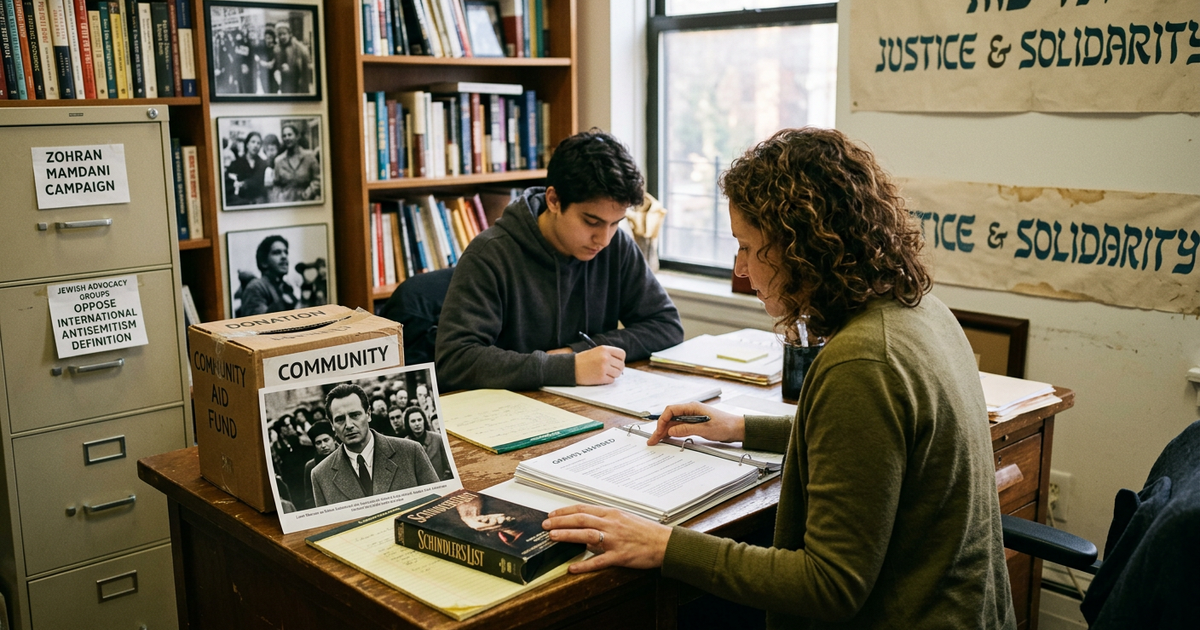

The Righteous Persons Foundation, founded with Schindler's List profits, gave about $3 million to four Jewish progressive groups from 2020 to 2024, in Olam's tabulation of its filings.
The Righteous Persons Foundation, which Steven Spielberg founded in 1994 with profits from Schindler's List, gave about $3 million between 2020 and 2024 to four Jewish progressive organizations, according to Olam's tabulation of its tax filings. The recipients are Bend the Arc, Jews United for Justice, T'ruah and the Jewish Social Justice Roundtable. This piece sets out the foundation's structure, its grants and what the public records do and do not show.
Updated October 8, 2026. Grant totals are Olam's tabulation from Form 990-PF filings. Descriptions of organizations come from their own published materials.
Righteous Persons Foundation: At a Glance
| Foundation | Righteous Persons Foundation |
| Founded | 1994, with $100 million in Schindler's List profits, according to press reports |
| Chairman | Steven Spielberg |
| Executive Director | Margery Tabankin (since October 1, 1994) |
| EIN | 95-4497916 |
| Total disbursements (1994 to 2024) | $160+ million, in Olam's cumulative analysis |
| 2024 grantmaking | About $8.9 million across about 30 grants |
| Revenue (2024 990-PF) | $9.31 million |
| Named after | The gentile rescuers of Holocaust survivors |
| Tax filings | ProPublica Nonprofit Explorer |
Which Four Organizations Received About $3 Million Since 2020?
Olam's tabulation shows the foundation gave about $3.07 million to Bend the Arc, Jews United for Justice, T'ruah and the Jewish Social Justice Roundtable from 2020 to 2024. The table summarizes each group's stated positions and activity from its own materials.
| Organization | Amount (2020 to 2024) | Stated position on IHRA | Key activity, per the group or Olam's reporting |
|---|---|---|---|
| Bend the Arc | $1,200,000 | Opposes the IHRA definition | First mayoral endorsement, for Zohran Mamdani (September 2025). Olam reports its 501(c)(4) arm is chaired by Alex Soros. |
| Jews United for Justice | $925,000 | Co-signed April 2025 letter opposing the Antisemitism Awareness Act | Regional advocacy in the Washington and Baltimore area |
| T'ruah | $690,000 | Co-signed the same April 2025 letter | Rabbinic human rights advocacy on Israeli policy and the occupation. Its CEO, Rabbi Jill Jacobs, is quoted by Olam using the phrase "war crimes." |
| Jewish Social Justice Roundtable | $250,000 | Co-signed the same April 2025 letter | Coalition coordinating messaging and legislative strategy across the network |
| Total | About $3,065,000 | Source: Olam's tabulation of IRS Form 990-PF filings, FY2020 to 2024 | |
One check on the totals matters. The foundation's own grants archive lists Bend the Arc grants of $50,000 (2013), $200,000 (2018) and $200,000 over two years (2020). Olam's tabulation shows $200,000 for 2020 alone, so readers should compare the two. Olam could not reconcile 2021 to 2024 against a public archive page for this update.
Which Other Groups Does the Foundation Fund?
| Organization | Domain | Function, as described by Olam |
|---|---|---|
| Union for Reform Judaism (RAC) | Religious infrastructure | Denominational advocacy in Washington |
| Dayenu | Climate justice | Frames climate activism as a Jewish moral imperative |
| Poor People's Campaign | Multi-faith economic justice | Cross-faith progressive coalition |
| Repair the World | Community organizing | Mobilizes Jewish young adults for service and organizing |
| New York Jewish Agenda | Political mobilization | Progressive coalition hub |
| Reboot | Cultural narrative | Reimagines Jewish identity around progressive values |
| Jewish Story Partners | Film and narrative | A foundation lead gift in 2021, per Olam; 101 film projects funded |
Sources: IRS Form 990-PF filings (EIN 95-4497916) via ProPublica Nonprofit Explorer; GrantStation; Righteous Persons Foundation grants archive; InfluenceWatch.
Why Did Spielberg Create a Foundation From Schindler's List Profits?
Spielberg has said the film's profits were not his to keep. According to press and JTA coverage, he described them as "blood money" that needed to go back to the Jewish community.1 He committed $100 million to a foundation named after the gentile rescuers of Holocaust survivors.
On October 1, 1994, the foundation appointed Margery Tabankin as executive director.2 Olam's biographical materials describe her earlier roles as national director of VISTA under President Carter, executive director of the Arca Foundation and a leader of the Hollywood Women's Political Committee.3 Olam also reports West Bank travel and meetings with Palestinian leaders during her Arca tenure, which it sources to biographical materials.4
Olam's reading of the filings is that the board has no independent directors and that Tabankin reports to Spielberg as chairman. The foundation has not commented on its decision-making. Olam's analysis is that her strategy has shaped the foundation's priorities. That analysis has not been confirmed by the foundation.
What Did Bend the Arc Say About Its Role in Mamdani's Election?
In September 2025, Bend the Arc issued what Olam reports as its first mayoral endorsement, for Zohran Mamdani, then a New York State Assemblyman from Queens. Olam reports that the decision was made in its 501(c)(4) political arm. Mamdani won the November 2025 election and took office on January 1, 2026.
After the election, Bend the Arc wrote: "With support from people like you, Bend the Arc helped shape this monumental victory with our air game and ground game." That is the organization's own description of its role.
The foundation's public grant descriptions for Bend the Arc (2013, 2018 and 2020) cover general support for community organizing and policy advocacy. They do not mention electoral work. The records reviewed do not show that any foundation grant was directed to the endorsement or to Mamdani's campaign.
What Is Olam's Analysis of the Foundation's Wider Grantmaking?
The foundation makes about 30 grants a year, totaling about $8.9 million in 2024, according to Olam's reading of the FY2024 filing.6 Recipients span religious institutions, climate activism, multi-faith economic justice, community organizing, political mobilization and cultural projects.
Olam's analysis is that this pattern reflects a coordinated effort to build progressive Jewish institutions across several fields. The foundation has not described its grantmaking that way. Other readings are available, including that the grants reflect long-standing support for social-justice work in the Jewish community.
Did Spielberg Meet With Mayor Mamdani After the Election?
On Monday, January 5, 2026, Steven Spielberg hosted Mayor Mamdani at the director's apartment on Central Park West. The meeting was first reported by the New York Times. Olam reports that Mamdani's City Hall and Spielberg's spokeswoman, Terry Press, confirmed it.
Olam reports that Kate Capshaw, their son Theo Spielberg and Theo's wife attended, and that Mamdani brought his advisor Morris Katz.
Who Is Margery Tabankin and Why Has She Run the Foundation for Thirty Years?
| Role | Executive Director, Righteous Persons Foundation (since October 1, 1994) |
| Prior: VISTA | National Director under Jimmy Carter (1977 to 1981), per Olam's biographical materials |
| Prior: Arca Foundation | Executive Director; progressive grantmaking |
| Other | Hollywood Women's Political Committee leadership |
| Tenure | 30+ consecutive years, reporting to Spielberg as chairman |
Spielberg Foundation Grantmaking: Frequently Asked Questions
What is Steven Spielberg's charity?
Spielberg's primary charity is the Righteous Persons Foundation, launched in 1994 with $100 million in Schindler's List profits, per press reports. Margery Tabankin has been executive director since October 1994. Olam puts its total grants at more than $160 million.9 It is separate from the USC Shoah Foundation, which collects Holocaust survivor testimony.
How much has the foundation given to organizations critical of Israeli policy?
About $3 million from 2020 to 2024 in Olam's tabulation of Form 990-PF filings. Recipients are Bend the Arc ($1.2 million), Jews United for Justice ($925,000), T'ruah ($690,000) and the Jewish Social Justice Roundtable ($250,000). The foundation's archive lists different Bend the Arc figures for some years, as noted above.
Did Steven Spielberg or Alex Soros back Mamdani's campaign?
This reporting found no record of campaign contributions by either. The foundation gave general-support grants to Bend the Arc, which endorsed Mamdani. Olam reports that Alex Soros chairs Bend the Arc's political arm. Spielberg hosted Mamdani at his apartment on January 5, 2026, after the election. For more, see Olam's coverage of the Spielberg foundation and the Mamdani campaign.
Where did Schindler's List profits go?
The $100 million went into the Righteous Persons Foundation in 1994, per press reports. In Olam's tabulation, about $3 million of its 2020 to 2024 grantmaking went to four Jewish progressive organizations.
Tax Filings & Source Documentation
- ProPublica Nonprofit Explorer: Righteous Persons Foundation filings, 2011 to 2024
- 2024 Form 990-PF (filed November 14, 2025): revenue $9.31M, expenses $9.35M, charitable disbursements $9.35M
- 2023 Form 990-PF (filed November 15, 2024): revenue $4.03M, expenses $4.07M, charitable disbursements $4.06M
- IRS Tax Exempt Organization Search: EIN 95-4497916
- GrantStation: grantee-level detail from 990 schedules
- Foundation grants archive: righteouspersons.org/grants-archive
Related Olam Coverage
- Spielberg Foundation Grants to Bend the Arc, Mapped
- UJA-Federation Gave $280,000 to Organizations That Endorsed Mamdani
- Conference of Presidents Political Audit
- The Other Spielberg Foundation: Hearthland Voter Mobilization
The Takeaway
The public record shows a foundation funded by Schindler's List profits making general-support grants to progressive Jewish organizations, some of which later took political positions. It does not show that the foundation directed those positions. Olam's analysis of intent is analysis, not a finding.
Footnotes
1 Spielberg's "blood money" remark as reported in JTA archive coverage and later interviews.
2 Tabankin's appointment as described in foundation founding materials. Official start: October 1, 1994.
3 Tabankin's VISTA tenure (1977 to 1981) as described in biographical materials Olam reviewed.
4 Tabankin's West Bank engagement as described in biographical materials related to her Arca Foundation tenure (1981 to 1988).
5 Grant figures are Olam's tabulation from IRS Form 990-PF filings (EIN 95-4497916) for fiscal years 2020 to 2024.
6 The 2024 grantmaking total of $8.9 million is derived from the FY2024 Form 990-PF (filed November 14, 2025).
9 The cumulative $160+ million total is Olam's analysis of 990-PF filings.
Last reviewed: October 2026.
How we report: Olam stories draw on public filings, company disclosures and named sources, checked by our editors. Read our methodology · Corrections