Waldorf Astoria Jerusalem: The Palace Hotel's Second Life
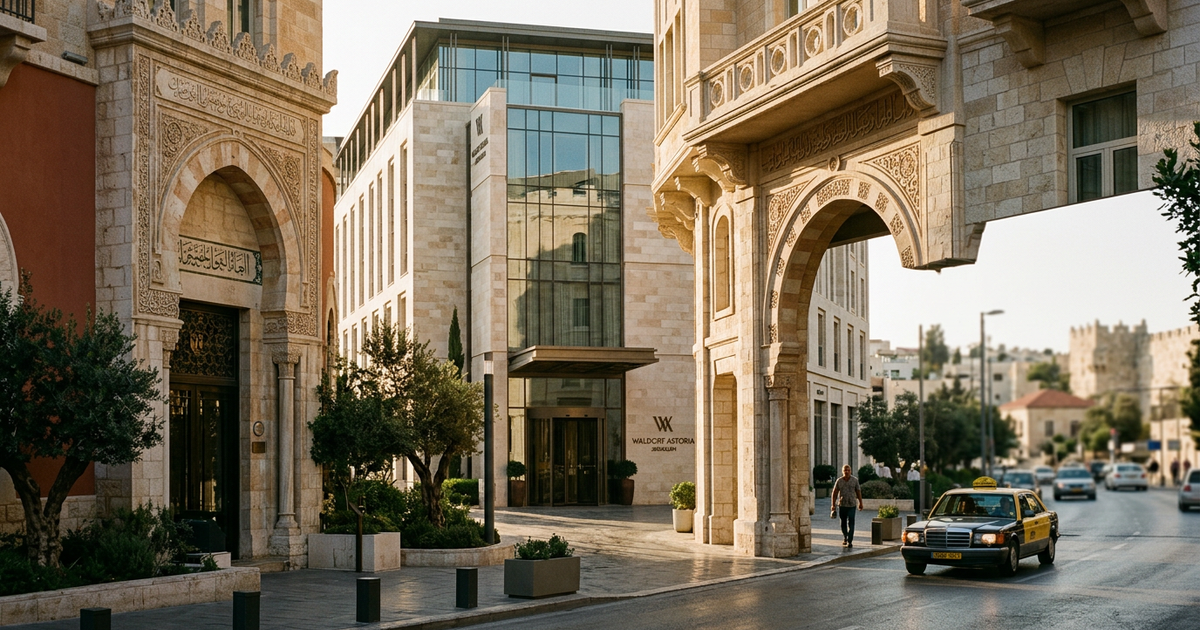
The restored 1929 Palace Hotel — owned by Africa-Israel, flagged Hilton — and the only global ultra-luxury brand contract at the top of the Jerusalem trophy cluster.
The restored 1929 Palace Hotel — owned by Africa-Israel, flagged Hilton — and the only global ultra-luxury brand contract at the top of the Jerusalem trophy cluster.
The Waldorf Astoria Jerusalem is the one Jerusalem trophy property that runs on a global brand contract. Owned by the Africa-Israel real estate group. Operated under a long-term management agreement with Hilton's Waldorf Astoria luxury brand. Built inside the restored 1929 Palace Hotel building. 226 keys at the top of the market. The only property in the trophy cluster where the ownership and the operating brand are separate parties.
The model is different from Alrov. Different from Dan. Different from Isrotel and Brown. The Waldorf is the test case for what happens when an Israeli real estate owner partners with a global luxury hotel brand to operate the asset — and the answer over a decade has been that the model works at the property level but does not scale across the country.
BY THE NUMBERS
- Owner: Africa-Israel Group · Lev Leviev-controlled holding company
- Operator: Hilton · Waldorf Astoria luxury brand · long-term management contract
- Keys: 226 · opened 2014 after multi-year restoration
- Building: 1929 Palace Hotel · Mandate-era architecture · restored façade and structure
- Location: Agron Street · adjacent to Mamilla, walking distance to Old City
- Position: one of five trophy properties in central Jerusalem
The Building
The Palace Hotel opened in 1929. Built by the Supreme Muslim Council during the British Mandate, it was the most ambitious Mandate-era hotel project in Jerusalem — a deliberate statement of architectural prestige in a city where the King David, which opened in 1931, was its only real peer.
The Palace did not survive the Mandate as a hotel. The building changed hands and uses repeatedly through the British, Jordanian, and Israeli periods. By the late 20th century it had been used as a government office building and was structurally tired.
Africa-Israel acquired the building and committed to a full restoration. The project was complex: the original façade and key interior elements were preserved under Israeli heritage requirements while a modern 226-key hotel was built behind and within the historic shell. The restoration took years and ran significantly over original budget projections — a pattern that defines almost every Mandate-era restoration in Jerusalem.
The hotel opened in 2014 as the Waldorf Astoria Jerusalem. The architectural payoff is significant. The lobby, the façade, and the principal public spaces preserve the 1929 character. The room product is modern luxury at full Waldorf brand specification.
The Ownership Structure
The owner is Africa-Israel Investments — a publicly listed Israeli holding company controlled by Lev Leviev. Africa-Israel's portfolio spans Israeli real estate, international real estate, and historical positions in diamonds and other categories. The Waldorf Jerusalem is one of the most visible single assets in the Israeli real estate book.
The Leviev relationship to the asset has been continuous through Africa-Israel's various restructurings over the past decade. Africa-Israel has gone through debt restructuring more than once. The Waldorf Jerusalem has remained inside the structure.
The Hilton contract is the operating layer. Hilton's Waldorf Astoria brand is the ultra-luxury tier of the Hilton portfolio — sister property to the original Waldorf Astoria New York and a small number of other flagship Waldorf properties globally. The brand contract gives the Jerusalem property access to Hilton Honors distribution, the global corporate and diplomatic booking network, and the operational standards that ultra-luxury international travelers expect.
The Brand Math
The Waldorf brand contract is the differentiating piece of the Jerusalem trophy cluster.
Alrov runs Mamilla and the David Citadel under its own management — no flag. Dan operates the King David under its own Dan brand. Isrotel runs the Orient under its Exclusive Collection sub-brand. Of the five trophy properties, only the Waldorf operates under a global luxury flag.
The trade-off is the standard hotel real estate calculation. The Hilton management contract delivers distribution, loyalty integration, and brand premium — the Waldorf flag carries a positioning level that an unflagged Israeli property has to build from scratch. In exchange, Africa-Israel cedes management fees (typically 3–5% of revenue plus incentive fees on profit) and operational control to Hilton.
For senior American diplomatic and business delegations who are members of Hilton Honors and accustomed to the Waldorf operating standard, the Jerusalem property is a known quantity in a market where most of the competition is locally branded. That distribution advantage is real.
The Clientele
The Waldorf shares the diplomatic, senior business, and high-yield religious pilgrimage demand that defines the trophy cluster — but with a clientele skew toward the segments where the Hilton brand carries weight.
American senior business delegations book the Waldorf at a higher rate than they book the unflagged Israeli properties. Western Catholic and Evangelical pilgrimage at the high end — senior clergy, major cathedral groups, premium religious-tour itineraries — flows disproportionately through the Waldorf and the Mamilla. The diplomatic flow is competitive with the David Citadel for non-US delegations.
The royal suite at the Waldorf clears $5,000 a night when occupied. The presidential floor product is built to the spec that Hilton's Waldorf brand requires globally.
The October 7 Cycle
The Waldorf was directly exposed to the post-October 7 collapse of the trophy cluster. International business delegations canceled. Christian pilgrimage stopped. The diplomatic flow paused.
Africa-Israel's portfolio exposure to the disruption was wider than the Waldorf alone — the Israeli real estate market broadly was under pressure through 2024. The hotel itself, like the rest of the trophy cluster, operated at occupancy well below design through 2024.
State displaced-family contracts filled some Waldorf inventory during the war period — at subsidized economics, not at commercial ADR. That contract layer has now wound down as families have returned to their communities.
Through 2025 and into 2026, American diplomatic and business demand has rebuilt fastest. American Evangelical pilgrimage is back to roughly two-thirds of pre-war volume. Western Catholic pilgrimage remains the slowest segment. The Waldorf has recovered toward but not back to pre-war occupancy.
WHY IT MATTERS
- Only global luxury brand contract in the Jerusalem trophy cluster — Hilton's Waldorf Astoria flag
- Owned by Africa-Israel (Lev Leviev-controlled) — Israeli real estate ownership, foreign brand operation
- 226 keys inside the restored 1929 Palace Hotel — the most architecturally ambitious Mandate-era hotel in Jerusalem
- Different operating model from Alrov, Dan, Isrotel, and Brown — the trade-off between brand distribution and direct control
- Significant exposure to American diplomatic, business, and high-yield Christian pilgrimage demand
Outlook
Three things to watch.
One — the Africa-Israel structure. Africa-Israel has gone through more than one round of debt restructuring over the past decade. The Waldorf Jerusalem has been a stable asset inside the structure. Any future restructuring could put the property in play — whether as a continued Africa-Israel hold, a sale to another Israeli real estate owner, or in a less likely scenario a transaction with a foreign sovereign or institutional buyer.
Two — the Hilton contract renewal. Long-term hotel management contracts run on multi-decade terms. The original 2014 Waldorf contract has years of runway. When it eventually comes up for renewal, the alternative options for Africa-Israel — extend with Hilton, switch flags to another global luxury operator, or convert to direct operation in the Alrov model — will be a meaningful strategic decision.
Three — the broader Christian pilgrimage recovery. The Waldorf's clientele includes the most pilgrimage-exposed segment of the trophy cluster. Western Catholic clergy, premium Christian tour itineraries, and senior religious NGO traffic are the structural laggards in the post-October 7 recovery. How quickly that segment rebuilds is the gating variable for the Waldorf reaching pre-war occupancy.
One building. Two parties. One ninety-five-year-old façade. The Waldorf Jerusalem is the most explicit hotel real estate transaction at the top of Jerusalem hospitality — and the only one where the brand on the door does not match the name on the deed.
↗ Index: this is the Waldorf entry in the Israeli Hotels cluster — the Olam guide to the Israeli hotel sector. Capstone: Who Owns the Israeli Hotel Sector. Companions: Jerusalem's Five Trophy Hotels · Alrov: Alfred Akirov's Hotel Empire.